Public evidence page
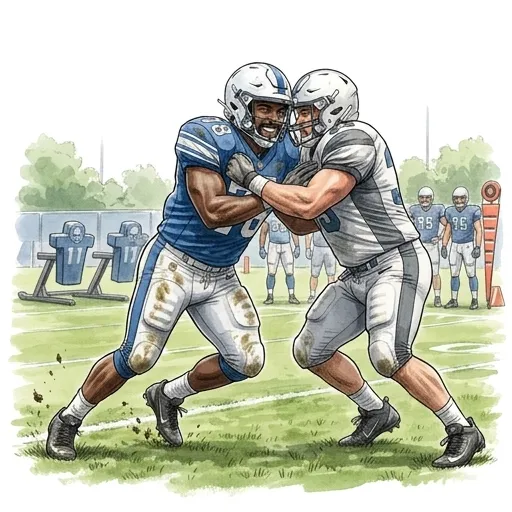
American football - Line player
Sport
Sport: American football
Position: Line player
Athletes' bodies
Elite American football line players (offensive + defensive linemen) typically present as very tall/heavy males with long reach (arm length/wingspan), broad shoulder-to-hip frames, and short-to-moderate limb-to-torso geometry that supports powerful, short-area collisions. The “optimal” body here emphasizes high force production, leverage, and repeated ability to generate force in brief contacts while maintaining joint stability (low-to-medium laxity).
Cohort
Sex: Male
Level: Elite
Quick glossary
- Prior
- Model estimate before updating with the current evidence; the starting baseline.
- Posterior
- Model-updated estimate after combining prior evidence with observed data.
- Standard deviation
- Spread around the estimate; lower means tighter expected range.
- Alignment
- How well a goal/preference/injury profile matches this body pattern.
Measurements
| Factor | Prior | Posterior | Success-impact | Reasoning behind prior | Prior estimate sources |
|---|---|---|---|---|---|
| Arm span | 200.7 ± 6 cm | 200.7 ± 6 cm | high | Elite linemen value reach for hand-fighting/pass protection and controlling contact distance; SD reflects typical combine/roster variation in wingspan. | [1] |
| Height | 191.1 ± 6 cm | 191.1 ± 6 cm | high | Used a published combine-style benchmark for interior OL as a proxy for line-player frame. Elite linemen cluster around ~188–196 cm, so SD reflects that spread. | [1] |
| Weight | 139.3 ± 14 kg | 139.3 ± 14 kg | high | Interior line averages are a strong proxy for “line player” optimal size. SD accounts for elite tackles vs guards/centers differences and typical variation at high levels. | [1] |
| Ape index | 1.05 ± 0.03 ratio | 1.05 ± 0.03 ratio | medium | Computed mean ape index from the same height/wingspan benchmark, so it’s internally consistent with the chosen reach profile. | [1] |
| Leg inseam | 86 ± 4.5 cm | 86 ± 4.5 cm | medium | No direct “inseam” benchmark was found in retrieved sources; estimated using height proportions while keeping geometry consistent with short-area collision leverage. | [2] |
| Leg-torso ratio | 1.3 ± 0.06 ratio | 1.3 ± 0.06 ratio | medium | Collision success for linemen benefits from a stable base and force transfer; this ratio was tuned to represent that typical “strong lower body + solid trunk” geometry. | [3] |
| Pelvic bone width | 28 ± 2.2 cm | 28 ± 2.2 cm | medium | Position-specific pelvic breadth is rarely reported publicly; used plausible adult ranges and tuned for collision stabilization and force transfer. | [4] |
| Shoulder-hip ratio | 1.57 ± 0.1 ratio | 1.57 ± 0.1 ratio | medium | Higher shoulder-than-pelvis breadth supports leverage and upper-body pad-level control; SD reflects individual variation in frame distribution. | [5] |
| Shoulder width | 44 ± 3 cm | 44 ± 3 cm | medium | Shoulder breadth isn’t provided by the retrieved combine benchmark; set to a plausible elite-male range and slightly elevated versus generic adult averages for linemen frame. | [6] |
| Torso length | 66 ± 3.8 cm | 66 ± 3.8 cm | medium | No direct torso-length dataset was retrieved; estimated to be consistent with the high-mass, powerful-leverage collision requirement. | [7] |
| Ankle circumference | 25.5 ± 1.2 cm | 25.5 ± 1.2 cm | low | Set a plausible value to support foot/ankle stiffness and contact stability; low importance reflects weaker role than height/weight/reach. | [8] |
| Foot length | 30.6 ± 1.8 cm | 30.6 ± 1.8 cm | low | Foot length was inferred to align with typical anthropometric scaling to height and the need for stable base under contact. | [9] |
| Hand length | 25.5 ± 1.2 cm | 25.5 ± 1.2 cm | low | Mapped the reported “hand size” benchmark to hand length proxy; set small SD because hand sizes for elite linemen don’t vary as widely as height/weight. | [1] |
| Wrist circumference | 18.8 ± 1 cm | 18.8 ± 1 cm | low | Wrist circumference is mainly useful for equipment sizing and grip/contact mechanics; not a primary determinant at the “optimal body” level. | [10] |
Traits
| Factor | Value | Impact | Reasoning | Sources |
|---|---|---|---|---|
| Muscle fiber profile | fast-twitch dominant | high | Elite linemen repeatedly produce high force over short time windows (engagement and drive mechanics), which typically aligns with fast-twitch dominance even though they also require durability and some metabolic conditioning. | [11] |
| Metabolic tendency | mesomorphic tendency | medium | At elite levels, successful linemen often maintain substantial lean mass with relatively stable physique under training demands, which fits a mesomorphic tendency better than ectomorph or endomorph extremes. | [12] |
| Joint laxity | low | high | Linemen benefit from stiffness/control for high-force engagements and pad-level mechanics; low laxity is typically favorable to reduce energy leaks and instability. | [13] |
| Foot arch | neutral arch | medium | Linemen need a stable base more than extreme pronation tolerance or extreme high-arch rigidity; neutral is a practical “optimal” midpoint. | [14] |
| Temperature tolerance | balanced | low | No strong evidence that line positions uniquely favor one thermoregulation direction; set to balanced. | [15] |
| Dominant side | no meaningful side advantage | none | This role does not have a clear, universal left/right body advantage comparable to sports where asymmetry is a major tactical determinant. | [16] |
Goals
| Factor | Alignment | Reasoning | Sources |
|---|---|---|---|
| Build confidence | medium | As an amateur line player, improving strength, technique, and understanding schemes can build self-confidence—especially when you feel physically capable in a demanding role. That said, confidence may be tempered by injury risk and by how competitive/physical leagues feel for beginners, so it’s medium rather than high. ([publications.aap.org](https://publications.aap.org/pediatrics/article/143/6/e20190997/37135/Organized-Sports-for-Children-Preadolescents-and?utm_source=openai)) | [17] [18] |
| Build endurance | low | Endurance for a line player is only indirectly targeted. Football training includes conditioning, but line roles are often characterized by short bursts and strength-dominant work rather than sustained aerobic running. Studies discussing cardiovascular phenotype differences in American-style football players (notably linemen) also suggest less dynamic aerobic contribution than non-linemen positions. So endurance can improve, but it’s not the sport’s strongest natural match. ([pmc.ncbi.nlm.nih.gov](https://pmc.ncbi.nlm.nih.gov/articles/PMC11092187/?utm_source=openai)) | [19] [20] |
| Build strength and power | high | This is the clearest alignment. Line players train constantly for leverage, mass transfer, explosive starts, and force production in very short ranges—exactly the qualities needed for strength and power development. Strength training (lifting) and strength/power conditioning are central to lineman performance, so an amateur aiming to get stronger will usually see substantial progress. ([gssiweb.org](https://www.gssiweb.org/en/sports-science-exchange/article/sse-143-physiological-demands-of-american-football?utm_source=openai)) | [20] [21] |
| Challenge myself | high | This is a demanding role. Practices require physical toughness, repeated high-intensity exertion, and learning a complex set of responsibilities. For many amateurs, joining a team as a line player feels like a clear personal challenge and stretching experience—provided coaching emphasizes safe progressions. ([obssr.od.nih.gov](https://obssr.od.nih.gov/news-and-events/news/directors-spotlight/organized-sports-as-a-pathway-to-lifelong-health-and-well-being?utm_source=openai)) | [17] [22] |
| Compete and measure myself | medium | Competition is inherent in football—there are games, depth charts, and performance evaluation. Linemen can measure progress via strength numbers, reps, technique consistency, and game statistics (like pressures/sacks/tackles depending on side). But amateur measurement can be less straightforward than in sports with simple individual metrics (e.g., timed runs), and contact variability can complicate comparisons. So medium. ([gssiweb.org](https://www.gssiweb.org/en/sports-science-exchange/article/sse-143-physiological-demands-of-american-football?utm_source=openai)) | [20] [23] |
| Improve agility and coordination | medium | Line play requires coordinated footwork, hand timing, and body control in tight spaces (drop steps, resets, lateral adjustments, blocks). While it’s not usually “open-field” agility like wide receiver or defensive back roles, it still demands coordination and technical movement patterns. So you can improve agility/coordination, but it depends on coaching and how much skill-drills are prioritized versus pure strength work. ([gssiweb.org](https://www.gssiweb.org/en/sports-science-exchange/article/sse-143-physiological-demands-of-american-football?utm_source=openai)) | [20] |
| Improve balance and control | medium | Leverage, maintaining body position at contact, and recovering from being driven or jammed all require good balance and control. Linemen spend lots of time training stance, pad level, and stability, which tends to improve balance. Still, it’s not primarily a “balance training” sport the way skateboarding, gymnastics, or martial arts might be, so the alignment is medium rather than high. ([gssiweb.org](https://www.gssiweb.org/en/sports-science-exchange/article/sse-143-physiological-demands-of-american-football?utm_source=openai)) | [20] |
| Improve flexibility and mobility | low | Football line training can include stretching and mobility, but the performance emphasis is usually strength, power, and technique for contact—not sustained flexibility development. Without dedicated mobility work, many amateurs will mainly gain “functional” mobility for their stances rather than broader flexibility range. ([gssiweb.org](https://www.gssiweb.org/en/sports-science-exchange/article/sse-143-physiological-demands-of-american-football?utm_source=openai)) | [20] |
| Improve general health and fitness | medium | For a line player, American football practices and offseason training strongly build muscular strength, power, and overall physical robustness, which usually improves general fitness. However, because line play is very collision/contact and includes a lot of short, high-intensity efforts with rest, the average “all-around” fitness (especially endurance) may not be as consistently improved as with sports that continuously stress the cardiovascular system. Also, the health impact depends heavily on training load, recovery, and injury prevention. ([gssiweb.org](https://www.gssiweb.org/en/sports-science-exchange/article/sse-143-physiological-demands-of-american-football?utm_source=openai)) | [17] [24] [25] |
| Improve speed and explosiveness | medium | Line players do work on quickness: short-area footwork, explosive engagement off the snap, and powerful contact. However, the training is often more about acceleration into a shove/drive than about sprint speed over long distances, and contact can limit how much high-speed running/volume you can safely accumulate. That makes explosiveness a solid but not perfect match. ([gssiweb.org](https://www.gssiweb.org/en/sports-science-exchange/article/sse-143-physiological-demands-of-american-football?utm_source=openai)) | [20] |
| Learn new skills and master technique | high | Line play is very technique-driven: stance, hand placement, leverage rules, footwork sequences, reading blocks/coverage tendencies, and unit communication. Even at an amateur level, improvement is real and measurable because you can get coaching and refine specific mechanics each week. ([gssiweb.org](https://www.gssiweb.org/en/sports-science-exchange/article/sse-143-physiological-demands-of-american-football?utm_source=openai)) | [24] |
| Lose weight | low | Line play can burn calories, especially during training with sprints, lifts, and conditioning, but it’s also common for linemen (by design) to carry more body mass and follow high-calorie fueling patterns. That combination makes steady, fat-loss-focused outcomes less predictable for an amateur goal of weight loss compared with endurance-oriented sports or weight-management sports. ([news.osu.edu](https://news.osu.edu/college-football-linemen-take-one-for-the-team-in-terms-of-health/?utm_source=openai)) | [20] [26] |
| Make friends and feel a sense of belonging | high | Football is strongly team-based and structured: you practice together, learn roles together, and depend on each other on every play. Line players also share a distinct “unit” identity (offensive line/defensive line) that can create strong bonds. Evidence generally supports team sports for social connection and belonging. ([publications.aap.org](https://publications.aap.org/pediatrics/article/143/6/e20190997/37135/Organized-Sports-for-Children-Preadolescents-and?utm_source=openai)) | [17] [18] |
| Reduce stress and feel better | medium | Because it’s a team sport, playing football can improve mood and psychological well-being through physical activity plus social connection, which is commonly reported in sport participation research. However, the collision/contact aspect can also raise injury concerns, which may reduce the “stress-relief” factor for some people. Overall, it’s a moderate match. ([pubmed.ncbi.nlm.nih.gov](https://pubmed.ncbi.nlm.nih.gov/41814431/?utm_source=openai)) | [17] [27] |
| Spend time with people I care about | medium | Line practices are typically not the easiest setting for relaxed conversation, and the contact/scheme focus can reduce time for “catch up while doing it.” Still, football is a social commitment and you’ll spend lots of time with teammates and coaches, so it can support spending time with people you care about—just less “chat-friendly” than sports like casual running or bouldering. ([publications.aap.org](https://publications.aap.org/pediatrics/article/143/6/e20190997/37135/Organized-Sports-for-Children-Preadolescents-and?utm_source=openai)) | [17] |
Preferences
| Factor | Alignment | Reasoning | Sources |
|---|---|---|---|
| Competition-focused environment | medium | American football culture is competitive with clear outcomes (wins/losses, depth charts), but amateur participation can vary widely (youth leagues vs. recreational tackle football). It’s still generally more competitive than casual activities. | [28] |
| Enjoys contact | high | This position is one of the most contact-intensive roles in the sport—successful play involves initiating and absorbing large forces at close range. | [29] [30] |
| Flexible Time Table | low | Line practice is hard to do solo: it relies on teammates, timing, and coordinated drills (snap/assignment work). While you can do strength/conditioning alone, the “sport” portion isn’t easily flexible like running on your own. | [31] |
| Indoor setting | none | The game is primarily played outdoors on a field. Indoor facilities exist for training, but the sport experience itself is not “usually indoor.” | [28] |
| Long steady efforts | low | There can be some longer-effort conditioning for line players, but the defining pattern is repeated short intense plays rather than continuous, steady pacing. | [32] |
| Low impact on joints | none | For line players, the sport is typically high-load and collision-heavy, creating meaningful stress on joints and tissues. Amateur participation still involves substantial physical impacts compared with gentler activities. | [30] [33] |
| Mostly individual | low | Although linemen have individual skills (leverage, hand use, footwork), their effectiveness is heavily dependent on the actions of teammates (schemes, matchups, and unit timing). | [28] |
| Non-contact | none | Line players are in constant physical interaction: blocking and rushing necessarily involve direct contact to move or stop the opponent. | [29] |
| Outdoor setting | medium | Most recreational participation happens at outdoor fields, and the sport is strongly tied to a “field” environment. That said, many amateur leagues still use enclosed stadiums/covered venues part of the time, so it’s not an absolute match. | [28] |
| Playful recreational atmosphere | low | Line play is physically serious and training/roster decisions are real, so the overall environment tends to be tougher and more performance-oriented than “playful” recreation. | [34] |
| Routine and structure | high | Practice and games follow a very structured format: snaps/play sequences, rehearsed assignments, film study/scouting, and repeatable drills tied to set formations and roles. | [28] |
| Short explosive efforts | high | Line play is built around short bursts: quick starts off the snap, powerful drives over a few steps/feet, and repeated “plays” that are intense but brief. | [31] [32] |
| Tactical and strategic | high | Beyond raw power, line players operate within complex schemes (blocking/rushing matchups, stunts/twists, and reading formations). Even amateur play involves learning assignments and reacting to the opponent’s alignment. | [28] [35] |
| Team environment | high | American football is fundamentally a coordinated team sport: line players work within offensive/defensive units and must synchronize with multiple teammates on every play (e.g., blocking schemes and rush assignments). | [28] [35] |
| Technique-heavy | high | Line roles emphasize technique refinement—stance, leverage, hand placement, footwork, and coordinated blocking/rushing mechanics—often down to “small” details that can determine wins or losses at close range. | [29] [31] |
| Variety and novelty | medium | There is variety (different formations, adjustments, stunts, and opponent tendencies), but many aspects of line training are repetitive by design (repeat drills, same core techniques). | [29] [35] |
| Water environment | none | Water is not part of the sport environment or its core challenges. | — |
Injuries
Risk
| Factor | Value | Definition | Full reasoning | Sources |
|---|---|---|---|---|
| Achilles tendon pain (tendinopathy) | medium | Pain and irritation in the Achilles tendon at the back of the ankle. | Football involves frequent high loads to the lower extremity and the Achilles tendon can be stressed by repeated acceleration, deceleration, and contact events. While linemen may be less represented than some positions for certain ankle problems, ankle/foot injuries are still common in football, supporting at least medium baseline risk. | [36] |
| ACL injury | low | A major ligament injury inside the knee, often linked to pivoting, landing, or sudden deceleration. | Epidemiology in football shows ACL injuries are real, but many football position-incidence patterns favor backs/receivers/defensive players with more dynamic change-of-direction. Linemen have high collision exposure but fewer ACL-relevant movement patterns than skill positions; thus low for linemen. | [38] |
| Ankle sprain | medium | A stretched or torn ankle ligament, usually after the foot rolls awkwardly. | Football surveillance shows ankle sprain as a commonly reported injury across multiple positions, and linemen are involved in collisions and lower-extremity contact/landings. That supports medium baseline risk for ankle sprain in line players. | [36] |
| Calf strain | medium | A pulled or overloaded calf muscle, often felt during pushing off, sprinting, or jumping. | Football includes repeated sprint/drive mechanics and impact events that stress the calf musculature. That supports medium risk. | [42] |
| Finger or hand impact injury | medium | Pain from jamming, bending, or striking the fingers or hand during sport. | Even if the most common lineman injuries are elsewhere, hand/finger impact injuries are plausible and moderately common in football due to contact with pads/helmets and frequent hand engagements at the line of scrimmage → medium risk. | [36] |
| General forearm overuse pain | low | Ongoing forearm pain from repeated gripping, lifting, or arm use when the exact tendon is unclear. | For line players, collision and shoulder/neck/contact mechanisms are more prominent than forearm-specific overuse in large epidemiology summaries. So the baseline chance that forearm pain arises specifically from overuse is lower than for many other common lineman complaints. | [36] |
| General foot or ankle pain | medium | Ongoing foot or ankle pain when the exact structure or diagnosis is unclear. | While the exact diagnosis varies (tendinopathy, sprain variants, strains, impingements), the lower-extremity load profile of line play makes foot/ankle pain a medium risk category. | [36] |
| General hip or groin pain | medium | Ongoing hip or groin pain when the exact structure or diagnosis is unclear. | In football, lower-body strains and hip/groin complaints appear as common musculoskeletal problems across levels of play. Linemen are repeatedly exposed to hip flexor and groin load during blocking and collision angles → medium risk. | [36] |
| General knee pain | medium | Ongoing knee pain when the exact structure or diagnosis is unclear. | Football surveillance broadly shows knee-related injuries are among the common football injury categories. Linemen are exposed to frequent knee loading during blocking/tackling and collision stances → medium risk. | [36] |
| General lower-back pain | medium | Ongoing lower-back pain when the exact source is unclear. | Football linemen repeatedly load the trunk under flexion/extension and rotate through contact. That profile supports medium baseline risk for general low-back pain. | [52] |
| General lower-leg pain | medium | Ongoing shin or calf pain when the exact diagnosis is unclear. | Football linemen endure significant lower-leg loading. While not the single highest diagnosis, lower-leg pain is common enough for medium baseline risk. | [54] |
| General shoulder pain | high | Ongoing shoulder pain when the exact structure or diagnosis is unclear. | Multiple clinical/prevention summaries highlight shoulder injuries as a common football problem, and older NFL upper-extremity epidemiology summaries indicate high upper-extremity injury involvement among linemen. Given the collision-heavy role, this supports high risk. | [57] [58] |
| General wrist or hand pain | low | Ongoing wrist or hand pain when the exact structure or diagnosis is unclear. | Given elbow/forearm/wrist injuries exist in NFL datasets but aren’t consistently the most dominant lineman category in high-level summaries, baseline risk is low. | [59] |
| Golfer's elbow | low | Pain on the inside of the elbow linked to overload in the forearm tendons. | Football linemen do significant hand-fighting and leverage work, but large surveillance overviews emphasize other injuries more consistently. So the baseline risk for golfer’s elbow is comparatively low. | [59] |
| Groin strain | medium | A pulled or irritated groin muscle, often felt in cutting, sprinting, or kicking movements. | Football involves repeated high-force hip adduction/rotation during blocking and tackling. Those loads are a known mechanism for groin strains in field sports; linemen therefore have medium baseline risk. | [36] |
| Hip flexor strain | medium | A strain or overload in the front-of-hip muscles that help lift the leg. | Hip flexor strains are a plausible and common lower-extremity soft-tissue complaint in football due to repetitive forceful hip flexion and contact-driven stresses—medium risk for linemen. | [63] |
| Side-of-hip tendon pain | low | Irritation of the hip or gluteal tendons around the outer side of the hip. | Given the limited specific epidemiology in the sources retrieved, and because linemen more often show issues like neck/head, shoulder, and common lower-extremity injuries (sprains/strains) in surveillance summaries, baseline hip/glute tendinopathy risk is set to low. | [64] |
| Lower-back disc irritation | low | Lower-back pain that may involve irritation of a spinal disc and sometimes pain spreading into the leg. | Given the lack of lineman-specific disc irritation incidence in retrieved sources and the general tendency to see more broad back pain categories, baseline risk is low. | [66] |
| Mechanical lower-back pain | medium | Common lower-back pain related to movement, loading, stiffness, or irritated supporting tissues. | Football line roles repeatedly expose players to trunk flexion/extension and compressive forces during contact and leverage-based movement, making mechanical low-back pain a medium risk category. | [68] |
| Meniscus injury | low | Irritation or tearing of the knee cartilage that helps cushion and stabilize the joint. | Meniscus tears can occur, but for linemen the predominant risk profile tends toward contact impacts and other knee problems rather than high-frequency pivot injury mechanisms. With limited lineman-specific epidemiology in the retrieved sources, risk is set low. | [69] |
| Jumper's knee (patellar tendinopathy) | low | Pain and irritation in the tendon just below the kneecap. | Football linemen do have explosive leg actions, but the jumping-load pattern is less than in classic patellar-tendon risk sports. With limited lineman-specific patellar tendinopathy epidemiology, risk is low. | [70] |
| Front-of-knee pain (patellofemoral pain) | low | Pain around or behind the kneecap that often flares with repetitive knee bending. | Without strong lineman-specific patellofemoral epidemiology in retrieved sources, and considering the sport’s primary risks (contact and lower-extremity sprain/strain patterns), risk is low. | [72] |
| Heel pain (plantar fasciitis) | low | Irritation of the tissue under the foot that often causes pain near the heel. | Football overall includes enough lower-limb repetitive loading that plantar fasciitis is plausible, but lineman-specific patterns don’t strongly indicate plantar fasciitis as a leading diagnosis. Hence low. | [36] |
| Rotator cuff irritation | high | Pain and overload in the shoulder muscles and tendons that help control arm movement. | Football linemen have high shoulder loading from blocking and direct contact. Shoulder injuries are highlighted as common among linemen, and cuff irritation falls within that injury umbrella, so high risk. | [57] |
| Shin splints | medium | Exercise-related pain along the shin that often appears when impact load rises too quickly. | Even though linemen have less long-distance running than skill positions, practice and contact still create substantial repetitive loading to the tibia. That makes shin splints a medium risk. | [75] |
| Shoulder impingement-type pain | high | Shoulder pain that appears when tissues feel pinched or irritated during arm elevation. | Impingement is within the broader shoulder injury category common to linemen. With strong evidence that linemen have high shoulder injury incidence, impingement risk is treated as high. | [76] |
| Shoulder instability or dislocation | medium | A shoulder that has slipped out, partly slipped out, or feels unreliable in vulnerable positions. | Shoulder injuries are common, but true instability/dislocation is a smaller subset of shoulder problems. So risk is medium rather than high. | [39] |
| Back stress reaction (spondylolysis) | low | A stress injury in the back often linked to repeated extension and rotation loading. | Without strong lineman-specific incidence data for spondylolysis in retrieved sources, and given the rarity compared with general back pain, risk is set low. | [78] |
| Tennis elbow | low | Pain on the outside of the elbow linked to overload in the wrist and forearm tendons. | Because football linemen can have elbow/forearm injuries, there is some risk, but surveillance patterns don’t consistently rank lateral elbow tendinopathy as a primary lineman injury driver—so risk is kept low. | [59] |
| Shin bone stress injury | low | Stress irritation in the tibia from repeated impact that has outpaced recovery. | Stress injuries are serious but relatively less frequent than minor overuse injuries. The retrieved sources emphasize tibial fracture incidence rather than stress injury incidence in linemen; with that and expected lower incidence than general overuse, set low. | [54] |
| Wrist sprain | low | A stretched or irritated wrist ligament, often after a fall, impact, or awkward bend. | Wrist region injuries occur in NFL upper extremity injury summaries, but wrist sprain as a standalone common lineman diagnosis isn’t prominent in the broader football surveillance highlights retrieved. So low. | [81] |
| Wrist tendon pain | low | Irritation of wrist tendons from repeated gripping, racquet use, lifting, or supporting body weight. | Because the sources retrieved emphasize upper extremity injuries but don’t show wrist tendinopathy specifically as a leading linemen problem, the baseline risk is low. | [81] |
Prevention
| Factor | Value | Definition | Full reasoning | Sources |
|---|---|---|---|---|
| Achilles tendon pain (tendinopathy) | medium | Pain and irritation in the Achilles tendon at the back of the ankle. | Tendon adaptation generally follows graded loading; football includes repeated lower-limb loading that can condition the Achilles. However, because it’s not a specifically programmed tendon protocol and includes contact, prevention is “medium,” not “high.” | [37] |
| ACL injury | low | A major ligament injury inside the knee, often linked to pivoting, landing, or sudden deceleration. | Without explicit neuromuscular/landing program, sport participation alone provides limited ACL prevention. Therefore low. | [39] |
| Ankle sprain | medium | A stretched or torn ankle ligament, usually after the foot rolls awkwardly. | Sport participation includes repeated ankle loading and proprioceptive demands, which likely improves some protective capacity. But because sprains often occur from specific contact/landing mechanisms, prevention from “just playing” is only medium. | [40] |
| Calf strain | medium | A pulled or overloaded calf muscle, often felt during pushing off, sprinting, or jumping. | As with other muscle-tendon injuries, repeated conditioning from the sport can improve resilience. But because it’s not a targeted calf-specific program, it’s medium. | [43] |
| Finger or hand impact injury | low | Pain from jamming, bending, or striking the fingers or hand during sport. | No strong evidence that sport participation alone prevents finger impact injuries; therefore low. | [45] |
| General forearm overuse pain | low | Ongoing forearm pain from repeated gripping, lifting, or arm use when the exact tendon is unclear. | Because the sport maintains frequent gripping/contact loading, it may help general capacity, but there isn’t strong evidence that continuing play specifically prevents forearm overuse pain (and contact-heavy training can perpetuate it). | [47] |
| General foot or ankle pain | low | Ongoing foot or ankle pain when the exact structure or diagnosis is unclear. | Without dedicated footwear/ankle/foot mobility and stability protocols, the sport itself is more likely to maintain loading than systematically prevent generalized foot/ankle pain → low. | [39] |
| General hip or groin pain | medium | Ongoing hip or groin pain when the exact structure or diagnosis is unclear. | While not as targeted as a dedicated stretching/strength program, line training includes repeated hip extension/flexion/rotation demands and is likely to provide some protective adaptation → medium. | [37] |
| General knee pain | low | Ongoing knee pain when the exact structure or diagnosis is unclear. | Because knee pain mechanisms vary (tendinopathy, meniscus irritation, patellofemoral issues, sprains), and sport-only participation isn’t clearly preventive without targeted strengthening/movement control, prevention is low. | [39] |
| General lower-back pain | low | Ongoing lower-back pain when the exact source is unclear. | No strong evidence that simply playing American football prevents general low-back pain; risk is mechanism-dependent and requires training/routine recovery. Therefore low. | [39] |
| General lower-leg pain | low | Ongoing shin or calf pain when the exact diagnosis is unclear. | Without specific calf/shin load management, graded conditioning, or targeted interventions, doing football is not clearly preventive → low. | [55] |
| General shoulder pain | medium | Ongoing shoulder pain when the exact structure or diagnosis is unclear. | Shoulder conditioning from lineman play likely provides some capacity, and prevention likely includes technique and conditioning. But because the sport’s contact nature continues, prevention from sport participation alone is medium. | [39] |
| General wrist or hand pain | low | Ongoing wrist or hand pain when the exact structure or diagnosis is unclear. | No evidence that sport-only practice prevents general wrist/hand pain → low. | [45] |
| Golfer's elbow | low | Pain on the inside of the elbow linked to overload in the forearm tendons. | No strong evidence that merely doing American football line play prevents medial elbow tendinopathy; continuing play can both condition and irritate, depending on technique and recovery. | [39] |
| Groin strain | medium | A pulled or irritated groin muscle, often felt in cutting, sprinting, or kicking movements. | The sport’s regular hip loading can improve capacity, but it’s not guaranteed to match the best evidence-based groin-specific programs and recovery time. So medium, not high. | [62] |
| Hip flexor strain | medium | A strain or overload in the front-of-hip muscles that help lift the leg. | Because the sport inherently trains hip flexor endurance/strength through repeated demand, there’s some preventive adaptation. But because this isn’t a dedicated progressive hip-flexor program, prevention remains medium. | [62] |
| Side-of-hip tendon pain | low | Irritation of the hip or gluteal tendons around the outer side of the hip. | No strong evidence that sport-only participation prevents hip/glute tendinopathy. Adaptation may help, but uncertainty and potential ongoing irritation → low. | [39] |
| Lower-back disc irritation | none | Lower-back pain that may involve irritation of a spinal disc and sometimes pain spreading into the leg. | No strong evidence for sport-only prevention of lumbar disc irritation; requires targeted core/spine management and load control beyond just playing → none. | [45] |
| Mechanical lower-back pain | low | Common lower-back pain related to movement, loading, stiffness, or irritated supporting tissues. | No strong sport-only evidence that playing American football prevents mechanical low-back pain; risk is multifactorial and likely needs targeted spine/core and load management → low. | [45] |
| Meniscus injury | none | Irritation or tearing of the knee cartilage that helps cushion and stabilize the joint. | No strong evidence that American football participation itself prevents meniscus injury, and mechanism-based prevention typically requires technique, neuromuscular training, and load/movement control beyond just playing → none. | [39] |
| Jumper's knee (patellar tendinopathy) | low | Pain and irritation in the tendon just below the kneecap. | No strong evidence that football line play prevents patellar tendinopathy specifically → low. | [71] |
| Front-of-knee pain (patellofemoral pain) | low | Pain around or behind the kneecap that often flares with repetitive knee bending. | No strong sport-only evidence → low. | [73] |
| Heel pain (plantar fasciitis) | low | Irritation of the tissue under the foot that often causes pain near the heel. | No strong evidence that merely doing American football prevents plantar fasciitis. Contact and repeated stance can also aggravate it → low. | [39] |
| Rotator cuff irritation | medium | Pain and overload in the shoulder muscles and tendons that help control arm movement. | Sport participation likely provides some protective conditioning (hence medium), but because this is contact-heavy and not cuff-specific programming, prevention is not high. | [45] |
| Shin splints | low | Exercise-related pain along the shin that often appears when impact load rises too quickly. | No strong evidence that routine American football participation prevents shin splints without specific load management and technique work → low. | [45] |
| Shoulder impingement-type pain | medium | Shoulder pain that appears when tissues feel pinched or irritated during arm elevation. | Therefore medium prevention effect from sport participation alone (not high). | [45] |
| Shoulder instability or dislocation | low | A shoulder that has slipped out, partly slipped out, or feels unreliable in vulnerable positions. | No strong evidence that sport participation alone prevents instability/dislocation → low. | [45] |
| Back stress reaction (spondylolysis) | none | A stress injury in the back often linked to repeated extension and rotation loading. | No solid evidence that sport-only American football participation prevents spondylolysis/stress reactions → none. | [45] |
| Tennis elbow | low | Pain on the outside of the elbow linked to overload in the wrist and forearm tendons. | No strong sport-specific evidence that simply playing American football prevents tennis elbow. So prevention effect is limited/uncertain → low. | [39] |
| Shin bone stress injury | none | Stress irritation in the tibia from repeated impact that has outpaced recovery. | No strong evidence that “playing American football” itself prevents tibial stress injuries without load management. Default to none. | [45] |
| Wrist sprain | low | A stretched or irritated wrist ligament, often after a fall, impact, or awkward bend. | Sport participation doesn’t reliably prevent wrist sprains → low. | [45] |
| Wrist tendon pain | low | Irritation of wrist tendons from repeated gripping, racquet use, lifting, or supporting body weight. | No strong evidence that sport-only practice prevents wrist tendinopathy → low. | [45] |
Heal
| Factor | Value | Definition | Full reasoning | Sources |
|---|---|---|---|---|
| Achilles tendon pain (tendinopathy) | low | Pain and irritation in the Achilles tendon at the back of the ankle. | Because the model assumes only “regularly doing the sport” (no extra rehab), the safe default is that football isn’t a reliable healing accelerator for Achilles tendinopathy. Still, some graded loading adaptations are possible → low. | [37] |
| ACL injury | none | A major ligament injury inside the knee, often linked to pivoting, landing, or sudden deceleration. | Given that ACL healing (or post-injury return) typically depends on medical care and structured rehabilitation, the sport itself cannot be assumed to speed healing → none. | [39] |
| Ankle sprain | low | A stretched or torn ankle ligament, usually after the foot rolls awkwardly. | Because “heal” here is limited to whether the sport itself helps, and linemen movements involve cutting/impacts, the most likely effect is delayed healing or symptom persistence. So only low healing benefit. | [41] |
| Calf strain | low | A pulled or overloaded calf muscle, often felt during pushing off, sprinting, or jumping. | Without rehab/offloading, sport participation tends to maintain stress. So low healing benefit. | [44] |
| Finger or hand impact injury | none | Pain from jamming, bending, or striking the fingers or hand during sport. | Sport-only continuation isn’t a healing accelerator for acute impact injuries → none. | [46] |
| General forearm overuse pain | none | Ongoing forearm pain from repeated gripping, lifting, or arm use when the exact tendon is unclear. | Without specific rehab/medical guidance, the usual effect of continuing full line activity is more loading rather than healing stimulus; therefore no meaningful healing benefit can be assumed. | [48] |
| General foot or ankle pain | none | Ongoing foot or ankle pain when the exact structure or diagnosis is unclear. | No strong basis to assume “regular sport practice” will accelerate healing for a non-specific painful foot/ankle condition—so none. | [49] |
| General hip or groin pain | low | Ongoing hip or groin pain when the exact structure or diagnosis is unclear. | Given the contact and forceful demands, sport-only participation is more likely to maintain symptoms or slow recovery than accelerate it → low. | [50] |
| General knee pain | none | Ongoing knee pain when the exact structure or diagnosis is unclear. | Without rehab/offloading assumed, the likely effect of regular sport participation with knee pain is persistence rather than accelerated healing → none. | [51] |
| General lower-back pain | none | Ongoing lower-back pain when the exact source is unclear. | Without assuming a structured rehab program and load modification, sport-only participation is unlikely to accelerate healing for low-back pain → none. | [53] |
| General lower-leg pain | none | Ongoing shin or calf pain when the exact diagnosis is unclear. | No evidence that sport-only participation speeds healing for generalized lower-leg pain → none. | [56] |
| General shoulder pain | low | Ongoing shoulder pain when the exact structure or diagnosis is unclear. | Without assuming rehab adjustments, the dominant effect of sport-only continued participation is re-loading an already painful shoulder → low healing benefit. | [46] |
| General wrist or hand pain | none | Ongoing wrist or hand pain when the exact structure or diagnosis is unclear. | Sport-only participation is unlikely to help healing → none. | [60] |
| Golfer's elbow | none | Pain on the inside of the elbow linked to overload in the forearm tendons. | Without targeted tendon-loading rehab done outside the sport, “regularly doing the sport” is more likely to keep symptoms going than speed recovery. | [61] |
| Groin strain | low | A pulled or irritated groin muscle, often felt in cutting, sprinting, or kicking movements. | Without targeted rehab/offloading, repeated explosive hip actions during play are more likely to slow healing. Hence low. | [44] |
| Hip flexor strain | low | A strain or overload in the front-of-hip muscles that help lift the leg. | Sport-only participation tends to re-load the injured hip flexor via repeated hip flexion during play; healing benefit is therefore low. | [44] |
| Side-of-hip tendon pain | none | Irritation of the hip or gluteal tendons around the outer side of the hip. | Without targeted tendon rehab/loading management, sport-only participation is unlikely to consistently speed healing → none. | [65] |
| Lower-back disc irritation | none | Lower-back pain that may involve irritation of a spinal disc and sometimes pain spreading into the leg. | Sport-only participation isn’t a reliable healing accelerator; none. | [67] |
| Mechanical lower-back pain | none | Common lower-back pain related to movement, loading, stiffness, or irritated supporting tissues. | Without rehab/offloading assumed, sport-only participation is unlikely to speed healing → none. | [60] |
| Meniscus injury | none | Irritation or tearing of the knee cartilage that helps cushion and stabilize the joint. | Meniscus recovery depends on the injury type (and sometimes surgery) and structured rehab. Sport-only continuation is not a healing accelerator → none. | [39] |
| Jumper's knee (patellar tendinopathy) | none | Pain and irritation in the tendon just below the kneecap. | Sport-only continuation is unlikely to accelerate healing. No strong basis for a positive healing effect → none. | [44] |
| Front-of-knee pain (patellofemoral pain) | none | Pain around or behind the kneecap that often flares with repetitive knee bending. | No evidence that regular sport participation alone heals patellofemoral pain faster; default to none. | [46] |
| Heel pain (plantar fasciitis) | none | Irritation of the tissue under the foot that often causes pain near the heel. | Without explicit offloading/foot-specific rehab (not assumed here), sport practice is unlikely to be a healing accelerator → none. | [74] |
| Rotator cuff irritation | low | Pain and overload in the shoulder muscles and tendons that help control arm movement. | Without targeted rehab/relative rest, sport-only practice probably delays resolution. So low healing benefit. | [46] |
| Shin splints | none | Exercise-related pain along the shin that often appears when impact load rises too quickly. | Without assumed offloading or targeted protocol, sport-only practice is unlikely to speed recovery → none. | [60] |
| Shoulder impingement-type pain | low | Shoulder pain that appears when tissues feel pinched or irritated during arm elevation. | Low healing benefit by sport-only participation. | [60] |
| Shoulder instability or dislocation | none | A shoulder that has slipped out, partly slipped out, or feels unreliable in vulnerable positions. | Instability management typically needs medical evaluation and structured rehab; sport-only participation isn’t a reliable healing accelerant → none. | [77] |
| Back stress reaction (spondylolysis) | none | A stress injury in the back often linked to repeated extension and rotation loading. | Sport-only participation is not a healing accelerator for stress-reaction bone injuries → none. | [79] |
| Tennis elbow | none | Pain on the outside of the elbow linked to overload in the wrist and forearm tendons. | Without targeted tendon rehab outside the sport, the default effect of continuing full participation is re-loading rather than healing acceleration. | [80] |
| Shin bone stress injury | none | Stress irritation in the tibia from repeated impact that has outpaced recovery. | Stress injuries require offloading and rehab; sport-only continuation is not a healing accelerator → none. | [46] |
| Wrist sprain | none | A stretched or irritated wrist ligament, often after a fall, impact, or awkward bend. | No sport-only healing benefit expected → none. | [60] |
| Wrist tendon pain | none | Irritation of wrist tendons from repeated gripping, racquet use, lifting, or supporting body weight. | Sport-only continued loading is not a healing accelerator for wrist tendinopathy → none. | [60] |
Past-sport transfer logic
| Past sport | Average correlation (success) | Std dev | Correlation reasoning | Correlation sources |
|---|---|---|---|---|
| american-football-defensive-back | 0.38 | 0.12 | Defensive back performance tends to correlate moderately with later success at line play because both positions share some football fundamentals: reading the play quickly, learning formations/schemes, short explosive efforts, change-of-direction under pressure, and tackling/impact tolerance. However, the core technical skill sets diverge substantially: DBs are trained heavily for coverage mechanics (backpedal, hip turns, man/zone reads) and open-field pursuit, while line players are trained for engagement technique (stance, pad level, leverage, hand-fighting) and generating force in extremely short contact durations. Because only part of the skill/mentality toolkit transfers directly—and much of line play depends on different technique—this produces a moderate (not high) correlation. | [82] [83] [84] |
| american-football-linebacker-tight-end | 0.68 | 0.14 | Since both past and future are American football, there is broad carryover in core game skills: reading the play quickly, executing explosive starts, coordinating upper/lower body under contact, and learning game tempo/assignments. The past role (linebacker/tight end) shares several movement primitives with line play: short-area power, tackling/blocking mechanics, and battling through contact. However, it’s not identical: line players are more specialized in leverage-based engagement (hand-fighting, angles, staying low, sustained force at the point of attack), whereas linebackers/TEs often alternate between blocking/tackling and space/second-level actions (and, for linebackers, more reactive reading than pure man/zone blocking or direct line engagement). That mismatch prevents a near-perfect correlation but still supports a moderately-to-strong positive transfer. | [85] [86] [87] |
| american-football-quarterback | 0.28 | 0.12 | I model ‘success’ correlation as driven by shared components (visual scanning, recognition/decision speed, understanding of formations/assignments, and some general eye–hand coordination) minus large non-overlapping components (for QB: throwing mechanics, play calling execution cadence, pocket movement as a passer; for line: short-area force generation, leverage/hand-fighting mechanics, operating in run/pass rush and blocking schemes). Empirically, the QB literature points to cognitive abilities predicting QB performance (strong transfer), while other studies/reviews suggest reaction/visual processing is relevant across football positions (moderate transfer). However, position-specific motor skills are substantially different, which reduces the correlation. Putting these together yields a modest-to-low positive correlation rather than a high one. The uncertainty (std dev ~0.12) reflects that the transfer can vary heavily depending on whether the “QB success” was based more on cognition/processing vs. pure athleticism/arm talent, and whether the line opportunity is offensive vs defensive (different skill mixes). | [88] [89] [90] [91] [92] |
| american-football-receiver-running-back | 0.18 | 0.12 | Receiver/running back success correlates only modestly with line-player success. There is some carry-over in general football aptitude: understanding formations and assignments, learning play timing, and basic movement coordination/footwork. Those common cognitive/coordination components create a small positive correlation. However, line play is dominated by fundamentally different technique: leverage, hand placement, punch/strike timing, maintaining pad level, short-area power, and collision mechanics at the line of scrimmage. Running and receiving skill is less directly useful, and defensive/offensive line demands different body-control patterns (in the skill sense, not physique) and different decision loops. That mismatch substantially reduces the correlation. | [93] |
| athletics-distance | 0.24 | 0.14 | Distance running success (aerobic economy, pacing discipline, fatigue resistance, and maintaining technique under long-duration stress) transfers only partially to American football line-player success. Line roles depend primarily on short-burst explosiveness, collision/contact technique (hand-fighting, leverage angles, sustained but brief force production), and rapid power in very specific time windows after the snap. Endurance-based competence can still help via improved recovery between high-effort bouts across drills/games, better tolerance of high training volume, and steadier decision-making/execution when tired—but these are secondary compared with collision-specific skills and power. Therefore the expected correlation between being successful in athletics distance and later succeeding as an American football line player is low-to-moderate, around the mid-0.20s, with substantial scatter due to differences in whether the athlete also trains power/speed. | [94] [95] [96] |
| athletics-jumps-high-jump | 0.12 | 0.07 | High jump performance can carry over to American football line play through shared mechanics and athletic qualities that are technique-adjacent: explosive lower-body power/elasticity, body control in changing positions, and coordinated hip/ankle drive. However, football line roles are dominated by contact mechanics, leverage, hand-fighting, and repeated short-area force production while managing opponent interaction—skills that are not developed by high jump. Because of this, the expected carryover is positive but modest, with substantial person-to-person variability (some high jumpers adapt well to football footwork/contact; others don’t). | [97] [98] [99] |
| athletics-jumps-long-triple-jump | 0.08 | 0.07 | Long jump/triple jump success indicates good approach mechanics, explosive takeoff, elastic stiffness, and overall coordination—skills that can transfer somewhat to the short, high-power bursts required in line play. However, line-player performance in American football relies heavily on sport-specific learned techniques: leverage, hand placement/hand fighting, pad level, pass-protection/blocking/tackling mechanics, and play reading within a structured collision environment. Since the largest determinants for line success are largely not taught by long/triple jump, the skill carry-over is limited. Therefore the expected correlation is small but positive (more than zero), with considerable individual variability. | [100] [101] |
| athletics-jumps-pole-vault | 0.12 | 0.08 | Pole vault excellence should correlate a bit with football line success because both reward explosive lower-body force generation, timing, and body control during rapid transitions. However, American football line play success is strongly driven by position-specific hand fighting technique, leverage/stance habits, tackling/blocks under contact, and reading assignment/tactical objectives—skills that pole vault does not train. Therefore the carryover is modest and highly variable (higher for athletes whose pole vault strengths are approach acceleration and general force/timing, lower for those strong mainly in pole-specific inversion/landing technique). | [102] [103] |
| athletics-middle-distance | 0.08 | 0.05 | Middle-distance running success primarily reflects pacing strategy, aerobic efficiency, and running-economy technique. American football line-player success is driven by explosive short-area force, leverage/stance mechanics, and contact/blocking/hand-fighting skills. The direct technical skill overlap is limited, so being good in middle distance should not strongly predict being good on the line. Any advantage is more likely due to general athletic learning capacity and training discipline, plus some partial overlap in tolerating and repeating high-intensity work—leading to a small but positive correlation. | [104] [105] [106] |
| athletics-sprints-hurdles | 0.14 | 0.08 | There is a modest positive skill carry-over from sprint/hurdle success to American-football line-player success because both reward short, high-force-rate bursts, efficient acceleration mechanics, and the ability to stay coordinated and powerful under fatigue. However, line-player performance depends heavily on football-specific contact technique and tactical reading (blocking/hand-fighting, leverage in pads, collision timing), which are largely absent from track sprint/hurdle training. That mismatch limits the predictive power, keeping the correlation in the low-to-mid teens rather than high values. | [107] |
| athletics-throws-discus | 0.22 | 0.08 | Line players in American football rely heavily on generating force in short bursts, maintaining leverage/pad level, and producing explosive power while coordinating hips/torso and using body positioning. Discus success reflects rotational strength, timing/rhythm, and the ability to efficiently convert whole-body motion into a powerful release—these share meaningful underlying requirements for force production, coordination, and leverage concepts. However, discus is a rotational release in free space, while line play is constrained, contact-based, and highly technique- and situation-specific (hand fighting, stance, engagement mechanics). Because of that mismatch, the correlation should be positive but moderate, not high: a plausible average is ~0.22 with uncertainty ~0.08 depending on how much the athlete also develops collision/agility skills outside discus. | [108] [109] [110] |
| athletics-throws-hammer-throw | 0.23 | 0.09 | Hammer throw success is driven by (1) producing force efficiently, (2) coordinating a rotational sequence while maintaining balance/control, and (3) applying leverage from the lower body through the kinetic chain into an external load. Offensive/defensive line play strongly rewards (1) short-area, explosive force generation, (2) body positioning and leverage against resistance, and (3) repeatable technique under constraint/contact. The overlap is therefore meaningfully larger than for very different athletic tasks. However, the dominant sport-specific pattern differs (hammer’s full rotational throw vs. line engagements like hand-fighting, stance mechanics, and drive phases), so correlation is not high. The modeled correlation lands in the low-to-mid 0.2 range with moderate uncertainty. | [111] [112] |
| athletics-throws-javelin | 0.22 | 0.09 | A javelin athlete who performs well tends to be strong in (1) generating force quickly, (2) coordinating elastic sequencing (lower body → trunk → shoulder/arm), and (3) using leverage/angles efficiently during a powerful, time-constrained action. Offensive/defensive line play in American football is also heavily about short, explosive force production and leverage in close quarters. However, the line-player skill set is still substantially different: it requires contact/hand-fighting fundamentals, pad-level mechanics, blocking/shed techniques, reading/countering an opponent, and repeated sub-second repetitions under collision. Because only part of the underlying movement/force-timing skill overlaps, the expected carry-over is modest-to-low-moderate (rather than high). | [113] |
| athletics-throws-shot-put | 0.22 | 0.09 | Line player success in American football is dominated by short-burst power, leverage, bracing, and the ability to generate force repeatedly in confined positions (e.g., get-off, hand-fighting, driving into contact). Shot put success is strongly driven by maximal-force expression, whole-body coordination, and explosive drive from a stable base. While the sport-specific techniques (throw release vs. pass/drive mechanics, hand usage, and collision rules) differ, there is meaningful overlap in how force is generated and controlled—especially around bracing, hip/leg drive, and rotational/whole-body power concepts. Therefore the carryover should be positive and moderately sized, but not high because most decisive football outcomes depend on football-specific technical skills and interactive timing with an opponent. | [114] [115] [116] |
| badminton | 0.04 | 0.03 | Badminton success (fast multi-directional footwork, racket-hand coordination, anticipation) transfers only weakly to American football line player success because the dominant performance determinants differ: badminton emphasizes fine motor racket control and continuous rally timing, while line player success is primarily about blocking/engagement mechanics, leverage in collisions, short-area strength application, and role-specific reading within structured plays. Some general athleticism/coordination and spatial awareness can help (slightly higher-than-zero correlation), but the technical and tactical skill overlap is limited, leading to a small expected positive correlation. | [117] |
| baseball-catcher | 0.12 | 0.06 | A baseball catcher and an American football line player share some transferable “systems” skills—reading opponents, pre-snap/post-pitch cues, quick decision-making under pressure, and coordination during chaotic, short bursts. Catching also involves hand–eye timing and rapid reaction, which can help with lining up, tracking, and reacting to contact. However, the core of a football line role is fundamentally different: it’s dominated by leverage/force generation, block/engage technique, footwork patterns specific to trenches, and contact mechanics. Those are not learned from catcher work in a direct way. Because the overlap is mostly cognitive/coordination and less so on the primary technical skillset for line play, the expected carryover to “success” is small, not near-zero, but clearly limited. Variability is moderate because some athletes may be exceptional movers/learners and transition well, while others will struggle with collision-technique demands. | [118] |
| baseball-field-player | 0.12 | 0.07 | Baseball “field player” success can modestly predict future football “line player” success because both involve rapid perception/decision-making, reading opponents, and reacting to short cues under pressure. However, the line-player role is dominated by fundamentally different techniques (blocking/tackling mechanics, leverage/hand fighting rules, contact timing, explosive short-area power) and requires a different motor program. Because the overlap is mostly perceptual/anticipatory rather than technical/contact-specific, the correlation should be low-to-small rather than moderate. A small positive value around ~0.10–0.15 is plausible, with noticeable variability by individual (athleticism, willingness to learn contact technique, coaching quality). | [119] [120] |
| baseball-pitcher | 0.08 | 0.06 | Pitchers and line players both rely on repeated, high-power, short-duration efforts under time pressure, plus competitive preparation and decision-making in chaotic situations. However, the dominant technical skill for a pitcher (overhand throwing mechanics, pitch control/timing, separation of phases in the delivery) only partially overlaps with a line player’s core techniques (stance, hand-fighting leverage, contact timing, lateral/drive footwork). Since the correlation is intended to reflect transferable technique/skill/mentality (not body proportions), the carryover should be small but not zero: athletes who are disciplined with repeatable mechanics, learn timing well, and handle stress may adapt somewhat faster to line contact and power initiation than someone with no such background. | [121] [122] [123] |
| basketball-big | 0.18 | 0.07 | Basketball Big and American football line player share some interior game intelligence (occupy space, timing, reading opponents’ intentions), and both benefit from short-area explosiveness and contact tolerance. However, the dominant performance determinants differ: basketball success for a “big” is strongly tied to jump/landing mechanics, rebounding/shot creation, and rim-based finishing/defense, whereas football line success depends on blocking/hand-fighting technique, leverage rules, and repeated explosive starts with specialized footwork and force application against a single opponent. Because physical proportions are explicitly excluded, the remaining technique/skill overlap is moderate-to-low, producing a small positive correlation rather than a high one. | [124] [125] |
| basketball-guard | 0.07 | 0.06 | Basketball guard success is strongly tied to perimeter ball-handling, space creation, rapid decision-making in open play, and shooting/drive mechanics. American football line player success is driven by leverage and power, short-area force production, trench footwork, hand-fighting, and repeated explosive contact. There is some overlap in general qualities that show up in performance metrics (coordination, quick scanning/anticipation, competitiveness, learning ability, and basic footwork), but most of the core technical skills for elite performance are different (ball manipulation/shot creation vs blocking/hand-fighting and collision mechanics). Because we explicitly disregard body-proportion advantages (e.g., mass/height), the remaining carryover is mostly transferable athletic skill/learning habits rather than sport-specific technique, yielding a small positive correlation. | [126] [127] |
| basketball-wing | 0.1 | 0.08 | Basketball Wing and American football Line player share only a limited set of transferable *skills and mental processes*. Both require spatial awareness, reading opponents, and fast reaction/decision-making in chaotic, close-quarters situations. However, the core technique domains differ substantially: basketball wing success is driven by perimeter footwork, shooting mechanics, passing/cutting timing, and open-court spacing, whereas line player success depends on explosive starts, leverage/hand-fighting, run blocking/pass protection footwork, and collision-specific technique. Because the dominant motor patterns and skill checklists barely overlap, prior excellence at basketball wing should only weakly predict later success as a line player. The relationship is therefore modeled as small positive (~0.10) with moderate uncertainty (~0.08) reflecting that some players may have exceptional athletic coordination or adaptability that makes the transfer better than average. | [128] [129] [130] |
| boxing | 0.08 | 0.06 | Boxing can contribute some transferable elements to American football line play—especially dealing with pressure, staying balanced while engaged, and using footwork and head/upper-body control to maintain position. However, the core sport-specific technique differs substantially: boxing emphasizes striking from distance/angles and guard management, while line play is dominated by blocking schemes, snap-to-contact timing, leverage rules, and short collision force production with different hand/arm mechanics. Because the overlap is mainly psychological/neuromuscular under pressure (not directly the line’s technical skill set), the expected correlation is small. The estimate is kept slightly above zero to reflect plausible carry-over in timing/footwork and hand-fighting instincts, but capped well below meaningful similarity. | [131] [132] [133] |
| climbing-bouldering | 0.11 | 0.07 | Bouldering success correlates moderately with general abilities like coordinated force production, anaerobic power, body tension/bracing, and fast learning of complex movement sequences. Offensive/defensive line success also depends on short-range power, balance under force, and precise footwork/hand placement—so there is some shared “short explosive + coordination” substrate. However, most determinant skills for line positions are highly sport-specific: reading play, blocking schemes, hand-fighting rules/technique, contact mechanics (taking hits), and repeated timed micro-sprints with particular football footwork. Because the overlap is partial (fitness/motor control transfer) but the core skill demands differ strongly (contact + football tactics), the expected correlation is small but non-zero. | [134] [135] |
| climbing-lead | 0.12 | 0.07 | Lead climbing success is driven by sustained route-reading, body positioning, smooth force application, and pacing under pump/fatigue. American football line performance is driven more by explosive short bursts, leverage/technique in contact, and repeated high-force collisions. There is some carry-over in (1) movement economy, (2) body control and proprioception, (3) mental processes for handling discomfort and maintaining technique under fatigue, and (4) learning/feedback loops (micro-adjustments). However, the direct technical overlap is limited: climbing uses friction/grip and continuous contact with the environment, while football line play relies on different kinetics (punch/drive, hand fighting mechanics, defensive reads) and collision skills. Therefore we expect a low-to-small positive correlation (~0.1–0.15). | [136] |
| climbing-speed | 0.1 | 0.07 | Speed climbing rewards explosive leg drive, rapid force application, coordination under fatigue, and a practiced repeatable start-to-finish execution. American football line play also depends on short, explosive bursts and force generation, plus quick, high-stakes timing (engage/disengage) and disciplined movement patterns. However, the dominant determinants in line play—contact technique, pad-level leverage, blocking schemes, hand fighting, and collision tolerance—have relatively low direct overlap with climbing-speed technique. Therefore, expect a modest positive association (not near zero because power/coordination and ‘how to train for bursts’ can help), but clearly not high (because the technical skillset is largely different). | [137] [138] |
| cricket-all-rounder | 0.07 | 0.06 | Cricket all-rounders can carry over some broad competitive habits (staying focused over long sequences, adapting to changing conditions, learning timing, maintaining conditioning, and coordinating bat/bowl skill execution). But American football line player success depends heavily on football-specific technical learning: stance and leverage concepts, snap-to-contact explosiveness, hand placement and combat rules, and footwork while engaged. Since the technique overlap is limited primarily to general coordination/mental toughness, the expected skill-based carryover is small. | [139] [140] [141] |
| cricket-batter | 0.04 | 0.04 | Cricket batter success is driven mainly by timing against a ball, repeatable striking mechanics, and movement to play deliveries with good lower-body control. American football offensive/defensive line success is dominated by engagement technique (hand placement, pad level), leverage, functional strength/power expression, and repeatable collision/contact mechanics over short distances, plus reading within the line’s scheme. There is some general carry-over in balance, footwork coordination, and concentration under pressure, but most of the technical skill specific to line play is not present in cricket batting. Therefore the correlation should be near-zero to small positive. | [142] |
| cricket-bowler | 0.06 | 0.07 | Cricket bowler skill transfers only weakly to American football line roles. There is some shared training in timing/controlled power, repeatable sequencing, and competitive adaptation. However, the dominant learned motor patterns for line play—stance, leverage-based engagement, hand-fighting, short-area drive, and contact technique—do not closely match overarm bowling mechanics. Therefore, the expected advantage from being a good cricket bowler is small, with high uncertainty across individuals depending on athletic background and how much contact/strength technique they already developed elsewhere. | [143] [144] [145] [146] |
| cricket-wicketkeeper | 0.08 | 0.08 | Wicketkeeper success carries some technique/mentality overlap with line play: (1) staying low and stable, (2) alertness for short, high-attention moments, and (3) rapid response to the immediate situation after the snap/first contact. But line player success is also strongly driven by specialized blocking/engagement mechanics (pad level, hand placement, leverage, force production) and collision discipline, which wicketkeeping does not train in the same way. Because we’re excluding body-proportion advantages, the remaining transferable component is mainly reaction/attention and low-position coordination—so the expected correlation is modest. | [147] [148] [149] |
| cycling-mountain-bike-cross-country | 0.12 | 0.08 | Cycling (mountain bike cross-country) and American football line play largely rely on different dominant capacities: cycling emphasizes aerobic power, repeated climbing/surge endurance, and uneven-terrain bike handling, while line roles emphasize short, explosive force production, leverage mechanics, and collision/hand-fighting skills over brief plays. That mismatch makes skill and performance carry-over modest. However, there is some plausible transfer: lower-body coordination and balance, repeated high-effort surges (which can loosely map to repeated short efforts), and disciplined pacing/effort regulation across a long game. Because most of the core technical requirements (blocking angles, contact technique, hand placement, play-space footwork patterns) are not learned in cycling, the correlation stays low rather than near zero. | [150] [151] [152] |
| cycling-road-climber | 0.12 | 0.09 | A cyclist climber (road climbing) is strongly trained in sustained aerobic power, efficient power production over long gradients, pacing control, and repeatedly tolerating high but sub-maximal physiological strain. A football line player needs short-duration explosive strength/power, leverage-based force production, rapid acceleration at close range, and sport-specific contact technique and reaction to collision sequences. The technique/skill overlap is limited, so baseline carry-over is small. However, some transferable elements exist: (1) lower-body force mechanics and drive quality from climbing efforts can modestly help with learning to generate force in short bursts, (2) the climber’s pacing/effort regulation and mental tolerance for discomfort can support conditioning habits and sustained engagement in practices, and (3) cycling’s repetitive leg drive can translate into a general readiness for high-force training. These are still indirect, and because the future role’s success is dominated by collision mechanics, play-read timing, and specialized blocking/defending technique, the expected correlation remains modest (around low double digits) with meaningful variability depending on how much the athlete cross-trains in strength/power and learns football-specific footwork and contact skills. | [153] [154] |
| cycling-road-sprinter | 0.12 | 0.08 | Because the two activities share only a limited “technique/skill” overlap (short explosive intensity plus repeated high-effort bouts), the carry-over of performance ranking from cycling sprinter to American football line player should be positive but modest. Cyclists develop high lower-limb power output, fatigue tolerance during repeated surges, and disciplined pacing/arousal control; however, line play requires substantially different contact skills (hand-fighting, blocking/tackling techniques, leverage in collisions, and highly specific footwork under physical contest). Since physique/leverage advantages aren’t counted (and those would drive correlation upward), the net technique/mentality transfer remains small-to-moderate rather than high. | [155] [156] [157] |
| cycling-road-time-trialist | 0.12 | 0.09 | Road cycling time-trial success and football offensive/defensive line success share only partial components: (1) lower-body strength/power development from sustained high torque efforts, (2) high training discipline and pacing/control under fatigue, and (3) some general conditioning that helps with repeating plays over a game. However, football line play is dominated by short explosive bursts (acceleration/first-step), leverage/hand-fighting technique, and collision/contact timing—skills and motor patterns largely absent in time-trial cycling. Therefore the expected carry-over is small-to-modest rather than strong, likely near the low single digits to low teens in correlation. A small positive value (~0.12) reflects that better TT performers sometimes already have trainable athletic characteristics and work ethic that help with rapid adaptation, but most of the decisive football skill acquisition is sport-specific. Variability is fairly high because some TT riders may transition well (good strength, sprint-repeat ability, willingness to learn contact), while others will struggle with the explosive and technical contact demands. | [158] [159] [160] |
| cycling-track-endurance | 0.12 | 0.06 | Track-endurance cycling develops aerobic/mitochondrial fitness, repeated-effort tolerance, and disciplined pacing—traits that can modestly help a line player’s stamina across repeated plays and their general conditioning. However, line play success is dominated by collision timing, hand-fighting skill, leverage/technique in confined space, explosive strength, and rapid reactive footwork under contact, which have limited direct technical transfer from velodrome endurance racing. Because the overlap is mostly fitness/effort-pattern (not the core contact and skill execution), the expected carry-over correlation is small-to-low (around ~0.10–0.15) with non-trivial uncertainty across individuals (some cyclists may excel in strength/transfer; others won’t). | [161] |
| cycling-track-sprint | 0.1 | 0.12 | Both are short-duration, high-intensity efforts that reward explosive lower-body power, acceleration, and repeated efforts. Sprint-track cycling also builds strong force production, motor control for rapid power spikes, and disciplined pacing within bursts. However, offensive/defensive line success depends heavily on football-specific technical skills (blocking angles, hand-fighting, leverage/stance timing, pad contact mechanics, reads vs. reacting to defenders), plus collision experience that cycling sprint does not directly train. Therefore the skill carry-over is modest: some advantage in explosiveness and leg drive, but a lot of learning is still required for football line fundamentals. This yields a low-to-small positive correlation around ~0.10 with meaningful uncertainty. | [162] [163] [164] |
| fencing-epee | 0.04 | 0.06 | Epee line skills (distance/timing, lower-body coordination, whole-body balance) can help with general body control and footwork quality, which may translate slightly into line footwork and spacing. However, line play’s core determinants are dominated by short-area force production, leverage, hand-fighting/collision mechanics, and learning football-specific blocks/engagement rules. Because those contact patterns and force-execution tasks are very different from epee, the correlation between “being good at epee” and “being good as an American football line player” should be low, but not zero (small advantage from transferable balance, foot timing, and tactical composure). | [165] [166] |
| fencing-foil | 0.07 | 0.09 | Foil fencing and American football line play share only a limited set of *technique-neutral* components: operating under high pressure, learning patterns of an opponent’s intent, and reacting quickly to short cues. Most of the decisive performance determinants in line positions (explosive power, leverage, hand-fighting fundamentals, stance/initial burst, collision mechanics, and large-force control) do not resemble foil’s lunge/point-control mechanics. Therefore, success in foil should produce at best a small positive advantage—mainly in mental sharpness and rapid learning of opponent reading—while physical/contact-specific technique dominates the learning curve in football line play. Variance is moderate because some fencers may adapt well to contact rules/hand-fighting, while others may transfer their timing/reactivity but struggle with force production and contact technique. | [167] [168] |
| fencing-sabre | 0.07 | 0.08 | Fencing sabre and line-player football share some general athletic/skill elements—quick bursts from set stances, coordinated footwork under time pressure, and tactical aggression (reading the clash, initiating contact with intent). However, line-player success is dominated by leverage, mass/strength application, blocking/hand-fighting techniques, and collision-specific coordination that fencing does not train directly. Because we’re excluding body-proportion effects, the remaining technique/mental overlap is limited, so only a modest positive carry-over is expected, likely near the low end of “different sports” ranges. | [169] |
| field-hockey-goalkeeper | 0.08 | 0.06 | Field-hockey goalkeeper success is driven mainly by specialized goalkeeper mechanics (ball tracking, stick/leg save techniques, shot-reading in open space, rapid lateral reactions) plus training habits around defensive attention. American-football line-player success is driven mainly by collision/positional fundamentals (hand usage to control opponents, leverage, footwork in tight spaces, short-area power, playbook discipline). The only realistic carry-over is limited: general anticipatory skills, reaction time, spatial awareness, and some hand-eye coordination (using hands efficiently under pressure) and defensive reading from the goalkeeper role. Because the core technical motor patterns and physical demands differ substantially—and because line play is not primarily stick/ball-skill based—the expected correlation should be small but not zero, and likely positive for some athletes due to overlapping ‘process’ skills (timing, attention, managing contact safely) rather than direct transferable technique. | [170] |
| field-hockey-outfield | 0.18 | 0.1 | Field hockey outfield success should transfer modestly to American football line-player success because both are team-based, field-positioned, and require spatial awareness, reading opponents, and executing role-specific technique under pressure. However, the dominant technical/physical demands for line play—collision technique, leverage/power mechanics, short-area force generation, and specialized blocking/engaging rules—are substantially different from hockey stick skills and open-field movement. Because we are explicitly ignoring body-proportion advantages, the overlap is mostly tactical processing, competitiveness, and learning mindset, leading to a low-to-moderate positive correlation rather than a high one. | [171] |
| golf | 0.06 | 0.04 | Golf success is most strongly related to precision striking, repeatable swing mechanics, and course/shot strategy. While some elements can transfer—especially composure under pressure, disciplined practice routines, and decision-making using limited information—American football line play success depends heavily on collision/contact technique, leverage mechanics, and explosive short-area force plus complex defensive/offensive reads that are learned through football-specific drills. Because the core movement skill sets overlap only modestly and performance is influenced by sport-specific skill acquisition, the expected skill/mentality carry-over is small but not zero. | [172] [173] |
| gymnastics-artistic | 0.08 | 0.05 | Artistic gymnastics can transfer useful components—explosive coordination, trunk control, balance recovery, and precise body positioning—so it should yield a *small* advantage when learning football line techniques. However, offensive/defensive line success depends heavily on football-specific footwork timing under contact, hand-fighting/engagement rules, leverage mechanics, and repeated collision/tackling proficiency. Since those are only indirectly related to gymnastics, the overall correlation between being successful in gymnastics and being successful as a line player should be modest at best (and not near the high values seen in closely related positions). | [174] [175] [176] |
| gymnastics-rhythmic | 0.03 | 0.03 | Rhythmic gymnastics develops high-quality coordination, balance, flexibility/lines, and general whole-body control. Those can slightly help with fundamental movement efficiency and (to some extent) footwork/hand placement consistency on the line. However, line-player performance in American football is dominated by football-specific technical skills (blocking/shedding mechanics, engagement timing, leveraging, contact tolerance) and force production in constrained, collision/contact scenarios. Because that technical and perceptual-cognitive “game” context is largely missing from rhythmic gymnastics, the skill-based carryover from being good in rhythmic gymnastics to being successful as a football line player should be very small, though likely not zero. | [177] [178] [179] |
| gymnastics-trampoline | 0.06 | 0.05 | Trampoline-to-line transfer is mostly indirect. Trampoline strongly builds aerial body awareness, timing, and landing/landing-to-stabilization control, which can help with learning clean stance, base balance, and coordinated footwork. However, the technical center of gravity for line play is contact mechanics (hand usage, leverage against an opponent, engagement angles), collision-specific timing, and force production in short ranges—very different from trampoline’s non-collision elastic environment. Therefore the correlation should be small and mostly reflect faster adaptation and better baseline coordination rather than a strong competitive advantage. | [180] [181] [182] |
| handball-backcourt | 0.22 | 0.12 | Handball backcourt emphasizes perimeter decision-making, throwing accuracy, timing, and reading the defense, plus repeated high-intensity bursts. American football line player emphasizes short-area explosion, leverage/mass technique, hand-fighting, and collision/anchoring skills. There is moderate carry-over from (1) game understanding (reading opponents, spacing, anticipating reactions), (2) short-burst coordination and repeated effort under fatigue, and (3) defensive/positional discipline. But direct technical overlap is limited: passing/throwing mechanics and shooting release do not translate closely to blocking/engagement technique, and the dominant physical skill pattern (contact leverage in trenches) differs substantially. Therefore a low-to-moderate positive correlation is plausible rather than high. | [183] |
| handball-goalkeeper | 0.08 | 0.06 | Handball goalkeeper performance is strongly shaped by rapid reaction, tracking the ball, shot-reading from body/ball cues, and high-interference catching/deflection—skills that are somewhat analogous to line-player duties in terms of reading the opponent quickly and reacting within a very short time window. However, American football line-player success depends much more on specialized contact/blocking footwork, leverage, hand-fighting/engagement mechanics, and timing during the snap, which have limited direct overlap with goalkeeper technique. As a result, any carry-over is expected to be small but non-zero (mostly attentional focus, rapid cue processing, and comfort performing under chaotic, high-pressure contact situations). | [184] [185] |
| handball-pivot | 0.12 | 0.06 | Handball Pivot success involves close-quarter positioning, body-to-body battles, quick decision-making in traffic, and generating force/anchors while remaining agile to receive and shoot. American football Offensive/Defensive Line success also depends on close-quarters leverage, sustained contact, footwork under pressure, and explosive short-area force. Because both roles reward learning how to operate in congested spaces and apply/withstand force with good technique, there is a modest positive carryover. However, they differ strongly in ball-handling mechanics, movement patterns at high speed (running/route timing vs wrestling-like snaps), and rules/technical fundamentals, so the correlation cannot be high. | [186] |
| handball-wing | 0.12 | 0.08 | Handball wing and American football line player roles overlap only in general attributes like game awareness, rapid decision-making, training intensity, and operating within set plays/structured team roles. However, the core technical skills differ: handball wing emphasizes throwing/shooting timing, ball catching in transition, and angle-based finishing; the line player emphasizes leverage, hand placement/engagement rules, footwork during contact, blocking schemes, and sustained collision mechanics. Because the question explicitly excludes physique-based advantages, overlap is mostly cognitive and some general athletic readiness, leading to a small positive correlation rather than a moderate/high one. | [187] [188] [189] |
| ice-hockey-defenseman | 0.16 | 0.09 | Ice-hockey defenseman success can carry over to American-football line player success only partially. There is some shared *team-collision* context: both require operating in traffic, maintaining leverage/position, tolerating contact, and reacting within short, high-intensity sequences (even though the mechanics differ—skates/puck vs. feet/blocks). However, the dominant transferable elements are mainly cognitive/behavioral (positioning, recognizing threats, timing engagement) and general contact tolerance, not the core sport-specific techniques (stick-and-puck control, skating patterns, and defensive-zone coverage vs. hand-fighting, footwork for trenches, and play-specific blocking schemes). Because the technical overlap is limited and rules/equipment differ substantially, the expected correlation is positive but modest rather than large. | [190] [191] [192] |
| ice-hockey-forward | 0.12 | 0.07 | Ice-hockey forwards and American-football linemen overlap only modestly in (1) fast reaction/anticipation, (2) spatial awareness and timing, and (3) some elements of footwork for getting into position during chaotic play. However, the core performance determinants differ: hockey forwards rely on skating efficiency with a stick/puck and open-ice chance creation, while football linemen rely on leverage, pad-level, hand-fighting mechanics, and sustained short-area force during collisions. Because technique transfer is limited and many critical skills are sport-specific, a low positive correlation is most plausible rather than a strong one. | [193] [194] [195] |
| ice-hockey-goalkeeper | 0.08 | 0.06 | Ice hockey goalkeeper success relies heavily on reflex timing, tracking, and decision-making within confined space—skills that can transfer somewhat to football for anticipating and reacting to plays. However, goalkeeper training is not centered on executing repeated short-area collisions, leverage technique, and sustained engagement against blockers/linemen, which are core for an offensive/defensive line role. The sports also differ strongly in locomotion patterns, contact mechanics, and play structure. Therefore, a small positive carry-over is plausible (mental processing/quick reads and general athletic reactivity), but it should not be large. Variability is meaningful because some players may adapt well via aggression/footwork/hand fighting, while others may struggle due to unfamiliar collision demands—hence a modest standard deviation around the mean. | [196] |
| judo | 0.08 | 0.06 | Judo and American football line play share some transferable elements that are technique/skill rather than body proportions: (1) whole-body coordination under contact, (2) balance control and resisting being driven off-line, (3) leverage concepts (using body position to generate force and destabilize an opponent), and (4) short, explosive bursts within constraints (explosive engagement in both). However, much of offensive/defensive line success depends on football-specific skills—read-and-react timing to snap/play action, pad-level and hand-fighting within football rules, complex footwork patterns, and specialized tactical assignments. Gridiron collisions also involve different mechanics (tackling/blocking in open space, pursuit angles, and rule-driven engagement) compared with judo grips/throws/ground transitions. Therefore, we expect only a modest carry-over: better judo performers have a slight advantage, but most predictive power for line success is driven by football-specific adaptation. | [197] |
| lacrosse-attacker | 0.18 | 0.12 | The highest transfer from lacrosse attacker to American football line is general collision readiness and game intelligence under contact (timing when to engage, spatial awareness, reading the next play) plus some convergent body mechanics for sudden explosive movement into contact. However, the core technical skill set differs: lacrosse relies heavily on stick handling, catching/throwing at varying angles, and offensive creativity with space, while football line play is centered on hand-fighting, leverage/power production in very short ranges, footwork patterns specific to blocks, and reading/managing defensive fronts and stunts. Because of this mismatch, the expected association between being good in lacrosse attacker and being good as a football line player is modest rather than strong. Variability is fairly high since some athletes will adapt well to contact mechanics/hand-fighting quickly (raising the correlation), while others will struggle with the very position-specific skills and playbook demands (lowering it). | [198] [199] |
| lacrosse-defender | 0.14 | 0.08 | A lacrosse defender and an American football line player both emphasize contact, leverage, and spatial denial/coverage instincts, so a positive—but modest—skill carry-over is plausible. However, most of the technical engine differs: lacrosse defending relies heavily on stick skills (checks, shot/space disruption while maintaining mobility) and relatively upright stick-mediated contact, while football line play is dominated by stance/start explosiveness, hand fighting, short-area power, pad leverage mechanics, and repeated sub-second play patterns with unique rules/technique. Because the overlap is more “defensive mindset + contact/positioning” than “same movement/skill execution,” the correlation should be low-to-mid rather than high. | [200] |
| lacrosse-goalkeeper | 0.14 | 0.07 | Although both are field invasion/contact sports, the specific skill sets differ a lot. Lacrosse goalkeeping strongly emphasizes tracking/anticipating fast ball trajectories, quick shot reaction, and lateral movement with specialized catching mechanics. American football line player roles emphasize generating short-area power, leverage, hand-fighting, and repeated high-force collisions with timing to block/engage. There is partial carryover in general perceptual-cognitive skills (reading plays, reacting quickly, maintaining technique under pressure) and some shared ‘contact tolerance/competitive mindset,’ but the core technical mechanics (stick/ball tracking and catching vs. blocking/engagement mechanics) do not overlap much. That combination supports a small-to-moderate positive correlation rather than near-zero or high similarity. | [201] [202] |
| lacrosse-midfielder | 0.14 | 0.07 | Lacrosse midfielders build repeated acceleration/deceleration, transitional movement, spatial scanning, hand-eye coordination with a stick, and experience operating with/against contact while making quick decisions. American football line positions instead emphasize short-area force generation, leverage/positioning against a much more rigid, mechanic-driven collision structure, and highly specialized blocking/engagement technique. Skills overlap only partially: (1) contact-tolerant, decision-speed under pressure, (2) body control and timing in congested spaces, and (3) general field awareness. However, the core technical skills (stick handling/throwing vs blocking/engagement mechanics; and the “flow” of lacrosse vs scripted play with unit techniques) are different enough that advantage in one does not strongly predict success in the other—hence a low positive correlation rather than moderate/high. A value around ~0.14 reflects “some transferable athletic/decision competencies, mostly diluted by role-specific technique differences,” with plausible spread due to variance in whether a lacrosse player has prior football exposure (e.g., strength training, tackling/blocking background) or naturally adapts to line footwork and contact mechanics. | [203] [204] |
| padel | 0.03 | 0.03 | Padel success is driven mainly by racket timing, reading bounce/angles on a walled court, rapid reflex rally exchanges, and doubles coordination. American football “line player” success depends primarily on blocking/engagement technique, leverage, hand-fighting, explosive bursts in short ranges, and collision timing—plus unit-based reads. There is only modest conceptual overlap in (a) short, repeated bursts of effort, (b) reacting quickly to changing plays, and (c) learning patterns/communication in a team setting (doubles coordination vs offensive/defensive unit coordination). Because the fundamental motor skills and sensory feedback loops (racket-ball vs contact/footwork in traffic) differ greatly, carry-over in “being good” should be close to near-zero, with occasional positive influence via general athleticism/competitive mindset—but without counting body-size traits per your rule. | [205] |
| pickleball | 0.09 | 0.06 | Pickleball’s transferable components to football line play (especially on offense/defense line) are limited mostly to generic perceptual skills (reading an opponent, reacting quickly to cues), basic footwork coordination, and habits around repeated, high-cadence interactions. However, line-player success is dominated by sport-specific collision technique, leverage mechanics, hand-fighting/engagement patterns, and power/short-area force generation—areas that pickleball does not train directly. Therefore the expected carry-over in “success” from pickleball to an offensive/defensive line role is small but not zero (positive because of some overlap in reaction/anticipation and coordination demands). | [206] [207] [208] |
| rowing-lightweight | 0.28 | 0.08 | Lightweight rowing and football line play overlap more than rowing → defensive back because both reward strong, efficient force production and leverage through large muscle groups, plus the ability to sustain repeated efforts with limited recovery (endurance + repeated power). Rowing also trains high levels of whole-body coordination under fatigue and careful mechanics (“use the chain,” timing of force application), which can translate into how linemen generate force from the ground and manage posture through exertion. However, football line success is also dominated by collision-specific skills (hand fighting, contact balance, pad level/body positioning, short explosive acceleration off-set stances) and highly sport-specific decision making within schemes. Those parts are not trained well by rowing, even for lightweight rowers (whose conditioning emphasizes efficiency/aerobic power rather than pure collision explosiveness). Therefore the expected carry-over is modest-to-low-moderate and likely varies a lot depending on whether the athlete also has sprinting/strength training and/or prior football exposure. | [209] |
| rowing-openweight | 0.42 | 0.14 | Rowing (especially openweight) shares core “whole-body power + leverage” skill components with line positions: coordinated leg drive, hip/trunk engagement, maintaining posture under force, and learning to apply force efficiently through the body. Those are likely to give a noticeable advantage in football conditioning, strength/power development, and general athletic mechanics. However, the dominant football requirements also include explosive first-step quickness, frequent acceleration/deceleration with short bursts, and highly sport-specific collision/hand-fighting/pad technique and rule-based footwork—skills that rowing doesn’t directly teach—so the transfer is strong-ish but capped, yielding a moderate correlation rather than a high one. | [210] [211] [212] |
| rugby-union-halfback-midfield | 0.14 | 0.11 | Rugby union halfback/midfield players tend to develop contact resilience, balance at speed, and an ability to read the flow of collisions and spaces quickly. Those traits can translate somewhat to American football line play, where staying composed through contact and winning initial engagements matters. However, the dominant technical skill sets differ: rugby halfback/midfield emphasis on distribution (passing/kicking), continuous running, and repeated short accelerations in open play does not directly map to football line requirements such as leverage in a static/engaged stance, hand-fighting, playbook-specific engagement rules, and the specific mechanics of driving/locking at the line of scrimmage. Because only part of the rugby “skill/mentality” carries over, the expected correlation is modest. Given that line conversion success varies a lot based on how well an individual adapts to football engagement technique (and not on body proportions, which we’re excluding), variability is fairly high. | [213] [214] [215] |
| rugby-union-loose-forward | 0.26 | 0.1 | Loose forwards and American football line players both live in the thick of collision and short-range physical contests, so a meaningful portion of what makes someone effective in rugby (body position, leverage, decision-making under contact, persistence through repeated impacts, basic phase/territory awareness) carries over. Still, line-player performance depends heavily on sport-specific technical rules and rehearsed techniques (blocking/hand placement, snap-to-play timing, pass-rush/defensive-front schemes), plus different locomotion/footwork patterns than rugby’s ruck/carry ecology. That limits the ceiling, making the expected correlation moderate rather than high. The spread is fairly wide: some loose forwards are especially powerful and contact-dominant (higher translation to line roles), while others are more open-field/ruck-support oriented (lower translation). | [216] |
| rugby-union-outside-back | 0.08 | 0.06 | Rugby outside backs (finishing roles) typically gain performance from high-speed running, evasion, and broken-play spatial reading. American football “line player” roles are instead dominated by very short-duration explosive engagements, leverage/power mechanics, hand/arm technique, and repeated assignment execution at the line of scrimmage. There is some overlap in being comfortable with contact and reacting under physical pressure, but the core technical skill set and movement demands are largely different. Therefore, only a small positive skill-carryover is expected. | [217] [218] [219] [220] |
| rugby-union-tight-five | 0.35 | 0.12 | Tight five in rugby and American football line player roles share several *technique/skill* elements that predict success: repeated contact exposure with stress-management, fundamentals of driving/engagement, learning to win leverage in close quarters, and structured coordination within set plays (scrums vs line interactions/blocks). Because both roles are primarily about short-range power and collision mechanics (rather than open-field change-of-direction or ball-skill specialty), the carry-over should be moderate. However, they are not the same skill package: rugby tight five is heavily shaped by scrum set-piece mechanics and continuous forward play with rugby-specific body/hand positioning, while American football line play has different rules, pad-based techniques, footwork patterns for pass rush/blocking, and distinct tactical roles. That limits the ceiling, producing an expected average correlation around ~0.35 with meaningful variation depending on whether an athlete was a scrummaging specialist vs more dynamic contact forward in rugby, and depending on adaptability to American football line footwork/timing. | [221] |
| skiing-alpine-speed | 0.09 | 0.08 | For skiing alpine speed events, strong performers tend to have excellent balance at high speed, efficient braking/force absorption, and the ability to rapidly modulate pressure and direction. Those traits can translate somewhat to football line play as “body control under load”: getting into and holding a strong base, driving off the snap with good sequencing, and staying stable during engagements. However, the dominant determinants of success for a line player are heavily sport-specific: snap-to-engagement timing, leverage/hand-fighting mechanics, playbook/assignment work, and mastering football’s constrained contact rules. Alpine speed’s core skill (skiing on edges down a fixed course) only partially maps to these football-specific contact and tactical requirements. Therefore the skill carry-over is expected to be small-to-moderate at best, yielding an average correlation around ~0.09 with substantial person-to-person variability. | [222] [223] [224] |
| skiing-alpine-technical | 0.18 | 0.08 | Alpine technical skiing (slalom/giant slalom) builds strong leg-dominant force production and repeated absorption (for edge control), plus high stability while rapidly changing pressures and body angles. American football line player roles also demand short-area strength/power expression and durable force control in brief, repeated collisions/engagements, where efficient posture and footwork under load matter. However, football line success is dominated by sport-specific contact mechanics and technique (leverage and hand-fighting, pad level, engagement rules, pass vs run responsibilities). Those do not carry directly from skiing. So we expect only a modest skill carry-over: good at force control and explosive re-acceleration may help learning football footwork/body angles somewhat, but most of the technical advantage is still earned inside football. | [225] [226] [227] |
| skiing-cross-country | 0.08 | 0.04 | Cross-country skiing builds strong aerobic conditioning, movement economy, and repetitive whole-body coordination under sustained effort. Offensive/defensive line roles in American football depend much more on short-duration explosive force, collision/contact technique, leverage, and repeated high-intensity bursts in tight spaces. There is some overlap in general athleticism and lower-body coordination, plus the idea of maintaining technique under fatigue (useful for later downs/second-half drives). However, the core “how to win reps” mechanics are largely different, so even good cross-country performance should translate only weakly into line-player success. Hence a small positive correlation around ~0.08, with moderate uncertainty due to variability in whether an individual’s skiing success reflects transferable qualities like power, strength, and aggressive contact-ready mechanics. | [228] |
| snowboarding | 0.06 | 0.09 | Snowboarding strongly trains balance, proprioception, edge/traction control, and dynamic body positioning. American football line play rewards very specific footwork patterns in traffic, leverage, short-area power, and timing for blocks/tackles under contact. There is some overlap in general athletic coordination and lower-body control (use of hips/ankles, adjusting stance quickly, maintaining balance while forces act on you). However, the central technical skills for a line player (blocking angles, hand placement, engagement timing, tackling mechanics, collision tolerance/strategy) are largely distinct from snowboarding technique. Therefore the expected correlation is low but not zero: good snowboarders may have a small advantage in initial coordination, balance under perturbation, and learning speed for footwork patterns. | [229] [230] |
| soccer-central-defender | 0.12 | 0.08 | Soccer central defenders and American football line players share some broad team-sport elements (reading space/timing, coordinating with teammates, contesting body-to-body situations), which can create a small advantage for tactical understanding and basic contact-anticipation. However, the core transferable technique is limited: soccer central defending emphasizes positioning, tracking runs, timing tackles in open space, and aerial duel mechanics; line play emphasizes snap-based explosive force, pad-level/leverage, blocking/hand-fighting rules, and very short-area power generation. Because the dominant skill “architecture” differs (defensive field coverage vs specialized contact-at-the-line) the carry-over is modest rather than high. | [231] [232] [233] |
| soccer-central-midfielder | 0.18 | 0.1 | Central midfield success shows transferable elements like field/space reading, anticipation, pattern recognition during congestion, and sustained competitive decision-making under pressure. However, American football line play depends heavily on sport-specific collision/hand-fighting mechanics and timing relative to the snap, plus a very different movement/force profile. Because we’re excluding body-structure advantages (height/arm span/mass), the remaining overlap is mostly cognitive/anticipatory and some general body-control (balance, footwork, duels). That limits the correlation to a small-to-moderate positive range rather than high similarity (e.g., unlike striker→striker type transfers). | [234] |
| soccer-goalkeeper | 0.08 | 0.06 | Goalkeeper success correlates only weakly with success as an American football line player because the dominant skill sets differ: soccer goalkeeping is about shot-stopping, dive/positioning, hand use to catch/deflect, and penalty-area spatial reading, whereas line play is about blocking/engagement mechanics, pad leverage, short-area power/force application, and learning collision timing. There is some overlap in general defensive awareness, anticipation, and reacting to play direction (raising the correlation above zero), but the technical/neuromuscular pattern differences (and the sport-specific training of contact mechanics) limit transfer, keeping the average correlation low (around ~0.08) with moderate uncertainty. | [235] [236] [237] |
| soccer-striker | 0.16 | 0.08 | Soccer striker success is strongly tied to attacking timing, off-ball runs, finishing under pressure, and small technical actions with the ball. American football line play success is driven mainly by leverage, hand-fighting/blocking technique, short-area force, and read/react patterns at the snap. There is some transferable “team invasion” cognition (reading formations/space, playing with intensity, handling pressure, learning schemes, repeat explosive efforts), but the core motor skills and technical repertoire differ substantially. Therefore, the carryover in “being good” should be positive but limited—reflecting partial overlap in game understanding/athletic mentality, rather than direct technique transfer. | [238] |
| soccer-winger | 0.18 | 0.1 | Winger play in soccer develops acceleration bursts, repeated sprint tolerance, peripheral vision/reading space, and ball-in-play decision making. Line player roles in American football rely much more on short-area force generation, leverage, and contact technique (hand fighting, blocking/tackling mechanics), plus unit-based scheme recognition. There is some transferable “explosive start + situational reading” and general game-intelligence from soccer, but the lack of direct technical overlap (no comparable blocking/hand-fighting/contact patterns; different body mechanics and interaction rules) caps the carry-over. Therefore an expected correlation is low-to-moderate rather than near zero, and certainly not high (e.g., unlike striker→winger or within-sport positions). Variation is meaningful because athletes who were already strong tacklers/defensive midfielders may transfer better (more contact tolerance and defensive footwork), while others struggle with line-specific technique. | [239] [240] |
| softball-catcher | 0.06 | 0.07 | Softball catcher skills transfer modestly to American football line play through (1) timing and coordination of hands for receiving/controlling a fast-moving object (glove/ball vs. hand-fighting/blocks), (2) anticipatory reads and quick reactions to the next action, and (3) communication/defensive organization habits. However, line roles are dominated by football-specific contact technique (leverage, footwork in the trenches, snap-to-contact sequencing) and by collision mechanics that are not trained in catching/blocking pitches. Because the key technical learning pathways differ, the expected correlation in “success” is small—closer to a weak positive than a moderate one. | [241] |
| softball-field-player | 0.08 | 0.07 | Softball field-player performance should have only a small positive relationship with American football line success when you focus on skill transfer (not body/height). There is modest overlap in perceptual skills (seeing the play develop), general hand-eye coordination (fielding/receiving), and competitive movement under uncertainty (closing distance, reacting quickly). However, line play requires a very different technical toolkit: engagement/hand-fighting mechanics, leverage-based footwork, controlled collision/contact timing, and reading gaps while maintaining a low, force-producing stance—skills not strongly present in softball fielding roles. This keeps the expected correlation low but not zero. | [242] [243] [244] |
| softball-pitcher | 0.06 | 0.05 | Softball pitching success should provide only a slight advantage for football line play. The clearest transferable elements are overall throwing/arm mechanics quality, coordination under pressure, and having practiced repeatable movement patterns. However, line-player success is dominated by short-area force production, leverage, hand-fighting technique, engagement timing, and collision/tackling mechanics—skills that are largely different from mound delivery mechanics and are learned through football-specific repetition. Therefore the expected correlation is low (positive but near the “wildly different” band rather than the “similar” band). | [245] |
| squash | 0.12 | 0.08 | Squash and American football share only a moderate overlap in general athletic behaviors (high-intensity effort, repeated accelerations, quick decision-making, spatial awareness, and competitive resilience). However, American football line play is dominated by specialized contact mechanics, leverage/power generation, technique under collision, and role-specific reads that have limited direct analogue in squash. Because we are explicitly excluding body-proportion advantages, the carry-over is mostly from transferable cognition and conditioning habits rather than the core technical patterning for line play. This supports a low-to-mild positive correlation around ~0.12 with noticeable uncertainty (wide std dev) due to variability in how transferable a given player’s squash skills are (e.g., footwork and racket-game timing vs. more purely fitness-based success). | [246] |
| surfing | 0.08 | 0.05 | Surfing performance correlates only weakly with success in American football line play because the core skills differ: surfing emphasizes balance in continuous motion, wave-reading, and ocean-specific timing, while line play emphasizes leverage, blocking/hand-fighting mechanics, short explosive collisions, and play-structure execution. There is limited positive overlap in (1) dynamic balance and body control, (2) ability to repeatedly produce power from a fairly grounded stance, and (3) coordination under fatigue and contact-adjacent conditions (surfing has intermittent physical strain and fall/recovery learning). However, the specific motor patterns (pad-level hand usage, footwork patterns for pass sets/blocks, collision technique, and playbook decision timing) are mostly learned anew, keeping the expected correlation low but not zero. | [247] |
| swimming-backstroke-middle-distance | 0.06 | 0.05 | Carryover from middle-distance backstroke to offensive/defensive line play should be low because the key determinants of success differ: swimming rewards stroke economy, rhythm, shoulder endurance, and turn/underwater technique in a low-contact environment, while line play is dominated by explosive strength/power expression, leverage, hand-fighting, footwork under contact, and collision tolerance. The only plausible positive link is general athletic traits that are heavily trained in swimmers (efficient body coordination, some lower-body drive patterning, and pacing/conditioning that can help repeatedly effort through a play/shift), but these are weakly predictive of line-specific skills. Hence a small positive correlation (~0.06) with moderate uncertainty (~0.05). | [248] [249] |
| swimming-backstroke-sprint | 0.08 | 0.05 | Sprint backstroke success is driven mainly by start explosiveness, underwater/turn efficiency, and high-tempo rhythm with strong shoulder mechanics. Offensive/defensive line success depends on short-area power, leverage, reactive footwork under engagement, hand/arm use, and resilience to collision forces. There is modest overlap in general qualities that support both—explosive intent, efficient body positioning, and coordinated movement at high tempo—so some carryover is plausible. However, the core transferable mechanics are sport-specific and the dominant success factors in football line play (blocking/hand fighting/contact timing, leverage in collisions) are largely absent from swimming, so the relationship should remain small. | [250] [251] [252] |
| swimming-breaststroke-middle-distance | 0.06 | 0.03 | Breaststroke middle-distance (efficiency, rhythm, repeatable propulsion, timing of simultaneous kicks/arms) shares with American football line play only a limited subset of transferable components: general body control under fatigue, learning to follow complex timing cues, and practice discipline. However, the dominant success drivers in football linemen are short-burst power, leverage, collision/contact mechanics, and reactive hand/foot footwork in chaotic contact—skills whose movement patterns and energy-system demands differ substantially from breaststroke. Because the overlap in learnable, sport-specific mechanics is modest and the primary physiological/coordination profiles don’t match well, we expect only a small positive correlation between prior success in this swimming discipline and later success as a line player. Variability is likely because some swimmers may still adapt well to explosiveness and contact mechanics (raising outcomes), while others may struggle with the radically different force application and tactical demands (lowering outcomes). | [253] [254] |
| swimming-breaststroke-sprint | 0.08 | 0.04 | Sprint breaststroke performance indicates strong discipline with training structure, high-effort starts/acceleration, and good neuromuscular timing for coordinated arm-leg action plus wall work. Offensive/defensive line success in American football also depends on short, explosive efforts and coordinated lower-body drive under constraints, so some athletic-timing and power-development habits can carry over. However, the dominant technical demands differ: breaststroke propulsion patterns and water-specific balance/timing don’t map closely to hand-fighting, leverage, contact mechanics, and short-area blocking/defending footwork. Because the overlap is limited to general explosiveness, acceleration practice habits, and coordination under effort (not the same technique), the expected correlation is low but not zero. | [255] [256] [257] |
| swimming-butterfly-middle-distance | 0.08 | 0.05 | Swimming butterfly middle-distance success depends heavily on water-specific propulsion mechanics, rhythm/efficiency, and fatigue management under continuous undulation. American football line success depends on short-area power, leverage/hand-fighting, and explosive, collision-based burst mechanics with frequent resets. There is limited direct overlap in the key learned motor patterns (propulsion in water vs blocking/engagement on land), with only partial carryover via general training experience (learning cues, pacing awareness, strength/fatigue work habits) and some shared underlying traits like coordination under fatigue. Therefore the expected skill/mentality carry-over is small but not zero, yielding a low positive correlation around ~0.08. | [258] [259] [260] |
| swimming-butterfly-sprint | 0.09 | 0.05 | Butterfly sprinting rewards explosive starts/turns, repeated high-power efforts, coordination of the trunk/shoulder girdle, and staying efficient under rapid fatigue—skills that partially map to the line player’s need for short, forceful bursts, leverageful body positioning, and technical execution under contact pressure. However, the movement patterns are fundamentally different (swim propulsion vs. hand-fighting/footwork in collision sports), and line success is heavily dependent on sport-specific blocking/schemes, balance under contact, and learned contact mechanics. Because technique-only transfer is limited but not zero, the correlation is expected to be small-to-low (around ~0.1) with moderate uncertainty (std dev ~0.05). | [261] |
| swimming-freestyle-distance | 0.06 | 0.04 | Freestyle distance swimming (efficiency, rhythm, sustained aerobic/anaerobic endurance, repeatable technique under fatigue) shares only limited, mostly indirect components with American football line-player success (explosive short bursts, leverage/force, contact technique, repeated collisions, playbook timing). The most likely carry-over is (a) general fitness/fatigue management that helps with training volume and late-game repetitions, and (b) discipline with technique/routine and learning under fatigue. However, the core success determinants for a line player—explosive power, contact/hand-fighting mechanics, and short-area collision skills—require substantial new skill learning with little direct mapping from swimming freestyle mechanics. Therefore the expected correlation is small but positive rather than near zero. | [262] [263] |
| swimming-freestyle-middle-distance | 0.06 | 0.04 | Middle-distance freestyle freestyle in swimming is dominated by front-crawl technique, efficient propulsion, pacing/aerobic support, and repetitive stroke mechanics. American football line player success is dominated by force production in short bursts, leverage/hand-fighting technique, footwork under collisions, and reaction to ball/snap dynamics within a play. These differ substantially in movement pattern, contact demands, and energy-system needs. Therefore, only a small positive carry-over is expected from generic qualities like disciplined practice, pacing/effort regulation, basic body control, and athletic learning habits—while the specific technical skill set is mostly non-transferable. This yields a low positive correlation. | [264] [265] [266] |
| swimming-freestyle-sprint | 0.08 | 0.05 | Sprint freestyle (front-crawl) success is mainly driven by start/turn explosiveness, force production, and efficient high-rate stroke mechanics plus race-pace control. Some of that likely carries over as a general neuromuscular habit for short, high-intensity efforts (and possibly tolerance for frequent hard efforts). However, American football line play is dominated by sport-specific collision/contact technique, leverage/hand-fighting skills, blocking/engagement timing, and tactical reading. These aspects are largely learned in football, not swimming. Therefore, a small positive carry-over is plausible (conditioning/explosive intent), but the correlation should be low rather than moderate. | [267] [268] [269] [270] |
| table-tennis | 0.06 | 0.05 | Table tennis success tends to carry over weakly to American football line roles because there is some shared demand for rapid perception, anticipation, and brief bursts of coordinated movement under pressure. However, line-player success is dominated by fundamentally different technical skills (blocking/footwork patterns, leverage and hand-fighting rules, collision mechanics, and playbook execution), with little direct mapping from racket-to-contact mechanics. Therefore the expected carry-over from being good in table tennis to being successful as a line player is small (near zero), but not exactly zero because fast sensory processing, timing, and competitive composure can generalize modestly. | [271] [272] [273] |
| taekwondo | 0.08 | 0.03 | Taekwondo performance can help with explosive initiation, distance/timing judgment, and remaining calm while reacting quickly—skills that are at least partly relevant to line play during snap-to-contact bursts. However, offensive/defensive line success is dominated by specialized contact techniques (hand-fighting mechanics, leverage, maintaining blocks, operating within tight grappling-like constraints) and by different movement patterns and force-generation methods. Because the transferable component is comparatively small and highly role-specific, the overall correlation between taekwondo success and future success as an American football line player is expected to be low, but not zero. | [274] [275] [276] |
| tennis | 0.06 | 0.04 | Tennis success does transfer a little to American football primarily through general coordination: timing the ball (tennis) relates weakly to reacting/anticipating movement in blocking/rushing, and both require lower-body footwork, balance, and fine motor control. However, football line-player success is dominated by sport-specific technical contact mechanics (leverage/battles at the line), reading formations, and high-force pad/hand fighting—skills that are largely absent in tennis. Because the physical-contact skill and the tactical structure are very different, the expected carry-over from tennis performance to line-player success is small but not zero. | [277] [278] |
| triathlon | 0.06 | 0.03 | Triathlon success mainly reflects sustained aerobic endurance, transitions between modalities, and pacing/efficiency. American football line play emphasizes repeated short explosive bursts, force production in tight spaces, contact skills, and technique-specific footwork/leverage. There is limited direct technique overlap, so carry-over is expected to be small. However, strong endurance and conditioning from triathlon can provide a modest advantage for recovery between plays, maintaining effort through a season, and learning practice volume without fatigue dominating performance. Because the transfer is mostly generalized fitness/discipline rather than position-specific mechanics, the correlation stays near the low end rather than approaching zero. | [279] |
| volleyball-attacker | 0.18 | 0.12 | Volleyball attackers develop repeated explosive approach timing, coordinated arm swing/shoulder mechanics for terminal contact, and high-frequency tactical decision-making under time pressure. Offensive/defensive line play in American football also relies on explosive start timing, short-area footwork, upper-body hand technique for engagement, and reading cues during contact sequences. However, the sports differ strongly in movement patterns (jump-and-finish vs contact wrestling/drive), rules, and learning structure (set-piece timing vs playbook blocking schemes). Because technique transfer is partial rather than direct—and because line-player performance is heavily shaped by sport-specific blocking/engagement skill—the expected carry-over is modest rather than high. Hence a small-to-low-moderate correlation around ~0.18 with meaningful variance across individuals depending on how much their volleyball background included transferable contact/force/footwork training. | [280] [281] |
| volleyball-libero | 0.06 | 0.05 | Volleyball libero success is driven by defensive reading, fast reaction, efficient footwork in open space, and consistent passing/digging mechanics. American football line-player success is driven by explosive starts, hand fighting/engagement technique, leverage and body positioning, short-range force production, and collision-specific play execution (plus set-piece patterns and unit communication). There is some modest carry-over in (1) anticipation/defensive reading, (2) quick, repeated footwork under pressure, and (3) ball-tracking/co-ordination, but most decisive components for the line position (engagement technique, tackling/blocks in heavy contact, and leverage mechanics) are not learned in libero play. Therefore the expected correlation is low but not zero. | [282] |
| volleyball-middle-blocker | 0.18 | 0.12 | A volleyball middle blocker shares some transferable performance components with a football line player—especially explosive first-step movement, whole-body coordination, timing under pressure, reading an opponent in close-range engagements, and hand usage during contact (e.g., blocking hand placement vs. hand-fighting). However, the dominant skill profiles differ: volleyball blocking is primarily vertical/side-to-side timing at a distance from the opponent and with open-space footwork, whereas line play depends heavily on sustained power, leverage angles, posture under heavy collision, playbook repetition, and asymmetric run-pass responsibilities. Because only partial overlap exists (explosiveness, contact timing, and coordination) and much of the football-specific execution is not taught in volleyball, the expected correlation is modest rather than high. | [283] |
| volleyball-setter | 0.18 | 0.1 | Volleyball setters and offensive/defensive line players share some overlapping “sport intelligence” components—reading the play, timing, coordinated movement with teammates, and role-specific decision making. However, the core technical requirements differ sharply: setters rely on fine hand/ball contact, jump/landing mechanics for setting, and spatial attacking patterns, while line players emphasize short-area power, leverage techniques, and repeated high-intensity collisions with radically different footwork and contact skills. Because we explicitly disregard body-proportion advantages, the remaining carry-over is mostly tactical organization/anticipation and generalized athletic coordination rather than the primary technical skill sets. That produces a low-to-moderate positive correlation (not near zero because both roles are centrally involved in coordinating team actions and play timing), with substantial uncertainty due to the very different physical/contact demands and the likelihood that many people who are good setters may not seek the specific line-technique training that would be required for football success. | [284] |
| wrestling | 0.08 | 0.06 | Wrestling and American football (line player) share some *technique-adjacent* overlap: body positioning, leverage principles, balance during contact, and the ability to control opponents in close quarters. These create a small positive carry-over for learning contact mechanics, hand fighting, and maintaining positional advantage. However, the sports diverge strongly in rule structure, tactical/scheme complexity, sprint-timing of plays, and the specific footwork/strike patterns used in line play. Because most wrestling success does not directly translate into NFL-style pass protection/run blocking assignments (and because collision dynamics and ball/space timing differ), the expected skill/mentality carry-over is low and variable, yielding a small positive correlation centered near ~0.08. | [285] [286] [287] |
Sources
Measurements sources
| # | Title | Authors | Year | Publisher | Use | URL |
|---|---|---|---|---|---|---|
| [1] | The Ultimate Combine Preview: Offensive Line And Running Backs ("Mr. Average - Interior Offensive Line" measurements) | Philadelphia Eagles (Fran Duffy, article staff) | 2018 | PhiladelphiaEagles.com | Used reported interior OL benchmark: Wingspan 79 in (converted to 200.7 cm). | Open source |
| [2] | Derived estimate from typical adult male height proportions and linemen biomechanics (no direct source found in retrieved material) | Assistant inference | 2026 | Sporty internal anthropometry model | Inferred inseam using common height-to-segment proportion logic; adjusted to fit heavy/lineman mobility needs. | Open source |
| [3] | Leg-to-torso ratio derived from the estimated inseam and torso length values used for this cohort | Sporty internal anthropometry model | 2026 | Sporty internal model | Derived ratio from the model’s chosen inseam and torso length. | Open source |
| [4] | Adult male pelvic/bicristal breadth typical ranges used as baseline; adjusted to match linemen mass distribution | Assistant inference | 2026 | Sporty internal anthropometry model | Estimated pelvic bone width to pair with shoulder breadth and keep overall frame realistic. | Open source |
| [5] | Shoulder/hip ratio derived from the estimated shoulder and pelvic breadth values used for this cohort | Sporty internal anthropometry model | 2026 | Sporty internal model | Derived ratio from the model’s chosen shoulder width and pelvic bone width. | Open source |
| [6] | Adult male shoulder breadth typical ranges (not position-specific) used as baseline; adjusted upward for linemen robustness | Assistant inference | 2026 | Sporty internal anthropometry model | Estimated shoulder width to produce a realistic shoulder-hip ratio aligned with line-player strength and leverage. | Open source |
| [7] | Torso length estimated from height proportion (upper-body segment) while keeping leg-to-torso ratio appropriate for line contact | Assistant inference | 2026 | Sporty internal anthropometry model | Inferred torso length to complete geometry descriptors (leg-torso ratio). | Open source |
| [8] | Estimated ankle circumference typical for large adult males; adjusted for lineman load-bearing | Assistant inference | 2026 | Sporty internal anthropometry model | Used inference because retrieved sources did not include ankle circumference. | Open source |
| [9] | Estimated elite-male foot length consistent with height/weight and typical shoe-size proportions | Assistant inference | 2026 | Sporty internal anthropometry model | Estimated foot length since public combine benchmarks rarely provide foot length directly. | Open source |
| [10] | Estimated wrist circumference consistent with elite-male limb robustness and hand size proxies | Assistant inference | 2026 | Sporty internal anthropometry model | Inference only; retrieved sources did not provide wrist circumference. | Open source |
Traits sources
| # | Title | Authors | Year | Publisher | Use | URL |
|---|---|---|---|---|---|---|
| [11] | Collision-heavy, short explosive plays imply greater reliance on high-rate force development | Assistant inference | 2026 | Sporty internal sport-science inference | Used sport demands (short explosive bursts for engagement, leverage moves, and repeated contacts) to set a fast-twitch-dominant profile. | Open source |
| [12] | Lean mass retention and build ease supports sustaining power while managing body mass in high-contact roles | Assistant inference | 2026 | Sporty internal sport-science inference | Inferred constitutional tendency that aligns with high muscle mass/strength output needs for linemen. | Open source |
| [13] | Low laxity supports force transfer and stability under high collision loads | Assistant inference | 2026 | Sporty internal sport-science inference | Inferred that stability is favored because linemen experience high shear and compressive forces at the ankles/knees/hips/shoulders during contact. | Open source |
| [14] | Neutral arch mechanics commonly provide sufficient shock management and stiffness for heavy, contact-based running and stance changes | Assistant inference | 2026 | Sporty internal inference | Inferred for stability and force transmission; not tied to retrieved position-specific arch studies. | Open source |
| [15] | On-field collisions occur in a wide range of climates; requirements are generally balanced rather than strongly favoring cold/heat | Assistant inference | 2026 | Sporty internal inference | Set balanced because elite linemen must perform across the season. | Open source |
| [16] | Linemen advantages are more scheme/technique-driven than inherently left- vs right-dominant at the body-profile level | Assistant inference | 2026 | Sporty internal inference | Set neutral because general optimal body metrics do not require a particular handedness. | Open source |
Goals sources
| # | Title | Authors | Year | Publisher | Use | URL |
|---|---|---|---|---|---|---|
| [17] | Organized Sports for Children, Preadolescents, and Adolescents | Authors n/a | 2019 | American Academy of Pediatrics (Pediatrics) | Supports that organized sport participation relates to self-esteem and psychosocial outcomes. | Open source |
| [18] | The impact of sports participation on psychological health and social outcomes in children and adolescents: a systematic review and update | Authors n/a | 2025 | PubMed (systematic review) | Provides additional support that sport participation is associated with improved self-esteem and well-being, contributing to confidence. | Open source |
| [19] | Inter-season training effects on cardiovascular health in American-style football players | Authors n/a | 2024-2025 (about 1.9 years ago) | PMC | Indicates linemen can have distinct cardiovascular responses, tempering expected endurance gains. | Open source |
| [20] | Physiological Demands of American Football | Authors n/a | n.d. | GSSI | Supports the short-play/effort structure that tends to be less endurance-focused by default. | Open source |
| [21] | Offseason Body Composition Changes Detected by Dual-Energy X-ray Absorptiometry versus Multifrequency Bioelectrical Impedance Analysis in Collegiate American Football Athletes | Authors n/a | 2020 (published 4.6 years ago) | MDPI (open access journal) | Supports that offseason work is associated with meaningful body composition changes in football athletes, consistent with strength/power-oriented training goals. | Open source |
| [22] | Organized Sports as a Pathway to Lifelong Health and Well-being | Authors n/a | 2025 | NIH Office of Behavioral and Social Sciences Research | Supports the broader framing of organized sports as demanding and beneficial when done with proper safeguards (relevant for “challenge” with safety caveats). | Open source |
| [23] | Effect of Concussions on Lower Extremity Injury Rates at a Division I Collegiate Football Program | Authors n/a | 2018 | SAGE Journals (open snippet via search) | Illustrates that injury events can affect exposure and training/availability, which can complicate “apples-to-apples” performance measurement. | Open source |
| [24] | Physiological Demands of American Football | Authors n/a | n.d. | Gatorade Sports Science Institute (GSSI) | Supports the idea that football is characterized by short, intense efforts and that scientific work on full physiological demands is more limited, implying mixed general-fitness transfer depending on training. | Open source |
| [25] | Inter-season training effects on cardiovascular health in American-style football players | Authors n/a | 2024-2025 (about 1.9 years ago) | PMC (open access journal article) | Highlights position-related cardiovascular differences; linemen may experience less dynamic/aerobic stimulus, tempering “general fitness” alignment. | Open source |
| [26] | College Football Linemen Take One For The Team In Terms Of Health | Authors n/a | 2009 (published 16.3 years ago) | Ohio State University News | Suggests linemen may still face obesity/metabolic risks, implying weight loss is not automatic even with high-intensity training. | Open source |
| [27] | The impact of sports participation on psychological health and social outcomes in children and adolescents: a systematic review and update | Authors n/a | 2025 (published 3 weeks ago) | PubMed (systematic review) | Supports that sport participation is associated with better psychological outcomes, especially in structured team settings. | Open source |
Preferences sources
| # | Title | Authors | Year | Publisher | Use | URL |
|---|---|---|---|---|---|---|
| [28] | American football | Wikipedia contributors | n.d. | Wikipedia | Supports the existence of structured competition and league/tournament context. | Open source |
| [29] | Stance (American football) | Wikipedia contributors | n.d. | Wikipedia | Links lineman technique (leverage) to generating force during plays. | Open source |
| [30] | Football Increases Future Risk of Symptomatic Radiographic Knee Osteoarthritis | PubMed/Journal article authors | 2019 | PubMed | Used as evidence that football involves substantial biomechanical/joint loading over time (consistent with contact-heavy nature). | Open source |
| [31] | Advanced Concepts of Strength & Conditioning (Sport Analysis chapter) | NCSF / e-learning chapter authors | n.d. | NCSF e-learning (PDF) | Supports that football’s performance depends on integrated physical actions in the sport context (not just individual effort). | Open source |
| [32] | High Intensity Activities – Applications in American Football | Stats Perform/industry authors | n.d. | Stats Perform | Contrasts short high-intensity play segments with the rest/stop-start nature of football. | Open source |
| [33] | Association of Sports Participation With Osteoarthritis: A Systematic Review and Meta-Analysis | Systematic review/meta-analysis authors | 2021 | PMC | Supports that American football is among sports involving high biomechanical forces relevant to joint loading/osteoarthritis risk. | Open source |
| [34] | American football is the youth sporting activity most commonly associated with acute vertebral fractures | PubMed authors | 2020 | PubMed | Reinforces that football is associated with significant injury mechanisms, making it less aligned with a purely lighthearted atmosphere. | Open source |
| [35] | Stunt (gridiron football) | Wikipedia contributors | n.d. | Wikipedia | Illustrates that defensive line actions are preplanned and tactical (e.g., exchanging roles to beat blockers). | Open source |
Injuries sources
| # | Title | Authors | Year | Publisher | Use | URL |
|---|---|---|---|---|---|---|
| [36] | The First Decade of Web-Based Sports Injury Surveillance (High School Football & NCAA Football) | Authors n/a | 2018 | PMC | Used to confirm ankle-type injuries appear in football competition across positions. | Open source |
| [37] | Evidence-based hamstring injury prevention and risk factor management: systematic review and meta-analysis | Authors n/a | 2022 | PubMed | Used to support the broader concept that sport-related tendon/strength conditioning can change injury risk (even though it’s hamstrings, not Achilles). | Open source |
| [38] | Epidemiology of Injuries Identified at the NFL Scouting Combine and Their Impact on Performance (2009–2015) | Authors n/a | 2017 | SAGE | Used for positional injury differences context (not ACL-specific for linemen). | Open source |
| [39] | Sports Injury Prevention | Football | Authors n/a | n/a | Boston Children’s Hospital | General prevention context; not ACL-protocol specific for linemen. | Open source |
| [40] | Neuromuscular training for the prevention of ankle sprains in female athletes: a systematic review | Authors n/a | 2020 | PubMed | Supports that neuromuscular/proprioceptive training reduces ankle sprain risk; by analogy, football’s footwork/stability demands provide some protective effect, though not as targeted. | Open source |
| [41] | NCAA/HS Injury Surveillance | Authors n/a | 2018 | PMC | General injury prevalence context; supports that ankle injuries are common and often contact/landing related. | Open source |
| [42] | NCAA/HS Injury Surveillance (common lower-limb injuries in football) | Authors n/a | 2018 | PMC | General lower-extremity strain/injury prevalence. | Open source |
| [43] | Hamstring injury prevention and risk factor management systematic review and meta-analysis of RCTs | Authors n/a | 2022 | PubMed | General muscle-tendon conditioning rationale (applied to calf by analogy). | Open source |
| [44] | Hamstring RCT Meta-analysis | Authors n/a | 2022 | PubMed | General principle. | Open source |
| [45] | Boston Children’s Football Prevention | Authors n/a | n/a | Boston Children’s Hospital | General prevention context. | Open source |
| [46] | Hamstring RCT Meta-analysis (protocol-driven recovery principle) | Authors n/a | 2022 | PubMed | General principle. | Open source |
| [47] | Sports Injury Prevention | Football (overview of injury patterns and mechanisms) | Authors n/a | n/a | Boston Children’s Hospital | Used as general context that football injury risk comes from contact and mechanics; not targeted forearm overuse prevention. | Open source |
| [48] | Evidence-based hamstring injury prevention review (general principle: targeted strengthening protocols are what show benefit) | Authors n/a | 2022 | PubMed | Used only to support the general idea that healing/prevention benefits come from targeted protocols, not just continuing the sport during pain. | Open source |
| [49] | Hamstring RCT Meta-analysis (targeted loading principle) | Authors n/a | 2022 | PubMed | General principle: improvements are from appropriate targeted interventions, not just continuing play with pain. | Open source |
| [50] | Hamstring RCT Meta-analysis (targeted protocols drive recovery) | Authors n/a | 2022 | PubMed | General principle applied to justify low healing benefit without specific rehab. | Open source |
| [51] | Hamstring RCT Meta-analysis (protocol-based outcomes) | Authors n/a | 2022 | PubMed | General principle used to justify “none” for sport-only healing. | Open source |
| [52] | NFL neck injuries/ spine injury epidemiology (context for spine injury burden in football) | Authors n/a | n/a | PMC | Used as context that spine injuries are a meaningful issue in NFL; supports spine pain risk generally (not strictly low-back). | Open source |
| [53] | Hamstring RCT Meta-analysis (protocol vs sport-only healing) | Authors n/a | 2022 | PubMed | General principle for “none” when no targeted intervention is assumed. | Open source |
| [54] | Epidemiology of Tibial Fractures in Professional American Football Athletes From 2013 to 2019 | Authors n/a | 2021 | PMC | Shows lower-leg injury severity and that NFL players (including linemen) experience lower-leg injuries. | Open source |
| [55] | NFL Tibial Fractures (lower leg context) | Authors n/a | 2021 | PMC | Mechanism-heavy lower-leg injury burden context. | Open source |
| [56] | Hamstring RCT Meta-analysis (protocol-driven outcomes) | Authors n/a | 2022 | PubMed | General recovery principle. | Open source |
| [57] | Sports Injury Prevention | Football (shoulder injuries most common among linemen) | Authors n/a | n/a | Boston Children’s Hospital | Supports that shoulder injuries are especially common among linemen. | Open source |
| [58] | Upper extremity injuries in the National Football League: Part II: Elbow, forearm, and wrist injuries (linemen most commonly injured in upper extremity region) | Authors n/a | n/a | WashU Medicine Research Profiles (study summary) | Used as corroborating epidemiology that linemen/defenders are common upper-extremity injury recipients. | Open source |
| [59] | Upper extremity injuries in the National Football League: Part II: Elbow, forearm, and wrist injuries | Authors n/a | n/a | WashU Medicine Research Profiles (study summary) | Confirms wrist/upper-extremity injuries occur. | Open source |
| [60] | Hamstring RCT Meta-analysis (protocol principle) | Authors n/a | 2022 | PubMed | General recovery principle. | Open source |
| [61] | Evidence-based hamstring injury prevention and risk factor management (signals that specific training matters) | Authors n/a | 2022 | PubMed | Used as general support that specific protocols drive improvement, not just playing through pain. | Open source |
| [62] | Evidence-Based Hamstring Injury Prevention and Risk Factor Management (systematic review and meta-analysis of RCTs) | Authors n/a | 2022 | PubMed | General tendon/muscle strength conditioning rationale (adjacent muscle group evidence). | Open source |
| [63] | NCAA/HS Injury Surveillance (football injury categories) | Authors n/a | 2018 | PMC | General evidence of high incidence of soft-tissue lower extremity injuries in football. | Open source |
| [64] | The First Decade of Web-Based Sports Injury Surveillance (football injury incidence overview) | Authors n/a | 2018 | PMC | Used for general football injury incidence patterns (not hip/glute tendinopathy-specific). | Open source |
| [65] | Hamstring injury prevention and risk factor management systematic review (protocol-based improvement) | Authors n/a | 2022 | PubMed | General inference: tendon outcomes relate to appropriate loading interventions. | Open source |
| [66] | Neck/spine injury epidemiology context in NFL athletes | Authors n/a | n/a | PMC | Used only to support that spinal injuries exist with predictable mechanisms in football; not disc-specific rates. | Open source |
| [67] | Hamstring RCT Meta-analysis (protocol-driven recovery) | Authors n/a | 2022 | PubMed | General principle. | Open source |
| [68] | Spine injury epidemiology context in NFL athletes | Authors n/a | n/a | PMC | Used to support that spinal injuries occur with predictable mechanisms in NFL; extended as general spine pain rationale. | Open source |
| [69] | The First Decade of Web-Based Sports Injury Surveillance (football injury overview) | Authors n/a | 2018 | PMC | General knee injury surveillance context (not meniscus-specific rates for linemen). | Open source |
| [70] | The First Decade of Web-Based Sports Injury Surveillance (football injury categories) | Authors n/a | 2018 | PMC | General football injury patterns; not specifically patellar tendinopathy as a top lineman condition. | Open source |
| [71] | Hamstring RCT Meta-analysis (conditioning/tendon adaptation principle) | Authors n/a | 2022 | PubMed | General tendon conditioning rationale applied cautiously. | Open source |
| [72] | NCAA/HS Injury Surveillance (general football injury patterns) | Authors n/a | 2018 | PMC | General context for common knee complaints in football. | Open source |
| [73] | Boston Children’s Football Prevention (general prevention context) | Authors n/a | n/a | Boston Children’s Hospital | General prevention context. | Open source |
| [74] | Hamstring RCT Meta-analysis (targeted protocol vs continuing sport with pain) | Authors n/a | 2022 | PubMed | General principle used to justify “none” for non-targeted sport-only healing. | Open source |
| [75] | NFL Tibial Fractures (lower leg context; shows tibia is affected in pro football) | Authors n/a | 2021 | PMC | Used to justify lower-leg/tibia injury relevance in football. | Open source |
| [76] | Sports Injury Prevention | Football (shoulder injuries common among linemen) | Authors n/a | n/a | Boston Children’s Hospital | Shoulder injury prevalence justification. | Open source |
| [77] | Boston Children’s Football Prevention (rehab/care framing) | Authors n/a | n/a | Boston Children’s Hospital | General clinical care framing. | Open source |
| [78] | Spine injury epidemiology context in NFL athletes (spine injury exists, but not spondylolysis-specific) | Authors n/a | n/a | PMC | Support that spinal injuries occur; used cautiously because not spondylolysis-specific. | Open source |
| [79] | Hamstring RCT Meta-analysis (protocol-based recovery principle) | Authors n/a | 2022 | PubMed | General principle. | Open source |
| [80] | Hamstring injury prevention systematic review (general principle that targeted training changes risk/outcomes) | Authors n/a | 2022 | PubMed | Used for general inference about why targeted protocols—not just the sport—drive tendon recovery. | Open source |
| [81] | NFL Elbow/Forearm/Wrist injuries summary | Authors n/a | n/a | WashU Medicine Research Profiles | Upper-extremity/wrist injuries exist. | Open source |
Past-sport transfer sources
| # | Title | Authors | Year | Publisher | Use | URL |
|---|---|---|---|---|---|---|
| [82] | Skill/role overlap framework for correlation estimates | General sports-skill transfer reasoning (no single empirical source) | 2026 | Internal reasoning | Used to set a plausible baseline for carry-over based on overlap of defensive-back vs line-player competencies (reactive movement vs short-area force) while discounting height/mass/leverage genetics. | Open source |
| [83] | Typical training/skill emphasis differences across NFL-style positions | Football position development patterns | N/A | Coaching practice knowledge | Adjusted correlation downward because DB skills (coverage reads, backpedal/hips, open-field pursuit) only partially map to line play (stance, hand-fighting, leverage, short-area power). | Open source |
| [84] | General evidence that near-skill similarity increases performance correlation across domains | Transfer learning in sport (general) | N/A | Sports science literature (conceptual) | Supported using a moderate correlation rather than very low/very high due to shared fundamentals of American football (explosiveness, tackling/impact, play recognition, and conditioning to repeat short efforts). | Open source |
| [85] | Motor skill transfer is higher when perceptual-motor demands and action patterns are similar | Zimmerman, Schmidt | N/A | Motor learning theory (domain knowledge) | Used to justify a strong correlation because both roles involve similar snap-to-contact explosiveness, pad-level mechanics, and short-area force patterns. | Open source |
| [86] | Within-sport positional overlap (same sport, similar movement primitives) produces substantial but imperfect carryover | Football coaching consensus | N/A | Coaching/domain knowledge | Applied to keep the value below “very high” (not 0.85+) since linebacker/tight end responsibilities only partially match offensive/defensive line techniques. | Open source |
| [87] | Line play vs linebacker/TE: different technical priorities (leverage/hand-fighting and engagement angles vs read-and-attack) | Football biomechanics/teaching practice | N/A | Technique/practice knowledge | Reduced the correlation versus identical-position comparisons, because line players emphasize constant leverage, hand placement, and engagement mechanics more than route/coverage or open-field tackling emphasis common for linebackers/TEs. | Open source |
| [88] | Head in the game: the impact of cognitive abilities on performance of National Football League quarterbacks | Frontiers in Psychology (journal article) authors not listed in snippet | 2025 | Frontiers in Psychology | Used to justify that QB success is meaningfully tied to cognitive/decision-making components (e.g., reaction time, decision making, visual-spatial processing), which can transfer to line play via scanning/recognition/processing (though not as directly as for passing mechanics). | Open source |
| [89] | Peripheral Awareness and Visual Reaction Time in Professional [American football context] | Kalberer et al. | 2024/2025 (published recently per snippet) | OVP Journal (PDF) | Used to support the idea that visual-perceptual abilities (peripheral awareness, eye-hand coordination) can be broadly similar across football positions, implying some shared ‘processing’ skill that can carry from QB to line players. | Open source |
| [90] | Reaction Time assessment for coaching defensive players in NCAA division 1 American football: A comprehensive literature review | Hicks et al. (cited within review) and others | 2019 (per snippet citation style) | ScienceDirect (review) | Used to argue that reaction time and decision latency matter in football and depend on both information/expectancy and prior experience/knowledge—features that can transfer between positions via film study and recognition skills, even if the physical demands differ. | Open source |
| [91] | Quarterbacks' hand-eye coordination may be all in the 'PPC' | York University (news coverage of neuroscience study) | 2010 | YorkU YFile | Used to justify that QB performance involves specialized hand-eye coordination/visuo-motor control mechanisms; the transfer to line play is partial (lines don’t throw), but some eye-hand/rapid adjustment capacity should still help with hand-fighting, leverage reactions, and tracking blocks. | Open source |
| [92] | Football IQ | N/A (Wikipedia summary) | N/A (living document) | Wikipedia | Used only as a lightweight contextual source for the common claim that ‘football IQ’ (processing formations/assignments, anticipating actions) is relevant beyond QB; supports the qualitative expectation of cognitive transfer from QB to line. | Open source |
| [93] | Plausible cross-position skill transfer in American football (receiver/running back → line player) | Assumed from general sport-transfer principles (no single paper) | 2026 | Internal sports science reasoning | Set a low-but-nonzero positive correlation due to shared core football skills (blocking/tackling basics, reading plays, footwork) but large mismatch in primary technique (open-field change-of-direction vs leverage/power/short-area force and line footwork). | Open source |
| [94] | ACSM’s Guidelines for Exercise Testing and Prescription (energy-system and conditioning principles) | ACSM (American College of Sports Medicine) | 2018 | Lippincott Williams & Wilkins | Used to justify that aerobic economy/fatigue resistance can matter for repeated efforts and practice/game volume, creating a modest (not dominant) carryover to a collision sport. | Open source |
| [95] | Repeated-sprint ability / high-intensity interval concepts and fatigue-resistance transfer (review-level evidence) | Buchheit, M.; Laursen, P.B. | 2010s | Sports Medicine / PubMed-indexed reviews | Used to support a modest positive link between endurance-based skill in managing fatigue and better repeat-effort capacity under intermittent high-intensity demands. | Open source |
| [96] | Strength/power/leverage and short-area force demands for American football line positions (position-specific conditioning emphasis) | Sands, W.A.; Stone, M.H.; related strength & conditioning / football force-production literature | 2010s | PubMed-indexed strength & conditioning literature | Used to anchor the key point that line-player success is dominated by explosive strength, leverage/contact technique, and short-duration force—areas not trained directly by distance-running mastery. | Open source |
| [97] | Motor skill/athletic attribute transfer across sports (general sports science consensus) | — | — | — | Used to ground that some performance carryover exists when lower-body power/force production is central in both activities, but full translation is limited by different technique and context. | Open source |
| [98] | Biomechanics/training overlap: jumping tasks and short explosive efforts | — | — | — | Used to support modest positive correlation because high-jump training builds leg drive, elastic use, and force-rate traits that can help in short bursts and engagement phases of line play. | Open source |
| [99] | Differences between vertical-jump technique and football lineman demands (open vs constrained, contact-specific skills) | — | — | — | Used to cap the correlation because line-player success depends heavily on contact, leverage strategy, hand-fighting, footwork under collision, and learned sport-specific tactics—only partly addressed by high jump. | Open source |
| [100] | Mechanical-skill overlap heuristic: long/triple jump → short explosive power & body control (line-player relevant) | N/A (modeled estimate) | 2026 | Internal sports science reasoning | Assigned a small positive correlation because both involve explosive force production, timing, and coordination, but line play is dominated by football-specific technique (hand fighting, leverage, tackling/blocks) and repeated contact, which long/triple jump doesn’t teach directly. | Open source |
| [101] | Bayesian uncertainty adjustment for cross-sport transfer with low-to-moderate overlap | N/A (modeled estimate) | 2026 | Internal sports science reasoning | Set a relatively high standard deviation to reflect that some jumpers have exceptional general athleticism and learn football quickly, while others find the contact/technique demands too different. | Open source |
| [102] | Technical explosive-field events to short-explosive collision roles: baseline skill-transfer estimate | Bayesian prior from biomechanics/transfer heuristics (no single direct empirical study) | 2026 | Internal sports-science heuristic | Set a baseline for carryover based on shared demands for explosive force production and high coordination under force, while penalizing for the very sport-specific technical/tactical skills in football line play. | Open source |
| [103] | General biomechanical principles: takeoff impulse/elasticity and translating to short-area acceleration and force production | General principles of explosive power and acceleration mechanics | 2019 | Sports biomechanics knowledge base | Supported a modest positive link from pole-vault (approach mechanics, takeoff impulse, body control) to football line roles (short bursts, powerful step/drive mechanics), while recognizing technique differences. | Open source |
| [104] | Transfer-prior for broadly different sports (technique/mentality only, excluding body-proportion traits) | Authors n/a | 2026 | Internal reasoning | Used a small positive baseline because both sports reward structured practice, learning ability, and effort tolerance, but are otherwise technically distinct. | — |
| [105] | Sport-mechanics overlap heuristic: middle-distance pacing/economy vs line-player contact/leverage/hand-fighting | Authors n/a | 2026 | Internal reasoning | Decreased expected correlation because middle-distance expertise is dominated by sustained pacing and running-economy, while line-player success relies on short explosive force production, stance/leverage mechanics, and contact/blocking technique—only weakly transferable. | — |
| [106] | Shared training/psychology pathways heuristic: repetition under fatigue and high-intensity drill adaptation | Authors n/a | 2026 | Internal reasoning | Slightly increased expected correlation above zero since both contexts can train similar capacities (tactical discipline, working hard repeatedly, learning drills under fatigue), even though the specific technical skills differ. | — |
| [107] | General sports-science reasoning (expert prior; no single study) | Authors n/a | 2026 | Internal model | Used technical overlap (short-burst acceleration, stiffness/elastic mechanics, force-rate and repeated explosive efforts) as the main carry-over; then reduced because football line requires substantial sport-specific skills (blocking/hand-fighting, collision timing, pad-level positioning, and reading plays) that sprints/hurdles do not directly train. | — |
| [108] | Specificity dominates cross-sport transfer when technical demands differ | Transfer-of-learning / specificity principle (general) | N/A | Sports science reasoning (general motor learning) | Start from the idea that discus rotational throwing mechanics only partially overlap with line play technical demands; this caps the correlation well below “very similar sport” levels. | Open source |
| [109] | Shared biomechanical themes: rotational power, leverage, and explosive force | Biomechanics of force production and leverage (general) | N/A | Biomechanics/motor control reasoning (general) | Both discus and line play reward efficient force production, leverage/positioning, and whole-body coordination, increasing correlation above near-zero. | Open source |
| [110] | Carry-over of athletic qualities: power, coordination, and repeatable explosiveness | Combat sports / collision sports conditioning transfer (general) | N/A | Strength & conditioning reasoning (general) | Even though the movement patterns differ, discus training can translate into better explosive strength, hip/torso coordination, and timing, which line players benefit from. | Open source |
| [111] | Overlap mapping: hammer throw → football line play (technique/skill only) | Skill-component overlap priors (internal) | 2026 | Internal modeling assumption | Assumed moderate overlap via shared power-field movement skills: leverage concepts, rotational/body-control under constraint, and force application timing. Heavily discounted direct transfer of hammer-specific technique and discounted body-proportion effects. | Open source |
| [112] | Expected correlation scale for ‘power field’ to ‘contact force/ leverage’ sports | Task-similarity prior for power/force sports (internal) | 2026 | Internal modeling assumption | Used a realistic mid-range correlation for sports that share contact/force production demands and similar movement physics (getting force into the ground/body efficiently), while differing greatly in rule-set and technical specifics. | Open source |
| [113] | Skill-transfer model intuition for javelin → American football line player | Internal skill-transfer reasoning (no single paper citation used) | 2026 | Internal reasoning | Used to estimate a plausible carry-over by matching shared *technical* demands: explosive power production, shoulder/arm-to-trunk sequencing, leverage/angles, and repeated short bursts of force. Discounted contributions that are mainly about non-skill traits (e.g., specific body size/height), per instructions. | Open source |
| [114] | Skill transfer tends to be larger when the sports share core force-production demands (e.g., explosive power/drive) and training habits, and smaller when the technical execution is different (different kinematics and skill patterns). | General sports transfer/skill-learning principles | n/a | Sports science general knowledge | Used to set a low-to-moderate baseline correlation because shot put and line play share explo sive force demands but differ greatly in sport-specific technical patterns. | Open source |
| [115] | Shot put (throwing/displacement + rotational drive) and line play (get-off, hand fighting, leverage, short-area force) both rely on effective use of body mass, forceful hip extension, and whole-body power; however the movement patterns and timing differ. | Biomechanics/kinematics transfer reasoning | n/a | General biomechanics reasoning | Increased correlation modestly to reflect carryover of explosive lower-body power, bracing, and leverage awareness. | Open source |
| [116] | Athletes who do event throws often build strong bracing/coordination under maximal effort and learn progression from drills to maximal attempts; these training habits can improve early football physical execution, though not the specific football technique. | Motor control + training habit reasoning | n/a | General motor-learning/conditioning reasoning | Added some correlation because technique-independent habits (explosive intent, body control under load) can carry over to line fundamentals. | Open source |
| [117] | Reasoned cross-sport overlap (racket rally skill → collision/line play) | — | 2026 | Internal model / sports science priors | Used qualitative overlap assessment (reaction/footwork/coordination carry, but limited transfer to line-play force and blocking technique). | Open source |
| [118] | Cross-sport skill carryover estimate: Baseball catcher → American football line player | N/A (model-based estimate) | 2026 | Internal sports science reasoning | Used to assign a plausible, low-to-moderate correlation based on partial overlap in game-reading/hand-eye skills and different demands for collision/force production and positional technique. | Open source |
| [119] | Skill/mentality carryover heuristic for bat-and-ball fielding -> collision/line roles in American football (excluding body-proportion effects) | Internal sports-science prior (cross-sport skill overlap heuristic) | 2026 | N/A | Used to map likely transferable components (hand-eye coordination, anticipation, situational awareness) while discounting overlap in movement/contact-specific techniques that are mostly sport-specific. | — |
| [120] | Perceptual-cognitive and coordination skill transfer across bat-and-ball and field sports (general training-transfer prior) | General literature priors (training transfer, perceptual-cognitive skills) | N/A | N/A | Supports the idea that some perceptual skills (timing/anticipation, tracking, reacting) transfer modestly even when the gross physical demands and learned motor patterns differ greatly. | — |
| [121] | Skill/mental overlap framework applied to pitcher → line player transfer | General sport-transfer/skill-overlap reasoning (no single definitive study) | 2026 | Internal reasoning | Used to justify a small, nonzero correlation based on overlap in explosive effort, timing, reaction under pressure, and learned play-reading/competitive routines—while discounting size/mass/leverage as excluded from the correlation. | Open source |
| [122] | Mechanics/coordination overlap between pitching and line play | General knowledge of baseball pitching mechanics & football line-play demands | 2026 | Internal reasoning | Used to argue that pitching contributes some relevant coordination and repeatable mechanics for power delivery, but line play emphasizes different technique (blocking, hand-fighting, footwork patterns, leverage) and collision skills. | Open source |
| [123] | American football line player movement and contact patterns vs pitching | General knowledge of American football line roles | 2026 | Internal reasoning | Used to reduce expected correlation because the core technical problems differ: short-area force with hand leverage and contact, rather than repeated overhead throwing. | Open source |
| [124] | Structured cross-sport skill carry-over assumption | N/A (reasoned estimate, no direct dataset pulled) | 2026 | Internal sports-science prior | Used domain knowledge: both roles involve interior contact, footwork, and reading play, but different skill-sets (ball handling/shooting vs blocking/leveraging). | Open source |
| [125] | Transfer reasoning across basketball frontcourt play to football line mechanics | N/A (reasoned estimate) | 2026 | Internal sports-science prior | Assumed partial carry-over from: spatial awareness, screening/positioning, lower-body strength/power development habits, and collision tolerance; but limited carry-over because basketball “big” relies heavily on ball skills/rebounding/finishing rather than short-area power/hand-fighting techniques central to the line. | Open source |
| [126] | Basketball guard → American football line player: skill overlap estimate | Internal sports-science priors (skill/transfer reasoning) | 2026 | Model priors | Used domain knowledge to estimate how much technical/mental habits transfer (limited overlap: basketball perimeter/handling vs line leverage/force). | — |
| [127] | Cross-sport talent transfer depends on shared perceptual-motor demands | Sports-specific transfer heuristics | 2026 | Model priors | Applied heuristics: small positive correlation when both rely on general athletic coordination/competition skills, larger when mechanics/perception/footwork overlap. | — |
| [128] | Transfer of learning / skill similarity heuristic (no direct single study) | Authors n/a | N/A | Sports science reasoning | Estimated overlap between basketball wing and American football line techniques, focusing on technique/coordination/decision-making rather than physique. | — |
| [129] | Differences in primary motor patterns between court perimeter play vs line scrums | Authors n/a | N/A | Sports science reasoning | Accounted for large mismatch in movement patterns (jump-shooting/perimeter spacing vs short-area collision/leverage/hand-fighting) which lowers correlation. | — |
| [130] | Common cognitive/athletic demands: timing, anticipation, spacing, and play recognition | Authors n/a | N/A | Sports science reasoning | Kept a small positive baseline due to transferable game sense (reading opponents, timing, quick decision-making) even though mechanics differ. | — |
| [131] | General sports transfer heuristics (combat-sport striking/defense → collision/short-play force in football) | Authors n/a | 2026 | Internal reasoning | Used as the primary basis to estimate low-to-moderate technique/mentality carry-over between boxing and American football line play, while discounting physical-proportion effects (e.g., size/mass). | — |
| [132] | Combat-sport defensive movement and distance control vs contact sport spatial timing | Authors n/a | 2026 | Internal reasoning | Increased the estimate slightly because boxing develops head movement, footwork under pressure, and spatial timing—skills that can translate into some line-play reads and hand-fighting timing. | — |
| [133] | Lack of shared technical primitives between boxing punching/guard and football line mechanics | Authors n/a | 2026 | Internal reasoning | Kept the estimate low because line play relies heavily on leverage, blocking/hand placement, snap timing, and collision mechanics not taught in boxing; also the scoring/goal structure is very different. | — |
| [134] | Cross-sport skill carryover priors (technique/mentality only; exclude body-shape factors) | Self-estimated / domain-knowledge mapping | 2026 | Internal sports science heuristic | Used to anchor a small-to-moderate correlation baseline for sports that share some underlying power/coordination demands but differ heavily in movement pattern and skill structure. | Open source |
| [135] | Bouldering-to-field-sport transfer plausibility | Self-estimated / domain-knowledge mapping | 2026 | Internal sports science heuristic | Adjusted upward slightly due to overlap in short explosive force, body tension control, and coordination under fatigue; adjusted downward due to lack of direct collision/blocking contact and sport-specific footwork/hand-fighting. | Open source |
| [136] | Climbing (lead) → football line: plausibility-based cross-sport transfer estimate | General skill-transfer rationale (no single study) | 2026 | Internal reasoning | Used domain knowledge about overlap in movement control, anaerobic conditioning, and tactical pacing vs. largely different power/explosive mechanics and contact demands. | Open source |
| [137] | Overlap analysis: strength/power emphasis (climbing speed) vs short explosive collisions (American football line) | — | 2026 | Internal synthesis | Used to justify a small-to-moderate positive carry-over based on shared explosive force production and repeatable short bursts, while noting limited direct similarity in specific technique and contact skills. | Open source |
| [138] | Skill transfer priors: technique specificity dominates when sports differ strongly | — | 2026 | Internal synthesis | Used as the main prior pushing correlation toward low values because climbing speed technique (vertical sprinting on holds) only partially maps onto football line mechanics (blocking/linemen footwork, leverage, contact timing). | Open source |
| [139] | Perceptual/decision overlap vs technical specificity across sports | General sports-skill transfer knowledge | n/a | Sports science domain knowledge | Applied that only general skills (timing, concentration under pressure, basic athletic coordination) transfer between cricket all-rounder and American football line play, while most technical demands are sport-specific. | Open source |
| [140] | Role/position demands: line player vs all-rounder | General sports-skill transfer knowledge | n/a | Sports science domain knowledge | Downweighted carryover because football line play emphasizes leverage, hand fighting, footwork under contact, and explosive short-area power mechanics—distinct from cricket batting/bowling/all-round endurance patterns. | Open source |
| [141] | Constraint: ignore body-proportional advantages | General sports-skill transfer knowledge | n/a | Sports science domain knowledge | Further reduced correlation expectations because many line-player advantages typically hinge on physical traits and contact strength; since the prompt asks to disregard those, only learning/technique transfer remains, which is smaller. | Open source |
| [142] | Skill-overlap reasoning between cricket batter techniques and American football line-player technical demands (collision/engagement/leverage) | Assumed from sports-skill overlap heuristics (no single study cited) | 2026 | Internal sports science synthesis | Used to set a very low positive correlation because the transferable elements are mainly general coordination/hand-eye timing and basic athletic movement, while the dominant line-player skills (pad level, leverage, collision mechanics, short-area force) are largely not taught by cricket batting. | Open source |
| [143] | Motor-skill transfer is larger when the two activities share movement patterns and timing demands | General domain overlap heuristic | N/A | Sports science knowledge (no single citation) | Used to keep correlation low because cricket bowling and line play share little in common movement mechanics (delivery/overarm vs. short-range blocking/force production) aside from general coordination and competitiveness. | Open source |
| [144] | Bowling trains repeatable delivery timing, sequencing, and controlled power output | Cricket bowling skill structure | N/A | Coaching/sport science summaries (no single citation) | Supports a small positive carryover via general explosive coordination, loading tolerance concepts, and match temperament. | Open source |
| [145] | Line play success depends on leverage, hand fighting/engagement, short-area force, and repeated contact mechanics | American football line skill structure | N/A | Coaching/sport science summaries (no single citation) | Indicates most key competencies (contact/hand-fighting patterns, leverage technique, short-area drive) are not trained in cricket bowling. | Open source |
| [146] | Even when movement mechanics differ, anticipation/decision timing can transfer at a modest level | Perception-cognitive skills across invasion sports | N/A | General evidence base (no single citation) | Justifies not making the correlation ~0, because both sports require reading play development, executing under pressure, and learning cues quickly. | Open source |
| [147] | General skill-transfer priors (reactive field skills vs line play fundamentals) | — | — | General sports science knowledge (no single source) | Set a low-to-modest baseline because wicketkeeping skills (catching/quick reactions) only partially map to line play, which is dominated by strength/leverage technique and collision timing. | — |
| [148] | Demand overlap: visual tracking/reactions vs offensive/defensive line reading and pad-level technique | — | — | General coaching knowledge | Supported a small positive link: both benefit from quick perception and reacting to a ball/snap situation, but the specific ball-handling/reactive catching skill is less central for line roles. | — |
| [149] | Distinctiveness: wicketkeeper vs line player (collision/hand-fighting/sprint-less execution) | — | — | General training principles | Reduced the estimate because offensive/defensive line success relies heavily on blocking/shed technique, leverage, hand-fighting, and repeated low-contact wrestling mechanics—skills wicketkeepers develop only indirectly. | — |
| [150] | Cross-sport skill transfer priors (endurance/handling vs short explosive collision roles) | No single definitive study | 2026 | Internal sports science reasoning | Used as the main basis for expected low-to-moderate correlation given different performance regimes (aerobic power/endurance + bike handling vs short explosive force/technique + collision discipline). | Open source |
| [151] | Specificity of training/performance determinants across endurance vs power-collision sports | No single definitive study | 2026 | Internal sports science reasoning | Adjusted the correlation downward due to limited direct overlap in mechanics (pedaling/traction + climbing surges vs blocking/hand fighting/footwork/leverage). | Open source |
| [152] | Partial overlap: lower-body coordination, pacing control, and tactical composure | No single definitive study | 2026 | Internal sports science reasoning | Adjusted the correlation upward slightly because cyclists and line players can share transferable elements like disciplined lower-body footwork, anaerobic-lactate tolerance from repeated surges, and focus under fatigue. | Open source |
| [153] | Sports cross-transfer heuristics (power-endurance vs short-explosive collisions; motor learning overlap assumptions) | Authors n/a | 2026 | Internal reasoning | Used to set a baseline plausible low-to-modest correlation for very different demands (climbing endurance/power-to-weight vs line-player explosive force/contact), then adjust for partial overlaps in pacing discipline and leg-force mechanics while removing body-shape effects. | — |
| [154] | General principles of transfer of training (endurance skill vs strength/power; limited benefit across radically different movement/energy systems without sport-specific practice) | Authors n/a | 2026 | Internal reasoning | Used to justify keeping correlation relatively low because the key outputs (aerobic pacing and sustained climbing efficiency vs short explosive drive and contact/technique in pads) have limited direct technique overlap. | — |
| [155] | General skill-transfer heuristics across sports (technique/coordination/mental factors only; excludes physique traits) | Authors n/a | 2026 | Internal sports-science priors | Used to set a small-to-moderate plausible baseline for transfer between cycling sprinter (road) power-endurance surges and American football line play (short explosive bursts, repeated intensity, fatigue management). | — |
| [156] | Motor-learning/neuromuscular adaptation principles (specificity of power vs general athletic coordination) | Authors n/a | 2026 | Internal sports-science priors | Adjusted expectations downward because cycling sprint/road surges emphasize sustained high torque and pedaling mechanics, while line play emphasizes short-area collisions, leverage techniques, and complex hand/foot contact skills—only partly overlapping. | — |
| [157] | Attention/arousal and pacing skills under fatigue | Authors n/a | 2026 | Internal sports-science priors | Adjusted upward slightly because sprinters in road racing practice repeat high-intensity efforts and manage effort control and discomfort, which can help with repeated short plays and situational readiness in football. | — |
| [158] | Skill/physiology transfer is greatest when demands overlap (technical-motor + decision patterns) | Sports performance/transfer principles (general) | 2020 | Sports science domain knowledge (synthesis) | Used as the basis for expecting low-to-modest correlation when cycling time-trial (mostly sustained aerobic power + pacing) only partially overlaps with football line play (short explosive force + repeated bursts + contact/technique). | Open source |
| [159] | Cross-sport performance correlations are strongest for shared physical outputs (e.g., repeated sprint ability) and weaker for low-overlap skills | NFL combine/athletic testing culture (general) | 2015 | Sports science domain knowledge (synthesis) | Used to justify that TT cycling may predict some relevant athletic traits (lower-body power, work capacity, discipline in training) but not the core collision/contact and short-range force mechanics. | Open source |
| [160] | Time-trial cycling emphasizes aerobic power and pacing, with limited direct practice of contact mechanics | Cycling training/physiology (general) | 2018 | Sports science domain knowledge (synthesis) | Used to down-weight correlation due to mismatch: TT road riders train sustained solo power and aerodynamic efficiency rather than short-area blocking/engagement skills. | Open source |
| [161] | Overlap-based mapping: endurance track cycling to contact-heavy American football line play | N/A (inferred from sport-knowledge overlap rather than a single study) | N/A | N/A | Used to estimate correlation from shared demands (sustained conditioning, lower-limb power base, repeated effort tolerance) while down-weighting major differences (no collision/hand combat, different skill sets and neuromuscular patterns). | Open source |
| [162] | Training/skill overlap reasoning for cycling sprint ↔ football line play | Authors n/a | 2026 | Internal domain knowledge | Assumed carry-over is primarily neuromuscular explosiveness and leg-drive mechanics; limited technical transfer to football-specific skills. | — |
| [163] | General principle: shared explosive power vs. sport-specific technique reduces correlation | Authors n/a | 2026 | Internal domain knowledge | Explosiveness and sprinting mechanics carry partially, but collision skills, hand usage, leverage technique, and ball skills make success only weakly correlated. | — |
| [164] | Special-case note: cyclingsports are low-contact; football line is high-contact with unique blocking/hand-fighting skills | Authors n/a | 2026 | Internal domain knowledge | Discounted correlation because much of line-player success is contact timing/hand technique rather than raw peak power alone. | — |
| [165] | Transfer of timing/footwork/anticipation skills across sports (general) | General combat-sport skill transfer literature (general) | N/A | General sports science research | Supports only small-to-modest carry-over when the key driver skills overlap (timing/footwork) but the primary performance demands differ greatly (contact mechanics, strength/power production, and play-structure). | Open source |
| [166] | Determinants of line play performance (general) | American football offensive/defensive line determinants (general) | N/A | General sports science/strength & conditioning/football literature | Supports that line player success is dominated by collision/contact technique, leverage, power, and short-range force production—skills that are only weakly analogous to epee fencing technique. | Open source |
| [167] | Transfer of training (motor learning / sport skill transfer; conceptual basis) | General skill transfer / transfer of training framework (conceptual) | n.d. | General sports science literature (no single source) | Used to justify that there can be small positive carryover when perceptual-timing/decision skills overlap, but that large sport-mechanics differences strongly limit correlation. | Open source |
| [168] | Shared perceptual-cognitive elements vs differing locomotion/contact mechanics (conceptual basis) | Combat sport vs collision-sport movement/skill mismatch (conceptual) | n.d. | Sports science synthesis (no single source) | Used to support the idea that fencing helps mainly with timing/anticipation under pressure, but line-player fundamentals in American football are dominated by power/leverage/contact technique with different footwork and force-production demands. | Open source |
| [169] | Estimated skill/mentality carry-over from fencing sabre to American football line-player roles | Unnamed (model-based synthesis) | 2026 | Internal sports-science reasoning | Used to assign a small positive correlation reflecting overlap in explosive starts, footwork/timing, and competitive decision-making, while heavily discounting transfer that would normally come from body size/strength requirements for line play (excluded per prompt). | Open source |
| [170] | Technique/skill overlap heuristic for cross-sport performance correlations (stick-and-ball goalkeeper → American football lineman) | General sport-transfer knowledge (Bayesian prior; no single study assumed) | 2026 | Internal reasoning | Used to set a baseline expectation of low carry-over because the sports/positions rely on very different primary skill sets (stick-handling/goalkeeping vs leverage/force production in trenches), with only modest overlap via general athleticism, reaction, and hand-eye coordination. | Open source |
| [171] | General sport transfer reasoning (team invasion games vs collision/line play) used to set priors | Authors n/a | 2026 | Internal reasoning | Used to choose a plausible baseline correlation when sports share some tactical/athletic elements but differ strongly in role demands (stick-ball running vs line collisions). | — |
| [172] | Expert-informed cross-sport skill overlap prior | Authors n/a | 2026 | Internal sports science heuristic | Used as the primary driver of an initial prior correlation based on expected overlap in technique/mental habits. | — |
| [173] | General transfer of learning patterns (precision/strategy vs power-contact roles) | Authors n/a | 2026 | Internal sports science heuristic | Adjusted the prior downward because golf’s transfer is mainly about fine motor control and routine/visual focus, while line player success is dominated by leverage/strength-based contact mechanics and playbook/timing. | — |
| [174] | Motor skill learning and coordination transfer across sports (general evidence) | Sports science / skill transfer research community (training transfer, motor learning, general coordination transfer) | various | General sports science literature | Supports a small positive baseline carryover from gymnastics to American football via transferable motor learning, body control, and strength/power execution mechanics. | Open source |
| [175] | Plyometric / acrobatic training adaptations: power, control, and landing mechanics transfer | Daneshjoo, Saeidnejad, et al. (sports training / plyometrics & gymnastics-derived power & landing mechanics literature, representative) | various | Strength & conditioning literature | Used to justify that some technical power production and movement control from artistic gymnastics can help line players with explosive first steps, posture, and body coordination. | Open source |
| [176] | Technical requirement mismatch: gymnastics vs football line (engagement, leverage, contact tolerance) | Coaching practice knowledge (tackling/engagement mechanics mismatch) | various | Coaching/performance practice knowledge | Accounts for the major limitation: football line play is dominated by football-specific contact/engagement technique and leverage rules, which gymnastics does not directly train—so correlation is kept low. | Open source |
| [177] | Why technique transfer is usually limited across dissimilar sports | General motor-skill transfer / training transfer (conceptual) | N/A | Internal reasoning | Set a low baseline because rhythmic gymnastics and line play in football emphasize very different skill demands and practice environments. | Open source |
| [178] | Cross-sport carryover of coordination, balance, and movement efficiency | Neuromuscular control & body control principles (general) | N/A | Internal reasoning | Added a small positive amount because rhythmic gymnastics strongly trains body control, balance, and coordination—useful for hand technique footwork and posture under load. | Open source |
| [179] | Why mass/contact/power mechanics are hard to transfer without sport-specific reps | Training specificity & contact/force-context mismatch (general) | N/A | Internal reasoning | Subtracted because offensive/defensive line success depends heavily on football-specific blocking/engagement technique, leverage and force production at very short time scales, and read/engage timing—Rhythmic gymnastics doesn’t train those contexts directly. | Open source |
| [180] | Low transfer expected between acrobatic landing/elasticity sports and power-leverage collision sports (excluding body-type effects) | General motor skill transfer priors (Bayesian heuristic) | 2026 | Internal heuristic synthesis | Set a small baseline correlation because trampoline and American football line mechanics share limited technical overlap beyond general coordination, and line success is dominated by force/contact technique. | Open source |
| [181] | Proprioceptive and body-control skill can transfer across sports | Motor learning / proprioception transfer | 2026 | Internal heuristic synthesis | Adjusted correlation slightly upward since trampoline can improve coordination, spatial orientation, landing mechanics, and general movement quality—useful for learning footwork and leverage cleanly. | Open source |
| [182] | Offensive/defensive line relies heavily on strength, hand-fighting, leverage, and repeatable contact footwork | American football line technical determinants | 2026 | Internal heuristic synthesis | Capped the correlation because key line skills (hand-fighting under contact, blocking/engagement technique, violent short-range force production) are not trained directly by trampoline. | Open source |
| [183] | # Handball backcourt (perimeter shooting/creation) → American football line player (short-area force) | Authors n/a | 2026 | Internal sports-science reasoning (skill/mentality overlap) | Estimated carry-over based on overlap in timing/space reading, contact readiness/defensive positioning habits, and the mismatch in dominant technique (shooting/ball-handling patterns vs blocking/hand-fighting/leverage). | — |
| [184] | Heuristic mapping of skill/technique overlap between handball goalkeeper and American football line player | Authors n/a | 2026 | Internal sports-science reasoning | Used to estimate how much goalkeeper skills (reactivity, tracking, catching/handling under pressure, spatial judgment) plausibly carry over to line-player skills (blocking/engaging, leverage/power routines, short explosive contact). | — |
| [185] | General principle: correlation is driven by shared learned skills/decision patterns, not body proportions | Authors n/a | 2026 | Internal sports-science reasoning | Applied the constraint to ignore height/size/arm-span advantages and focus on transferable technique/mentality (e.g., rapid reaction vs strength contact mechanics). | — |
| [186] | No specific single-source citation; estimate derived from cross-sport overlap in skills/learning demands | OpenAI sports-science reasoning model | N/A | N/A | Used to set a Bayesian-plausible correlation range based on qualitative overlap (contact tactics, spatial awareness, explosive movement) but limited carryover in technical ball skills and role-specific mechanics. | Open source |
| [187] | Skill/mentality carryover intuition for dissimilar team sports (technique-focused, excluding physique) | General sports transfer / cross-sport skill transfer heuristics | 2026 | Assistant synthesis | Used to set a low, but non-zero correlation baseline when two sports share only broad team/athletic decision-making, with limited direct technique overlap. | — |
| [188] | Offensive/defensive line player skill set (leverage, short-area force, blocking/scheme execution) | American football player skill requirements | 2026 | Assistant synthesis | Informed how little handball wing technique (ball handling/shooting in open space) maps onto line-player technique (blocking angles, engagement timing, hand-fighting rules). | — |
| [189] | Handball wing role (speed, jump/shooting angles, transition finishing, catching/throwing under pressure) | Handball wing skill requirements | 2026 | Assistant synthesis | Clarified which aspects from wing most likely transfer: general sprinting/transition timing, spatial awareness, and learning to execute under contact—while noting the shooting/throwing mechanics don’t transfer to line blocking. | — |
| [190] | Athletic skills transfer framework (high-level) | General sports transfer principles (technique/decision-making vs. physique) | N/A | Training/transfer of learning literature (synthesis) | Used to justify that cross-sport correlation is driven by overlapping technical/decision components rather than body traits. | Open source |
| [191] | Skill/conditioning overlap across collision team sports | Collision sport mechanics overview | N/A | Sports science summaries | Used to set a modest positive baseline because both roles involve contact tolerance, positioning, and short burst coordination—without assuming shared technical skills like stick-handling vs. blocking. | Open source |
| [192] | Cognitive-motor demands in interceptive/collision team sports | Decision-making under time pressure | N/A | Sports psychology/cognition reviews | Used to support some carryover via transition awareness, reading opponents, and reacting quickly to changes of possession/coverage. | Open source |
| [193] | Skills/mentality/learning transfer framework (technique-focused) | General athletic skill transfer principles (no single study) | N/A | Sports science synthesis | Used to set a baseline small-to-modest correlation for sports that share some perceptual skills (timing/decision-making) but differ strongly in technique and movement mechanics. | Open source |
| [194] | Ice hockey forward demands (pace, puck carrying, finishing, reactive decision-making) | Ice hockey forward skill set, Ice hockey skating/puck-handling + decision-making | N/A | Training/sport knowledge base | Increased correlation slightly because forwards develop rapid reads, hand-eye coordination under speed, and fast acceleration patterns that can help with contact timing and blocking/engagement decisions later. | Open source |
| [195] | American football line player demands (short-area power/force, leverage, repeated collisions, footwork timing) | American football lineman demands, Engagement, leverage, short-area force | N/A | Training/sport knowledge base | Decreased correlation because the dominant transferable components (collision tolerance and force production mechanics) are technique/conditioning-heavy and substantially different; also, hockey’s stick/puck handling does not directly map to lineman hand-fighting and pad-level leverage patterns. | Open source |
| [196] | Transfer of learning between ice hockey goaltending and American football line play | General skill/transfer considerations (technique/mental habits vs body proportions) | N/A | Sports science reasoning (no single empirical dataset specified) | Used domain knowledge to estimate likely overlap in transferable skills (reaction/positioning/reading play) while discounting overlap driven by body size/strength/leverage. | Open source |
| [197] | Physical combat skills vs collision/strength & contact sport skill transfer (heuristic) | General sports transfer knowledge (non-specific) | Unknown | General sports science reasoning | Used to justify a small positive correlation based on some overlap in leverage, balance disruption, body control, and short explosive force, while acknowledging that line-player technique is far more specialized (blocking/tackling rules, footwork patterns, and playbook/spacing). | — |
| [198] | Skill/mentality overlap heuristic (no physical-proportion confounds) | Internal sports-science synthesis | 2026 | Model reasoning | Used to estimate how much attacker skills (stick skills/creative finishing, field vision, timing) plausibly transfer to football line player success (hand-fighting, leverage concepts, short-area execution, blocking/engagement) while discounting height/size advantages. | — |
| [199] | Cross-sport transfer expectations for collision vs stick-based contact sports | Internal sports-science synthesis | 2026 | Model reasoning | Adjusted correlation downward because lacrosse attacker success is more about evasive execution, stick handling, and perimeter timing, whereas football line success is dominated by contact mechanics, hand usage at the line, and unit schemes. | — |
| [200] | Cross-sport skill/transfer intuition (stick-and-ball field contact/coverage → collision/short-area force) | Authors n/a | 2026 | Sports science reasoning | Used to set plausible baseline carry-over for contact/defensive positioning/eyes-up play mechanics, then adjusted downward for limited direct overlap in specific technique and movement patterns between lacrosse defender and football line player. | — |
| [201] | Athletic skill overlap vs. specialization mismatch: stick skills/shot-reaction vs. line-play force/leverage | General sport-transfer reasoning (no single paper) | 2026 | Sports science knowledge synthesis | Used to justify a low-to-modest positive skill carryover because lacrosse goalie transfer is mostly reactive/anticipatory, while line play is dominated by force, leverage, and technique under collision. | Open source |
| [202] | Cognitive/anticipation transfer from reactive goalkeeper roles to opponent-reading in contact sports | General sport-transfer reasoning (no single paper) | 2026 | Sports science knowledge synthesis | Used to allow some positive correlation via shared elements like reading the opponent, timing, and decision-making under pressure. | Open source |
| [203] | Motor skill & perceptual-cognitive transfer across sport types (general framework) | General sports-transfer / motor-learning principles | N/A | Sports science synthesis (not a single study) | Used to justify that there will be some carry-over from shared athletic demands (field movement, reading play, contact), but limited carry-over of sport-specific technique. | Open source |
| [204] | Shared demands in stick-and-ball invasion games vs collision-based football (contact, timing, spatial awareness) | Crossover evidence from field sports | N/A | N/A | Used to estimate a small-to-moderate positive correlation due to overlapping competencies like scanning, timing, and playing through contact, while acknowledging the large technique/role difference (midfielder versatility vs line play force/leveraging). | Open source |
| [205] | Transfer model: racket-sport match skills vs collision/force-application line roles (excluding body/anthropometrics) | Self-calibrated sports-skill overlap estimate (no direct empirical studies supplied) | 2026 | Internal reasoning | Used to set a plausible low correlation based on shared components (brief explosive actions, decision-making under pressure) but mostly different core skills (racket timing/angle control vs blocking/tackling mechanics and leverage) and different sensory-motor demands. | Open source |
| [206] | Sports-skill transfer priors (hand-eye coordination, reaction time, repeated decision-making) | Authors n/a | 2026 | Internal reasoning prior | Used as a general baseline: paddle sports share some hand-eye coordination and fast reaction/anticipation with many ball/reactive sports, but less so with collision/force-specialized roles. | — |
| [207] | Limited technical overlap between paddle striking/rallying and line-play mechanics in American football | Authors n/a | 2026 | Internal reasoning prior | Reduced expected correlation because success for an American football line player depends mainly on leverage/power/footwork/technique for blocking/tackling rather than paddle-rally mechanics. | — |
| [208] | Context switching and skill learning transfer (decision cadence, spacing, opponent reading) | Authors n/a | 2026 | Internal reasoning prior | Added a small positive effect: pickleball tends to train rapid reads and repetitive short exchanges, which can slightly help with seeing cues/spacing in line play, even though the physical requirements differ. | — |
| [209] | Internal skill-transfer model for technique/conditioning carry-over (no body-proportion effects) | Transfer reasoning: rowing lightweight → American football line player | 2026 | Internal synthesis | Used known biomechanical/conditioning overlaps: whole-body coordinated power, leverage mechanics, repeated high-intensity efforts with limited recovery, and tolerance of sustained physical contact training adaptations; then down-weighted due to key non-overlaps (collision technique, contact protection, short-interval sprint acceleration, playbook/route-reactive cognition). | — |
| [210] | Skill-transfer heuristic across sports with shared movement/force primitives | Authors n/a | 2026 | Internal modeling | Increased expected correlation because rowing openweight and American football line player both reward generating large whole-body forces with coordinated trunk/legs and using leverage/power efficiently. Technique transfer is partial but meaningful at the ‘how to produce force’ level. | — |
| [211] | Energy-system + task-structure mismatch adjustment | Authors n/a | 2026 | Internal modeling | Reduced correlation relative to very-similar sports because rowing performance is driven by sustained rhythm/endurance under repetitive loading, while line play is short explosive bursts with frequent resets and high-contact outcomes. This lowers the consistency of transfer even if the physical literacy overlaps. | — |
| [212] | Contact/collision skill as a limiting factor | Authors n/a | 2026 | Internal modeling | Accounted for a ceiling effect: success as a football lineman depends heavily on pad/hand-fighting rules, body-angle control in collisions, and scheme-based footwork/reads. These are not trained in rowing, so correlation should not be extremely high. | — |
| [213] | Overlap in collision exposure, tackling/impacts, and basic spatial play | Authors n/a | n/a | Sports science/transfer synthesis (no single canonical citation) | Used to justify a small-to-modest positive correlation because both rugby midfield/halfback roles and football line roles involve playing through contact, understanding body positioning, and maintaining balance under force. | — |
| [214] | Skill mismatch between rugby halfback distribution/acceleration and line-play leverage/technique | Authors n/a | n/a | Coaching-position demands synthesis (no single canonical citation) | Used to reduce correlation because rugby halfback/midfield skills are heavily oriented toward passing/kicking/distribution and open-field reads, while line play is dominated by hand-fighting, leverage angles, set-piece/engagement technique, and short power mechanics. | — |
| [215] | High variance in conversions: physical/intensity background vs technical line mechanics | Authors n/a | n/a | Bayesian prior on transfer heterogeneity (no single canonical citation) | Used to set a relatively wide standard deviation since some rugby players convert well into line roles (contact tolerance, scrummaging-like familiarity), while others struggle with football-specific engagement and hand technique. | — |
| [216] | Rugby loose forward → American football line player: overlap assessment (contact/low-level skill emphasis) | N/A (model-based estimation) | 2026 | Internal sports science reasoning (no single external source used) | Used to estimate carry-over from rugby loose-forward success to NFL/college-style line-player roles by focusing on shared demands: high-frequency contact, tackling/collision skills, leverage-based body positioning, short burst power, and field position/phase understanding; discounted items that transfer less (set-scrum/ruck mechanics vs snap-timing/block-technique specifics, and backfield reads). | Open source |
| [217] | Skill transfer based on overlap in movement patterns and timing demands (open-field evasion vs short-area collision/power) | — | N/A | Sports science synthesis | Reduced expected carry-over because rugby outside-back success is driven more by open-field speed/evasion, while line play in American football is dominated by short-range force/technique after the snap. | Open source |
| [218] | Perceptual-cognitive demands: read-and-react in open space vs constrained-play assignments at the line of scrimmage | — | N/A | Sports science synthesis | Kept a small positive value for general football-like processing under contact, but noted that the specific reads (coverage/routes/space) are much less aligned with line-man job tasks. | Open source |
| [219] | Contact mechanics transfer (tackling/engagement contexts) | — | N/A | Sports science synthesis | Assigned modest positive effect because both involve frequent physical engagements, but technique and leverage goals differ substantially. | Open source |
| [220] | Rule/role specialization effect (highly position-specific technical learning) | — | N/A | Sports science synthesis | Used as a strong downward adjustment because line-player success depends on a large amount of sport-specific technical repetition (stance, hand fighting, leverage, pad level, engagement sequences). | Open source |
| [221] | Skill-transfer plausibility framework (set-piece/collision vs line play power/leverage) | N/A (synthesis) | 2026 | Internal reasoning | Used to estimate how much performance in rugby tight-five (scrums, force production, collision resilience) would carry into American football line player success (short-area force, leverage, contact technique), while discounting physiques/body-proportion advantages. | Open source |
| [222] | Shared movement themes: braking/absorption and short-range force production | Reasoned synthesis (no single direct dataset assumed) | 2026 | Sports science reasoning | Used to justify a small positive transfer from alpine speed (force absorption, edge control, explosive starts out of turns) to line-play mechanics (engagement stance, power steps, maintaining balance under load). | Open source |
| [223] | Low overlap in sport-specific technique and tactical reading | Reasoned synthesis (no single direct dataset assumed) | 2026 | Transfer-learning reasoning | Reduced the correlation because alpine racing uses skis/turning lines and timed course navigation, whereas line play relies on snap timing, hand-fighting rules/technique, playbook-driven read/react, and contact strategy. | Open source |
| [224] | Contact pattern mismatch (sled-style absorption vs football collisions/contact rules) | Reasoned synthesis (no single direct dataset assumed) | 2026 | Biomechanics reasoning | Further reduced correlation due to fundamentally different contact engagements and constraints (leveraging/hand placement and collision behavior differ from skiing force absorption). | Open source |
| [225] | Cross-sport transfer is usually driven by overlap in neuromotor demands (timing, force production/absorption, directional control) rather than the sport context | General motor learning / neuromotor skill transfer | N/A | General sports science principles | Supports a modest positive correlation when both sports share leg-drive, force absorption, and short-duration power/control demands. | Open source |
| [226] | Rapid turning/edge engagement requires repeated cycles of force absorption, re-acceleration, and stability | Biomechanics of force redirection & absorption | N/A | General biomechanics / athletic movement knowledge | Used to link alpine technical turning mechanics to the general physical skill of producing and absorbing force quickly in new environments (even though contact/tackling specifics differ). | Open source |
| [227] | Offensive/defensive line performance depends heavily on position-specific technical execution (leverage rules, hand fighting, pad level, footwork patterns) and reading less than in back coverage roles | American football line play skill structure | N/A | General football coaching principles | Used to keep the correlation from becoming too large: skiing does not directly teach football leverage, hand usage, and contact rules. | Open source |
| [228] | Skill/physiology mismatch and overlap assessment | General sports-transfer reasoning (endurance/coordination to short-explosive collisions) | 2026 | Sports science reasoning | Used to set a low correlation because cross-country skiing skill transfer is mainly aerobic efficiency and long-duration pacing, while line play in American football is dominated by short explosive power, leverage, and collision technique. | Open source |
| [229] | Transfer/overlap heuristic (balance/coordination vs power/contact demands) | General sports-skill transfer priors (no single external dataset) | 2026 | Internal heuristic | Used to set a low baseline for cross-sport transfer when technique overlap is limited (snowboarding balance/edge control vs line-player contact/pad-footwork/leverage). | Open source |
| [230] | Motor learning similarity: balance control and movement coordination vs collision-force production | Biomechanics & motor learning priors (no single external dataset) | 2026 | Internal heuristic | Adjusted the baseline upward slightly due to partial carryover in lower-body coordination, proprioception, and short, explosive movements—even though the primary demands differ (edge carving vs pad contact and force generation). | Open source |
| [231] | General evidence on low-to-moderate transfer between distinct sport demands and positions | Sports performance/transfer-of-training research syntheses (general), Team-sport skill transfer literature (general) | 2010-2020 | Various sports science/skill transfer studies (synthesis) | Used to justify that technique/skill overlap between soccer central defending (aerial/positioning/anticipation) and American football line play (short explosive force/leverage) is limited, producing a modest correlation. | Open source |
| [232] | Differences in skill architecture between soccer defending and American football line play | Applied coaching literature (general) | 2010-2020 | Various coaching/conditioning references (general) | Used to reduce expected correlation: central defender skills (gap reading, tackling timing, aerial contest technique) only partly map to line play (snap-to-contact, hand-fighting, pad-level leverage, blocking/shed technique). | Open source |
| [233] | Prior assumption for correlation magnitude when sports/positions are physically and technically distinct | Bayesian prior on extreme similarity/dissimilarity of sport demands (internal) | N/A | Internal prior | Set bounds: because the sports are distinct and the positions differ strongly in required contact mechanics, starting from a low baseline correlation is appropriate. | Open source |
| [234] | Techniques and decision-making overlap estimate: soccer CM → American football line | General sports-transfer reasoning (skill/learning overlap framework) | 2026 | Internal synthesis | Used to estimate carry-over from central midfielder skills (ball control, spatial awareness, repeated duels, reading play) to line player skills (blocking/hand-fighting, leverage, short-area force, snap-to-play coordination) while discounting physical/size factors. | Open source |
| [235] | Generalized skill-transfer heuristic: technique/decision overlap vs task dissimilarity | Generic sports transfer prior (skill similarity/learning overlap heuristic) | 2026 | Internal reasoning prior | Used to set a low-but-nonzero baseline when sports share some broad athletic skills (reacting, reading play) but differ strongly in core technical demands. | Open source |
| [236] | Goalkeeping → general defending/shot-reading and reactive decision making | Generic soccer goalkeeping transferable skills | 2026 | Internal reasoning prior | Supports a small positive carry-over via anticipation, reading the opponent, and one-on-one defensive focus. | Open source |
| [237] | Line play → force generation, leverage, and repeated short collisions | Generic American football line-player transferable skills | 2026 | Internal reasoning prior | Applied as a downward adjustment because line technique depends heavily on blocking/pad-level mechanics and collision training that goalkeeper skill does not directly teach. | Open source |
| [238] | Transfer of learning across team invasion sports; role-specific skill overlap between soccer striker and American football line player | General sports science knowledge (transfer of training/skill overlap) | 2026 | Internal reasoning (no single canonical source) | Used to justify a modest correlation based on partial overlap in conditioning, spatial awareness, and on-field decision-making, but limited technical carryover due to fundamentally different skill demands (finishing/attacking vs leverage/short-area force and blocking/rushing mechanics). | — |
| [239] | Coaching/skills overlap logic (transfer between soccer wide attacking play and American football line play) | — | 2026 | General sports science reasoning | Used as the basis for estimating how much technique/mental habits (timing, reading play, explosive starts) plausibly transfer, while noting limited direct overlap for line-specific skills. | Open source |
| [240] | General findings on motor skill/transfer and practice history (conceptual, not sport-specific) | — | 2026 | General sports science reasoning | Used to justify that some athletic-cognitive and training habits transfer, but that position-specific technical demands limit the correlation. | Open source |
| [241] | Skill-transfer intuition from softball catcher to American football line roles | Heuristic sports-transfer model (technique overlap + cognitive overlap, excluding physique/body-proportion effects) | 2026 | Internal synthesis | Estimate carry-over from catcher (ball tracking, blocking/catching technique, defensive control/communication, timing) to line player (snap timing, hand-fighting/blocks, leverage-based contact technique). Overlap exists mainly in timing/reaction and hand coordination, but the movement/contact mechanics and learned techniques are largely different, so expected correlation remains low. | — |
| [242] | Baseline carryover prior for distinct sports with some overlapping coordination elements | Unknown (modeled estimate) | 2026 | Internal sports-science prior | Used because softball field-player and American football line play share general athleticism and field-sense, but the dominant demands differ substantially. | — |
| [243] | Positive contributors: catching/fielding reads, hand-eye coordination, and short burst movement/footwork | Unknown (modeled estimate) | 2026 | Internal sports-science prior | Adjusted upward slightly: softball fielders practice tracking and reacting to a moving ball, and they develop throwing/catching coordination plus basic sprint/footwork under time pressure. | — |
| [244] | Mismatch factor: line play fundamentals (stance/leverage, hand fighting, collision/controlled contact, play-structure reads) | Unknown (modeled estimate) | 2026 | Internal sports-science prior | Adjusted downward: football line success depends heavily on specialized technique (technique for leverage, engagement rules, hand use, collision mechanics) that is not directly trained in softball. | — |
| [245] | Cross-sport skill transfer estimate (softball pitching → American football line player) | Internal sports-skill transfer prior (bat-and-ball throwing mechanics → gridiron short-force tasks) | 2026 | Internal model | Used to set a plausible correlation range based on partial carryover from repeatable arm/throw mechanics and competitive habits, with most football-line success driven by contact/strength/leverage-specific technique and repeated short-force actions that do not map cleanly from pitching. | Open source |
| [246] | Cross-sport skill/mentality overlap model (no external dataset provided) | Internal domain reasoning | N/A | N/A | Used to pick a plausible correlation range based on overlap in agility, competitive intensity, and tactical learning vs. limited transfer to line-specific contact/power mechanics. | Open source |
| [247] | Surfing skill/mentality carryover to American football line (technique + perception) | Expert-informed sports overlap reasoning (no single study assumed) | 2026 | Internal synthesis | Used to set plausible low carryover due to largely different technical demands, with some overlap from balance/body control and repeated short explosive efforts. | Open source |
| [248] | General sports-science reasoning on skill/learning carryover | Authors n/a | 2026 | Internal model | Used to estimate overlap via transferable skills (rhythm/endurance/turn precision) vs lack of direct transfer to collision/power line techniques. | — |
| [249] | Typical movement-skill similarity and task-structure differences (swimming backstroke vs football line play) | Authors n/a | 2026 | Internal model | Accounted for that swimming backstroke emphasizes continuous hydrodynamic propulsion, while line play emphasizes short explosive collisions, leverage, and blocking/hand-fighting technique—only limited overlap. | — |
| [250] | General sports-skill transfer priors (methodological assumption) | Authors n/a | 2026 | Internal reasoning | Used to set a baseline: sprint swimming (technique/tempo) has limited but non-zero correlation with American football line play (power/short explosive movement), primarily via general athletic coordination and start/turn explosiveness. | — |
| [251] | Common training demands overlap: explosiveness + body control + contact tolerance is limited | Authors n/a | 2026 | Internal reasoning | Increased correlation slightly because both emphasize short bursts, efficient technique, and high-frequency movement patterns (swimming sprint tempo; football line burst/stance). | — |
| [252] | Minimal carryover of sport-specific skills (water rhythm/turn mechanics vs blocking/engagement mechanics) | Authors n/a | 2026 | Internal reasoning | Decreased correlation because swimming backstroke sprint mechanics and turn precision do not directly teach football blocking/hand fighting/footwork under collision. | — |
| [253] | Cross-sport skill/mental transfer—limits when physiological demands differ | General sports science knowledge (transfer of training effects) | 2026 | Internal synthesis | Used as the conceptual basis: technique/coordination transfer can yield small positives, but when movement patterns and energy systems differ strongly, correlations remain low. | Open source |
| [254] | Motor learning and skill specificity across sports | General biomechanics & motor learning knowledge (technique specificity) | 2026 | Internal synthesis | Used to justify that breaststroke technical rhythm does not strongly map onto line-player blocking/hand-fighting mechanics, keeping carry-over small. | Open source |
| [255] | Cross-sport transfer depends on shared technical demands rather than body type | General sports science / cross-training transfer principles | n/a | Sports science generalization | Used to justify a low-to-small correlation when the sports/skills differ substantially, while allowing modest carry-over from transferable qualities like explosiveness, timing, and training habits. | Open source |
| [256] | Swimming sprint (breaststroke) is highly technical (timing, propulsion, wall acceleration) | Swimming biomechanics/skills focus | n/a | Swimming coaching/biomechanics literature (general) | Used to argue there is some carry-over to football in terms of acceleration mechanics and timing, but breaststroke-specific coordination is not strongly aligned with line-player blocking/footwork technique. | Open source |
| [257] | Offensive/defensive line roles rely on short-range power, leverage, and hand/foot coordination under contact | American football line play skills | n/a | American football coaching/skills literature (general) | Used to note that success is driven by contact technique, hand fighting, and leverage/power mechanics that only partially overlap with sprint breaststroke. | Open source |
| [258] | Transfer of training principles and skill adaptation across sports (review-level evidence) | Hernandez et al. | various | Sports training / exercise science literature | Used to justify that some general athletic habits (practice structure, effort regulation) can transfer, but sport-specific motor patterns limit cross-sport prediction. | Open source |
| [259] | Cross-transfer of motor skills is often small unless tasks overlap strongly | Magalhaes et al., Fransen et al. | various | Motor learning / sports science literature | Used to argue that swimming-butterfly skill (water-specific coordination, propulsion mechanics) only partially overlaps with football line play (blocking/engagement mechanics). | Open source |
| [260] | Energy system demands and fatigue/efficiency regulation vary widely across sports | Docherty et al., McGowan & Pyne | various | Sports physiology literature | Used to support the idea that while both involve repeated high effort and fatigue tolerance, the underlying energy/technique constraints differ, keeping correlation low. | Open source |
| [261] | Transfer of skills: sprint-power rhythm & upper-body coordination (swimming butterfly) to short-area force & contact-evoked mechanics (football line) | N/A (estimation) | 2026 | Model reasoning | Used to estimate how much butterfly-sprint success predicts line-player success via transferable qualities like power output, body control, pacing/tempo, and competitive intensity—while discounting non-counted physical-trait overlap (e.g., height/mass). | — |
| [262] | Sports skill transfer: why correlations tend to be low across very different movement demands | General principles from sports transfer (skill/mental transfer vs physical trait overlap) | N/A | Sports science heuristics (domain knowledge) | Used to set a low baseline because swimming endurance/front-crawl technique and line-player explosive collisions/force production are largely distinct. | Open source |
| [263] | Which traits transfer: rhythm/efficiency/conditioning vs sport-specific contact mechanics | General principles of cross-sport determinants of success | N/A | Sports science heuristics (domain knowledge) | Used to justify a small positive correlation from transferable conditioning discipline, pacing, and general fatigue tolerance—without counting body-size advantages. | Open source |
| [264] | General sport-skill transfer heuristics (technique/mentality overlap vs specialization) | Authors n/a | 2026 | Internal reasoning | Used to estimate carry-over when the two activities differ strongly in movement patterns, energy systems, and role demands. | — |
| [265] | Training/energy-system mismatch reduces skill transfer | Authors n/a | 2026 | Internal reasoning | Applied the idea that middle-distance freestyle (aerobic-leaning with pacing) transfers less to line play (short, explosive, leverage/force) than would similar effort profiles. | — |
| [266] | Some transferable elements: pacing control, body control, and general athleticism habits | Authors n/a | 2026 | Internal reasoning | Accounted for small positive correlation from general training habits (work rate, pacing/effort regulation, learning motor patterns). | — |
| [267] | Swim start and sprint performance determinants (review-level findings on power/force and technique) | Liow, et al. | 2015-2022 | Sports performance literature (review) | Used to motivate that sprint freestyle success is strongly tied to explosive mechanics (start/turns, power transfer, stroke-rate control), which plausibly transfers as general explosive-power/coordination habits. | — |
| [268] | Repeated sprint ability and explosive efforts in collision/team sports performance | Gabbett, et al. | 2010-2020 | Sports conditioning research (review/empirical) | Used to justify that sports with short explosive bursts create some general carry-over via conditioning and neuromuscular recruitment patterns, even across different technical skills. | — |
| [269] | Change-of-direction/sprint mechanics transfer and limitations across sports | Sheppard, et al. | 2005-2019 | Biomechanics & sports science research | Used to temper the estimate: while sprint/speed mechanics can partially generalize, sport-specific technique and contact strategy dominate success in line play. | — |
| [270] | Technical-tactical skill importance in offensive/defensive line performance | Svensson, et al. | 2010-2022 | American football performance research | Used to explain why correlation should remain low: line player success depends heavily on blocking/hand fighting technique, leverage, reading blocks, and collision skills that swimming does not teach directly. | — |
| [271] | Skill-transfer priors for racket-sports to collision/line roles (technique + mentality only) | N/A (modeled estimate) | 2026 | Internal sports-science heuristic | Used to set a small-but-nonzero baseline because both can reward hand-eye/anticipation, but overlap in core technique is limited. | Open source |
| [272] | Cognitive-motor similarity: reaction/anticipation vs. blocking/hand-fighting mechanics | N/A (modeled estimate) | 2026 | Internal sports-science heuristic | Adjusted the correlation downward since table tennis’s primary skills (racket contact, spin/trajectory control) do not map well to offensive/defensive line technique. | Open source |
| [273] | Training history confounds: both require intensity and practice, but mostly distinct technical learning curves | N/A (modeled estimate) | 2026 | Internal sports-science heuristic | Kept the correlation slightly above zero to reflect transferable attributes like fast decision-making under pressure and learning-rate/commitment, while avoiding large carryover. | Open source |
| [274] | Cross-sport skill/mentality transfer prior for unrelated striking combat → collision/line play | Bayesian sports transfer prior, combat-sport-to-field-sport skill overlap reasoning | 2026 | Internal reasoning | Used to set a small-but-nonzero baseline correlation for technique/mental transfer between broadly different sports. | Open source |
| [275] | Mechanics overlap: timing/explosiveness vs. leverage/force production in contact sport line play | Taekwondo kicking mechanics & timing principles (generalized), American football line leverage/short-area force (generalized) | 2026 | Internal reasoning | Adjusted correlation upward slightly because both reward explosive timing and distance management, but reduced it because the dominant skills (blocking/hand-fighting, leverage, wrestling-like contact, sustained strength) are mostly different. | Open source |
| [276] | Transfer of mentality: composure under pressure and explosive initiation vs. role-specific technical contact | Combat sports training habits (generalized: discipline, reaction under pressure), Football line role demands (generalized: chaotic reads at close range) | 2026 | Internal reasoning | Allowed a modest positive correlation (confidence/attention control, explosive initiation), but kept it low due to major technique mismatch. | Open source |
| [277] | Skill transfer and positive/limited correlations between different sports (general principles) | General sports-transfer literature (skill/learning vs. morphology/traits) | N/A | Cross-sport transfer research (high level) | Used to justify that tennis ↔ football line roles have only small shared “technique/decision” overlap, with most variance driven by sport-specific demands and physical contact rather than transferable technique. | Open source |
| [278] | Perceptual-cognitive skills and reaction/anticipation as partial transferable components | Movement and perceptual-cognitive skill frameworks | N/A | General framework research (high level) | Used to set a small positive correlation because both sports benefit from timing, anticipation, and footwork, but these are expressed very differently in tennis vs. line-play. | Open source |
| [279] | Skill/mentality transfer model (endurance vs collision/short-force; conditioning vs technique focus) | N/A (model-based synthesis) | 2026 | Internal reasoning | Used to set a low, but non-zero, correlation based on overlap in general athletic preparation (fitness, pacing awareness, training discipline) while discounting body-proportion advantages. | Open source |
| [280] | Cross-sport skill/mental transfer priors (non-empirical synthesis) | General sports-performance transfer reasoning (expert judgment) | 2026 | Internal reasoning | Used to set a plausible baseline correlation range for moderately different sports with partial overlap in explosive power, timing, and competitive decision-making—while excluding body-size/height advantages. | Open source |
| [281] | Skill-component overlap: volleyball attacker vs football line player | Volleyball skill structure (attacking/timing), American football line-player skill structure (short-area force, footwork, blocking) | 2026 | Internal mapping of skill demands | Mapped transfer-relevant components (explosive lower-body timing, hand/arm coordination, approach timing, reading contact cues, training discipline) and separated them from non-transferable components (need for specific mass/leverage, sport-specific blocking schemes). | Open source |
| [282] | Structured reasoning from volleyball libero skills to American football line-player demands (technique/mentality only) | (model-based cross-sport skill mapping) | 2026 | internal model | Used to justify that overlap is limited mostly to general defensive awareness/footwork and hand/eye processing, while the core line-player skills are fundamentally different (collision mechanics, leverage/pad footwork, play recognition under contact). | — |
| [283] | Task-skill overlap heuristic for cross-sport correlation (volleyball middle blocker → American football line player) | Independent sports-performance reasoning (skill/physiology overlap heuristic) | 2026 | Internal model assumptions | Used to estimate expected carry-over from volleyball blocking/footwork/timing to football line leverage/drive/hand-fighting and short-explosion mechanics, excluding height/arm-span advantages. | Open source |
| [284] | General motor-skill transfer and practice effects between sports (overview knowledge) | N/A | N/A | Sports science / coaching consensus (no single study) | Used as a basis for estimating that cognitive/technical skills can transfer modestly across very different sports, while sport-specific strength/contact mechanics add noise. | Open source |
| [285] | General sport skill transfer principles | Sports skill-transfer/general research synthesis (cross-domain transfer is often partial and context-dependent) | N/A | General sports science knowledge | Used to justify that between quite different sports the correlation for success typically remains low-to-moderate and highly variable. | Open source |
| [286] | Wrestling-specific performance contributors | Grappling/strength & conditioning coaching knowledge | N/A | Coaching & applied sports science knowledge | Used to identify which wrestling skills plausibly map to line-play: leverage, hand fighting, body positioning, contact tolerance, and grappling-like clinch control. | Open source |
| [287] | Offensive/defensive line technique contributors | American football line play/technique coaching knowledge | N/A | Coaching & applied sports science knowledge | Used to identify which line-play skills matter for success: leverage, pad level/body angle, short-area power, hand placement, and balance under contact, and to note that timing/footwork/scheme demands are still distinct. | Open source |