Public evidence page
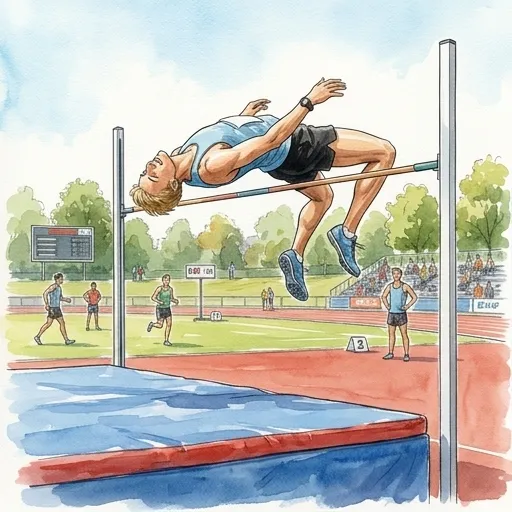
Athletics - Jumps - High jump
Sport
Sport: Athletics
Event_family: Jumps
Event: High jump
Athletes' bodies
Elite male high jumpers typically look tall with a long, springy lower-body build and relatively low-to-moderate mass (for power-to-weight). They tend to have an arm span roughly matching or slightly exceeding height (useful for clearance/reach) plus a shoulder/torso frame that allows efficient lead-leg takeoff, midair body control, and fast, elastic re-contact. Overall morphology aligns with an ectomorphic-to-balanced ectomorphic (slight linearity, not overly bulky) “springy” build.
Cohort
Sex: Male
Level: Elite
Quick glossary
- Prior
- Model estimate before updating with the current evidence; the starting baseline.
- Posterior
- Model-updated estimate after combining prior evidence with observed data.
- Standard deviation
- Spread around the estimate; lower means tighter expected range.
- Alignment
- How well a goal/preference/injury profile matches this body pattern.
Measurements
| Factor | Prior | Posterior | Success-impact | Reasoning behind prior | Prior estimate sources |
|---|---|---|---|---|---|
| Height | 188 ± 7 cm | 188 ± 7 cm | high | High jump technique rewards generating high takeoff velocity and positioning the COM favorably relative to bar clearance. Taller athletes often have higher leverage and longer contact-to-flight mechanics opportunities, and elite cohorts often skew toward above-average stature (modeled here as ~188 cm). | [1] [2] |
| Leg inseam | 92 ± 4.5 cm | 92 ± 4.5 cm | high | High jumpers benefit from long effective lower-limb segments to generate higher takeoff velocities while maintaining elastic stiffness and favorable segment COM contributions; modeled with relatively high inseam for tall builds. | [3] [4] |
| Leg-torso ratio | 1.08 ± 0.06 ratio | 1.08 ± 0.06 ratio | high | A higher leg-to-torso ratio generally aligns with more leg dominance in takeoff, modeled here as ~1.08 for a tall, jump-specialist physique. | [5] |
| Weight | 75 ± 6 kg | 75 ± 6 kg | high | To reach extreme heights, athletes need high mechanical power but must avoid excess mass that increases COM inertia without proportionate force gain. Modeled as ~75 kg for ~188 cm tall elite males (lean, athletic build). | [6] [7] |
| Ape index | 1.02 ± 0.03 ratio | 1.02 ± 0.03 ratio | medium | Modeled slightly above 1.0 to represent a mild reach advantage without requiring extreme proportions. | [8] [9] |
| Arm span | 192 ± 8 cm | 192 ± 8 cm | medium | Arm span is typically near height and sometimes slightly greater in elite jumpers; modeled slightly above height to reflect clearance reach and body alignment advantages. | [7] [10] |
| Foot length | 27.8 ± 1.1 cm | 27.8 ± 1.1 cm | medium | High jumpers often have larger feet consistent with stature; foot length supports leverage and ankle stiffness/contact mechanics in takeoff. | [11] |
| Shoulder width | 44 ± 3.5 cm | 44 ± 3.5 cm | medium | Modeled as moderately broad for tall, lean males—enough for trunk/arm involvement in body rotation and bar clearance control. | [12] |
| Torso length | 86 ± 4.5 cm | 86 ± 4.5 cm | medium | Modeled with slightly longer trunk to help midair body positioning while allowing efficient lead-leg blocking; still consistent with a light springy profile. | [13] |
| Ankle circumference | 22 ± 1.2 cm | 22 ± 1.2 cm | low | Modeled as moderate circumference for a lean elite build; enough soft tissue for stability without indicating excess mass. | [14] |
| Hand length | 19.2 ± 0.9 cm | 19.2 ± 0.9 cm | low | Scaled to the modeled stature of elite male high jumpers. | [15] |
| Pelvic bone width | 27 ± 2.2 cm | 27 ± 2.2 cm | low | A moderate pelvic breadth supports hip stability and efficient transfer from lead-leg to trunk while keeping overall linear/ectomorphic body profile. | [16] |
| Shoulder-hip ratio | 0.86 ± 0.05 ratio | 0.86 ± 0.05 ratio | low | Modeled to reflect relatively stable, controlled rotation/positioning without requiring an overly top-heavy build. | [17] |
| Wrist circumference | 17.8 ± 1.1 cm | 17.8 ± 1.1 cm | low | Estimated from an elite lean male frame consistent with modeled height/weight. | [18] |
Traits
| Factor | Value | Impact | Reasoning | Sources |
|---|---|---|---|---|
| Muscle fiber profile | fast-twitch dominant | high | High jump requires explosive concentric action in the last steps and highly elastic takeoff; fast-twitch dominance is favored for peak force and shortening velocity. | [19] [20] |
| Metabolic tendency | ectomorphic tendency | medium | Modeled as ectomorphic tendency: easier leanness maintenance and a lighter build that supports power-to-weight ratio in repeated approach-and-takeoff training cycles. | [21] [22] |
| Joint laxity | medium | medium | Elite high jumpers need enough range to optimize hip/ankle angles and elastic pre-load, but also require sufficient stability to control landing/through-bar body alignment; modeled as medium. | [23] |
| Foot arch | high arch | medium | Modeled as high-arch tendency to reflect elastic stiffness/moment transmission advantages often sought in explosive jump mechanics. | [24] [25] |
| Temperature tolerance | balanced | low | High jump is characterized by brief maximal efforts with downtime, so extreme heat/cold specialization is less dominant. | [26] |
| Dominant side | no meaningful side advantage | low | Lead-leg/approach patterns are individualized; no strong universal right/left performance advantage is assumed. | [27] |
Goals
| Factor | Alignment | Reasoning | Sources |
|---|---|---|---|
| Build confidence | medium | Progress in high jump (clearances, form consistency, confidence in approach/takeoff) can be very confidence-building. However, beginners may have a steep learning curve and occasional setbacks (missed heights), so confidence gains are plausible but not guaranteed—hence “medium.” | [28] [29] |
| Build endurance | none | High jump is primarily anaerobic/explosive: repeated takeoffs, short approach runs, and power-focused jumping. While it might produce some conditioning, it’s not designed to build the aerobic stamina people associate with endurance goals (e.g., comfortably sustaining long efforts). | [28] [29] |
| Build strength and power | high | This is one of the best matches: high jump specifically rewards force production and power from the lower body, plus the ability to express that power explosively during the takeoff. Training commonly includes strength, power, and plyometric/elastic takeoff elements, which directly map to the goal. | [28] [30] [31] [32] |
| Challenge myself | high | High jump is demanding: maximal efforts, coordination under fatigue, and the psychological challenge of trying to clear a higher bar. For amateurs, it can feel very rewarding because you can directly test yourself with each trial. | [28] [29] |
| Compete and measure myself | medium | You *can* compete (local meets, club competitions), and performance is easy to measure (clearing height). But for many amateurs, access to proper pits/coaches and consistent training time can limit how often competition is feasible. So it’s a solid but not “highest” alignment. | [28] |
| Improve agility and coordination | medium | High jump involves coordination and body control—especially during the approach rhythm, last steps, takeoff, and bar clearance. But compared with sports that require frequent directional changes/reacting to an opponent (like basketball/tennis), the “agility” component is more specialized and less reactive. So it’s meaningful, but not a top-tier match for general agility. | [28] [29] |
| Improve balance and control | medium | To clear the bar, athletes must maintain control through takeoff and mid-air (and especially landing mechanics to train safely). High jump does train balance and body alignment, but it’s not as balance-dominant as disciplines like gymnastics, skateboarding, or surfing where balance is constantly challenged. | [28] [30] |
| Improve flexibility and mobility | low | High jump benefits from mobility (hips/ankles/back) and many coaches include flexibility work, but the main performance driver is power and technique rather than large gains in general flexibility. Without intentionally adding mobility/flexibility sessions, improvements may be modest. | [28] [31] |
| Improve general health and fitness | medium | High jump training is very physically demanding (short, powerful efforts plus repeated practice), so it can improve overall fitness—especially leg strength and neuromuscular fitness. However, it’s usually not as “general” or steady-aerobic as sports built around long-duration running/cycling, and amateurs may end up doing relatively low weekly volume if they’re focusing on technique and explosive attempts. So the health benefit is real, but not the best match. | [28] [29] |
| Improve speed and explosiveness | high | High jump requires rapid, explosive takeoff mechanics and timing—especially the transition into the final steps and the “elastic” upward drive. Even for amateurs, practicing approach, takeoff, and plyometric movements is very directly aligned with explosiveness. | [28] [29] [30] |
| Learn new skills and master technique | high | This is a strong match. High jump is essentially a technique sport: approach mechanics, takeoff timing, body positioning over the bar, and landing/rehab-safe mechanics all require learning and refinement. Amateur progress typically comes from mastering these details over time. | [28] [33] |
| Lose weight | low | Because high jump is mostly short bursts of maximal/near-maximal effort with lots of rest and technique practice, it’s not typically the most efficient sport-subcategory for sustained calorie burn compared with endurance-focused activities. It can contribute to weight management indirectly (more muscle, better fitness), but the alignment is usually weaker for weight loss than running sports, rowing, or circuit-style training. | [34] |
| Make friends and feel a sense of belonging | medium | Track & field clubs/teams are social, and field events like jumps can have a community feel (shared setups, watching others jump, coaching). Still, it’s not as naturally “chatty” as some sports with constant partner interaction, so this is a medium match. | [35] |
| Reduce stress and feel better | low | Any sport can help mood and stress when you enjoy it, but high jump is more “performance/technical” and less like the calming, repetitive, low-stress nature of some activities. For many amateurs, the heavy focus and occasional risk of technique-related discomfort/injury can make it feel more stressful than restorative unless you train gently and consistently. | [28] |
| Spend time with people I care about | low | High jump practice often involves waiting for turns, focusing on technique, and protecting safety around the bar/landing area. It’s usually not the kind of continuous “talk while doing” sport. You *can* socialize at the facility, but the activity itself is not optimized for conversation. | [28] |
Preferences
| Factor | Alignment | Reasoning | Sources |
|---|---|---|---|
| Competition-focused environment | medium | Meets are results-driven, and the sport has clear competition culture. But for amateurs, it’s also common to train for personal improvement, local meets, or coached progression rather than living in a hyper-competitive environment. | [36] |
| Enjoys contact | none | Direct contact with opponents is not part of the event. | — |
| Flexible Time Table | low | You *can* train flexibly, but effective high jump practice usually requires specific equipment (approach area, bar, landing pit) and coaching/spotting for safe technique—so it’s less “drop in whenever” than running. | [37] |
| Indoor setting | low | There can be indoor track meets, and some training can happen at indoor facilities, but high jump is not primarily an “indoor-only” sport in the way some gym sports are. | [38] |
| Long steady efforts | none | You’re not usually doing sustained, steady pacing for long durations. Training may include conditioning, but the event performance is not built around long steady output. | — |
| Low impact on joints | low | High jump is jump/landing work, which can be high-impact for joints (especially if you’re inexperienced or land stiff). Even though you land in a mat/pit, training still involves repeated loading through the lower limbs. | [39] [40] |
| Mostly individual | high | Your performance depends mostly on your own approach, takeoff, and clearance. While you can have a coach, the actual event outcome is not based on teammates working together. | [41] |
| Non-contact | high | You don’t directly collide or grapple with other competitors. The main “contact” you worry about is your own body with the bar/pit (not physical contact with people). | [42] |
| Outdoor setting | medium | A lot of high jump competition and many training sessions happen outside (track-and-field season), but it’s not as “outdoorsy” or environment-dependent as, say, hiking or beach sports. | [43] |
| Playful recreational atmosphere | low | High jump typically feels technical and performance-focused rather than playful. Even recreational participants tend to focus on form and measurable clearance, because the event is precise. | — |
| Routine and structure | high | High jump has a repeatable structure: a consistent approach, a set takeoff sequence, then clearance. Training is often drill-based and measurable (e.g., step patterns, takeoff spot, bar progression). | [44] |
| Short explosive efforts | high | A high jump is dominated by a fast, powerful takeoff and a brief airborne phase—most of the “big effort” is short and explosive. | [45] [46] |
| Tactical and strategic | medium | There is some strategy (when to start at a height, how to attempt/treat misses, managing attempts), but it’s not a “game of tactics” like basketball or fencing—your technique and physical execution are the main driver. | [47] |
| Team environment | none | High jump is essentially a one-person event: you train and compete by yourself, even if you’re doing it at a meet alongside other athletes. | [41] |
| Technique-heavy | high | Form matters a lot: approach curve/steps, takeoff timing, body position over the bar, and landing mechanics. Small technical differences can noticeably change clearance. | [48] [49] |
| Variety and novelty | low | Compared to sports with many constantly changing actions (like soccer), high jump is fairly repetitive: approach/takeoff/clearance over progressively higher bars. You can vary techniques/styles, but the event “shape” is consistent. | [50] |
| Water environment | none | High jump doesn’t involve water as part of the activity. | — |
Injuries
Risk
| Factor | Value | Definition | Full reasoning | Sources |
|---|---|---|---|---|
| Achilles tendon pain (tendinopathy) | medium | Pain and irritation in the Achilles tendon at the back of the ankle. | Jumping events expose athletes to high ground-reaction forces through the lower limb; Achilles tendinopathy is plausibly associated with high-impact jumping/loading. While the surveillance study emphasizes locations like posterior thigh and lateral ankle, Achilles problems are a known concern in jumping sports broadly, and Achilles injury risk is strongly linked to loading and ground forces. For a moderately frequent (couple times/week) athlete, the injury risk is not the highest, but it is clearly more than “none.” | [51] [52] [53] |
| ACL injury | low | A major ligament injury inside the knee, often linked to pivoting, landing, or sudden deceleration. | ACL injury risk is influenced by landing mechanics and knee alignment. However, the jump-specific surveillance evidence used here highlights ankle and posterior thigh as common sites, not ACL. With that limitation, ACL injury risk is set low for a moderately participating high jumper rather than medium/high. | [51] [55] |
| Ankle sprain | high | A stretched or torn ankle ligament, usually after the foot rolls awkwardly. | In collegiate track-and-field jumping surveillance, the most common injury locations included the posterior thigh and the lateral ankle, with lateral ankle injuries highlighted as frequent. Jump mechanics involve high ground reaction forces and rapid stabilization, which increases sprain risk. Therefore ankle sprain risk is high for this event category. | [51] [57] |
| Calf strain | low | A pulled or overloaded calf muscle, often felt during pushing off, sprinting, or jumping. | High jump repeatedly stresses the plantarflexors for takeoff, so calf strain is plausible. However, the surveillance evidence emphasized posterior thigh and lateral ankle as top injury locations. So risk is low rather than medium/high. | [51] |
| Finger or hand impact injury | none | Pain from jamming, bending, or striking the fingers or hand during sport. | Injury patterns in jump events are dominated by lower-limb strains/sprains. Finger impact is more typical in contact sports or where equipment is frequently handled. So set to none. | [51] |
| General forearm overuse pain | none | Ongoing forearm pain from repeated gripping, lifting, or arm use when the exact tendon is unclear. | In high jump, the main repetitive high forces are on the takeoff leg and landing mechanics, not on the forearm. Surveillance data and biomechanical risk discussions in jump events focus on lower-limb locations (e.g., ankle and posterior thigh). Therefore forearm overuse pain is not a typical injury pattern for this event. | [51] |
| General foot or ankle pain | medium | Ongoing foot or ankle pain when the exact structure or diagnosis is unclear. | Jumpers show frequent lower-limb injury patterns including lateral ankle and posterior foot/toe regions in surveillance studies, which supports that “general foot/ankle pain” is an expected risk category for this event. For a moderate couple-times/week athlete, it’s not certain every athlete gets this, but it’s common enough to rate above low. | [51] |
| General hip or groin pain | low | Ongoing hip or groin pain when the exact structure or diagnosis is unclear. | Surveillance in jump events emphasizes posterior thigh strains and ankle injuries, suggesting those are more common. Hip/groin pain can still occur due to eccentric control, but without strong high-jump-specific epidemiology for hip/groin pain, the baseline risk is set low. | [51] |
| General knee pain | medium | Ongoing knee pain when the exact structure or diagnosis is unclear. | Jumpers expose the knee to repeated high loads, and knee tendinopathy/pain syndromes are well known in jumping athletes. While the provided jump surveillance data emphasizes certain sites, knee pain as a general category is common in explosive field events. Hence medium risk for this broad knee-pain category. | [51] [60] |
| General lower-back pain | low | Ongoing lower-back pain when the exact source is unclear. | Jumping uses the trunk for coordination and balance and can load the lumbar spine. However, the jump injury surveillance sources used here emphasize posterior thigh and ankle rather than low back. So risk is plausible but not expected to be high for a moderate high jumper. | [51] |
| General lower-leg pain | medium | Ongoing shin or calf pain when the exact diagnosis is unclear. | Jumping sports expose the entire lower leg to repeated high forces, and jump surveillance shows frequent posterior thigh and lower-limb injuries. Since “general lower leg pain” covers several structures that can be overloaded, risk is medium for a moderately practicing high jumper. | [51] [62] |
| General shoulder pain | none | Ongoing shoulder pain when the exact structure or diagnosis is unclear. | In jumping events, high injury burden is concentrated in the lower extremity. Therefore shoulder pain is not a typical injury expectation. Set to none. | [51] |
| General wrist or hand pain | none | Ongoing wrist or hand pain when the exact structure or diagnosis is unclear. | Given the biomechanics and injury patterns discussed for jump events, wrist/hand overuse pain is not commonly expected. Default to none. | [51] |
| Golfer's elbow | none | Pain on the inside of the elbow linked to overload in the forearm tendons. | High jump is an explosive vertical-jumping event; the dominant stresses occur at the lower limb (takeoff/landing). There’s no strong evidence that typical high jump training commonly causes medial elbow tendinopathy (golfer’s elbow). | — |
| Groin strain | low | A pulled or irritated groin muscle, often felt in cutting, sprinting, or kicking movements. | Compared with knee/ankle and posterior thigh injuries, groin strains are less highlighted in jump surveillance. Because high jump does involve forceful hip motions, it is plausible but not enough evidence to rate medium/high without more event-specific data. | [51] |
| Hip flexor strain | none | A strain or overload in the front-of-hip muscles that help lift the leg. | While hip flexors may contribute to hip mechanics during takeoff, high-jump-specific surveillance highlights other sites more frequently. With no strong evidence tying high jump moderately performed to hip flexor strain, risk is set to none (default). | [51] |
| Side-of-hip tendon pain | none | Irritation of the hip or gluteal tendons around the outer side of the hip. | Jumpers have lower-limb injuries, but most prominent injury locations in surveillance are lateral ankle and posterior thigh. Gluteal tendinopathy is possible but not well supported as a typical high jump outcome in the used evidence, so it stays at none. | [51] |
| Lower-back disc irritation | none | Lower-back pain that may involve irritation of a spinal disc and sometimes pain spreading into the leg. | Although jumping has whole-body loading, the evidence referenced in this task does not identify lumbar disc irritation as a typical high jump injury. Therefore risk remains at none. | [51] |
| Mechanical lower-back pain | none | Common lower-back pain related to movement, loading, stiffness, or irritated supporting tissues. | Given the limited high-jump-specific injury surveillance emphasis on other sites (ankle/posterior thigh), mechanical low back pain is not sufficiently supported as common to raise risk above none. | [51] |
| Meniscus injury | none | Irritation or tearing of the knee cartilage that helps cushion and stabilize the joint. | In jumpers, common injury sites in surveillance emphasize posterior thigh and lateral ankle. While meniscus injury is possible with knee trauma, the evidence base in this task does not support it as a typical common injury from high jump performed moderately. Therefore set to none. | [51] |
| Jumper's knee (patellar tendinopathy) | medium | Pain and irritation in the tendon just below the kneecap. | Patellar tendinopathy is described as common in athletes exposed to repetitive high-load jumping/running activities. It aligns well with high jump biomechanics: explosive concentric takeoff and eccentric control into landing and penultimate steps. Therefore risk is medium (common enough to matter, but not the single most emphasized injury site in the limited surveillance summaries used). | [60] [63] |
| Front-of-knee pain (patellofemoral pain) | medium | Pain around or behind the kneecap that often flares with repetitive knee bending. | High jump includes repetitive knee flexion/extension under high force and often involves landing/landing-control demands that can stress patellofemoral joint mechanics. While the provided sources focus on patellar tendinopathy, patellofemoral pain is a common consequence of excessive or poorly controlled knee loading in jumping athletes, supporting a medium risk estimate. | [51] [60] |
| Heel pain (plantar fasciitis) | low | Irritation of the tissue under the foot that often causes pain near the heel. | High jump produces high forces through the foot, so plantar structures are exposed. However, the most frequently reported injury locations in jump surveillance are more often lateral ankle and posterior thigh rather than plantar fasciitis specifically. With limited direct event-specific evidence for plantar fasciitis, risk is rated low. | [51] |
| Rotator cuff irritation | none | Pain and overload in the shoulder muscles and tendons that help control arm movement. | No strong high jump-specific evidence suggests rotator cuff irritation is a common injury. Therefore set to none. | — |
| Shin splints | low | Exercise-related pain along the shin that often appears when impact load rises too quickly. | High jump athletes may have an approach run, but the main demand is vertical jumping. Without event-specific shin splint incidence data here, risk is set to low using the general track-and-field injury distribution that includes shin-related injuries, but not making it high. | [51] [62] |
| Shoulder impingement-type pain | none | Shoulder pain that appears when tissues feel pinched or irritated during arm elevation. | Given the absence of evidence linking high jump practice to shoulder impingement as a common outcome, default to none. | — |
| Shoulder instability or dislocation | none | A shoulder that has slipped out, partly slipped out, or feels unreliable in vulnerable positions. | Without trauma, instability dislocation is unlikely in high jump. No evidence suggests it’s a common high jump-related injury; set to none. | — |
| Back stress reaction (spondylolysis) | none | A stress injury in the back often linked to repeated extension and rotation loading. | The jump injury sources highlighted in this task focus on lower extremity. Without strong evidence tying high jump to spondylolysis/stress reaction in a typical moderate participant, risk remains none. | [51] |
| Tennis elbow | none | Pain on the outside of the elbow linked to overload in the wrist and forearm tendons. | In high jump, injury patterns overwhelmingly relate to the lower extremity (e.g., ankle, posterior thigh, strains) rather than lateral elbow tendon overload. Thus tennis elbow is not commonly expected here. | [51] |
| Shin bone stress injury | low | Stress irritation in the tibia from repeated impact that has outpaced recovery. | The event includes takeoff impacts, but tibial stress injuries are classically more linked to high repetitive loading patterns (e.g., running volumes). With no strong high-jump-specific tibial stress injury incidence data in the used sources, risk is set low. | [51] |
| Wrist sprain | none | A stretched or irritated wrist ligament, often after a fall, impact, or awkward bend. | No evidence suggests high jump is commonly associated with wrist sprains; set to none. | — |
| Wrist tendon pain | none | Irritation of wrist tendons from repeated gripping, racquet use, lifting, or supporting body weight. | No evidence supports wrist tendinopathy as common in high jump; default none. | — |
Prevention
| Factor | Value | Definition | Full reasoning | Sources |
|---|---|---|---|---|
| Achilles tendon pain (tendinopathy) | low | Pain and irritation in the Achilles tendon at the back of the ankle. | The sport involves repeated elastic takeoff and landings that load the tendon, which can promote adaptation. However, without intentional tendon-prep or load management beyond regular training, that same loading can also provoke tendinopathy. That makes prevention beneficial but not strongly assured for a typical moderate high-jumper, so the net prevention effect is low. | [52] |
| ACL injury | low | A major ligament injury inside the knee, often linked to pivoting, landing, or sudden deceleration. | Skill and landing mechanics training can improve motor control and potentially reduce ACL-type mechanisms. But because doing high jump is not equivalent to a dedicated ACL-prevention program, prevention benefit is limited—low rather than medium/high. | [56] |
| Ankle sprain | medium | A stretched or torn ankle ligament, usually after the foot rolls awkwardly. | Because high jump necessarily exposes the ankle to repeated loading, the body can adapt (strength/stability) and practicing landing mechanics can help reduce risk. However, adaptation does not eliminate risk since sprains occur with missteps and insufficient stability under force. Thus the prevention effect from doing the sport moderately is meaningful but not complete. | [58] |
| Calf strain | none | A pulled or overloaded calf muscle, often felt during pushing off, sprinting, or jumping. | Because calf strain prevention is likely tied to specific progressive training and technique, and we are not assuming extra exercises beyond typical sport practice, prevention effect is set to none. | — |
| Finger or hand impact injury | none | Pain from jamming, bending, or striking the fingers or hand during sport. | No evidence or strong mechanism that sport practice prevents hand injuries. | — |
| General forearm overuse pain | none | Ongoing forearm pain from repeated gripping, lifting, or arm use when the exact tendon is unclear. | Because high jump mechanics don’t heavily load the forearm, doing the sport moderately a couple times per week is not expected to meaningfully strengthen or condition forearm tissues against overuse. | — |
| General foot or ankle pain | low | Ongoing foot or ankle pain when the exact structure or diagnosis is unclear. | Moderate participation can improve tendon/foot-ankle resilience and landing mechanics. But without explicit preventive load management beyond normal training, it provides only limited certainty of reducing general foot/ankle pain risk—hence low rather than medium/high. | [51] |
| General hip or groin pain | low | Ongoing hip or groin pain when the exact structure or diagnosis is unclear. | If the athlete maintains good technique and sufficient conditioning, hip strength and coordination can improve tolerance to explosive takeoff. But because the sport also produces high mechanical demands, prevention is not assured; hence low. | — |
| General knee pain | low | Ongoing knee pain when the exact structure or diagnosis is unclear. | Regular training can improve strength and tendon/soft-tissue capacity (including around the knee), but ongoing high-impact loads can also provoke knee pain if the athlete’s load tolerance is insufficient. Net prevention effect from the sport alone is limited, so low. | [61] |
| General lower-back pain | none | Ongoing lower-back pain when the exact source is unclear. | Without evidence that the sport itself (as practiced) prevents general lower back pain, prevention is set to none by default. | — |
| General lower-leg pain | low | Ongoing shin or calf pain when the exact diagnosis is unclear. | Because lower-leg pain can be an overload outcome, sport participation provides both adaptation and overload risk. Net prevention effect from doing the sport itself at moderate frequency is limited to low. | [51] |
| General shoulder pain | none | Ongoing shoulder pain when the exact structure or diagnosis is unclear. | No direct mechanism or evidence that high jump practice prevents shoulder pain. | — |
| General wrist or hand pain | none | Ongoing wrist or hand pain when the exact structure or diagnosis is unclear. | No evidence-based prevention link. | — |
| Golfer's elbow | none | Pain on the inside of the elbow linked to overload in the forearm tendons. | Since moderate high jump practice doesn’t repeatedly stress the elbow flexor-pronator tendon system in the way that racket/gripping sports do, prevention effect is not expected. | — |
| Groin strain | none | A pulled or irritated groin muscle, often felt in cutting, sprinting, or kicking movements. | Groin strain risk reduction typically involves targeted strengthening and progressive load management for adductors/hips, not just the sport’s regular training. So prevention effect is not expected from high jump alone. | — |
| Hip flexor strain | none | A strain or overload in the front-of-hip muscles that help lift the leg. | No clear evidence that regular high jump at moderate frequency prevents hip flexor strain compared with other conditioning approaches. | — |
| Side-of-hip tendon pain | none | Irritation of the hip or gluteal tendons around the outer side of the hip. | Without specific evidence that high jump practice prevents gluteal tendinopathy (as opposed to simply loading the hip), prevention effect is set to none. | — |
| Lower-back disc irritation | none | Lower-back pain that may involve irritation of a spinal disc and sometimes pain spreading into the leg. | No strong evidence within the used materials that high jump prevents lumbar disc irritation; set to none. | — |
| Mechanical lower-back pain | none | Common lower-back pain related to movement, loading, stiffness, or irritated supporting tissues. | Prevention likely depends on broader trunk training and technique/load management beyond “doing the sport.” No direct evidence provided, so none. | — |
| Meniscus injury | none | Irritation or tearing of the knee cartilage that helps cushion and stabilize the joint. | Without specific evidence that high jump training reduces meniscus tear incidence (via neuromuscular control or technique) enough to be meaningful, prevention effect is none. | — |
| Jumper's knee (patellar tendinopathy) | medium | Pain and irritation in the tendon just below the kneecap. | Tendon disorders respond to appropriate loading, and jumping practice provides that loading stimulus. However, because high jump also includes high tendon forces that can provoke symptoms if volume ramps up, prevention isn’t guaranteed, leading to medium rather than high. | [61] [64] |
| Front-of-knee pain (patellofemoral pain) | low | Pain around or behind the kneecap that often flares with repetitive knee bending. | Strength/coordination improvements may reduce patellofemoral joint overload and improve tracking. However, without specific patellofemoral-targeted training and with high-impact exposure continuing, prevention is limited—low. | [64] |
| Heel pain (plantar fasciitis) | none | Irritation of the tissue under the foot that often causes pain near the heel. | Prevention for plantar fasciitis usually depends on dedicated load management and calf/foot interventions. Since normal high jump practice does not necessarily include those targeted elements, there’s no strong basis for a meaningful prevention effect from the sport alone. | — |
| Rotator cuff irritation | none | Pain and overload in the shoulder muscles and tendons that help control arm movement. | Prevention depends on overhead loading/strengthening patterns; not provided by typical high jump practice alone. | — |
| Shin splints | none | Exercise-related pain along the shin that often appears when impact load rises too quickly. | Because typical shin-splint prevention is closely tied to running volume/load and foot/leg conditioning, and we are not assuming extra specific rehab/prevention work, prevention effect is none. | — |
| Shoulder impingement-type pain | none | Shoulder pain that appears when tissues feel pinched or irritated during arm elevation. | No strong evidence for prevention; set to none. | — |
| Shoulder instability or dislocation | none | A shoulder that has slipped out, partly slipped out, or feels unreliable in vulnerable positions. | No evidence-based prevention link from sport practice alone. | — |
| Back stress reaction (spondylolysis) | none | A stress injury in the back often linked to repeated extension and rotation loading. | Prevention of spondylolysis generally requires specific control and conditioning, not just general participation; set to none. | — |
| Tennis elbow | none | Pain on the outside of the elbow linked to overload in the wrist and forearm tendons. | Without specific forearm/wrist loading as part of the sport, there’s no reason to expect a meaningful prevention effect. | — |
| Shin bone stress injury | none | Stress irritation in the tibia from repeated impact that has outpaced recovery. | Without evidence that moderate high jump prevents tibial stress injuries, prevention is none. | — |
| Wrist sprain | none | A stretched or irritated wrist ligament, often after a fall, impact, or awkward bend. | No evidence-based effect. | — |
| Wrist tendon pain | none | Irritation of wrist tendons from repeated gripping, racquet use, lifting, or supporting body weight. | No evidence-based prevention link. | — |
Heal
| Factor | Value | Definition | Full reasoning | Sources |
|---|---|---|---|---|
| Achilles tendon pain (tendinopathy) | low | Pain and irritation in the Achilles tendon at the back of the ankle. | Healing from Achilles tendinopathy typically relies on progressive loading strategies (often heavy slow resistance or eccentric-type work). Regular high jump does load the tendon, which could support some remodeling, but it’s not as controlled or gradually progressed as a targeted rehab program, and it may increase symptoms. Therefore the expected healing support from doing high jump itself is low rather than medium/high. | [53] [54] |
| ACL injury | none | A major ligament injury inside the knee, often linked to pivoting, landing, or sudden deceleration. | ACL healing generally requires structured rehabilitation and, often, surgical or clinician-directed management. Normal high jump training is not expected to provide a healing effect for an ACL injury, so none. | — |
| Ankle sprain | low | A stretched or torn ankle ligament, usually after the foot rolls awkwardly. | While sport-specific movement might help some people maintain function, ankle sprain healing typically requires protection and progressive rehabilitation; ongoing high jump tends to increase loading and risk of re-irritation before adequate healing. Therefore healing support from continuing the sport is low. | [59] |
| Calf strain | none | A pulled or overloaded calf muscle, often felt during pushing off, sprinting, or jumping. | Calf strain healing generally needs reduced provocative loading. High jump is provocative, so no positive healing effect is assumed. | — |
| Finger or hand impact injury | none | Pain from jamming, bending, or striking the fingers or hand during sport. | No positive healing effect is expected. | — |
| General forearm overuse pain | none | Ongoing forearm pain from repeated gripping, lifting, or arm use when the exact tendon is unclear. | Without direct loading/rehabilitation of the forearm, ongoing participation is not expected to improve healing of forearm overuse pain. | — |
| General foot or ankle pain | low | Ongoing foot or ankle pain when the exact structure or diagnosis is unclear. | Without targeted rehab, ongoing high jump is likely to keep mechanical stress high, which may maintain symptoms. That said, gentle movement/continued loading can sometimes help tolerance once pain is managed, so the net healing effect is low rather than none. | — |
| General hip or groin pain | none | Ongoing hip or groin pain when the exact structure or diagnosis is unclear. | Healing for hip/groin pain generally requires specific rehabilitation and reduced provocative loading; the sport itself isn’t a controlled rehab stimulus for these tissues. Therefore no positive healing effect from doing high jump alone is expected. | — |
| General knee pain | low | Ongoing knee pain when the exact structure or diagnosis is unclear. | Knee pain from tendinopathy often responds to progressive loading, yet continued jumping is frequently provocative. Because the sport provides some tendon/muscle loading but not the controlled progression of rehab, the healing support is low. | [61] |
| General lower-back pain | none | Ongoing lower-back pain when the exact source is unclear. | No strong reason to expect high jump practice itself to improve lumbar healing, absent targeted rehab or modifications, so none. | — |
| General lower-leg pain | low | Ongoing shin or calf pain when the exact diagnosis is unclear. | Lower-leg pain from overuse often improves with modifying/controlling load and progressive rehab. Sport continuation keeps forces high, so healing benefit from sport alone is low. | — |
| General shoulder pain | none | Ongoing shoulder pain when the exact structure or diagnosis is unclear. | Without targeted shoulder loading, sport practice is not expected to improve shoulder pain healing. | — |
| General wrist or hand pain | none | Ongoing wrist or hand pain when the exact structure or diagnosis is unclear. | No positive healing effect assumed. | — |
| Golfer's elbow | none | Pain on the inside of the elbow linked to overload in the forearm tendons. | Healing would require specific tendon loading/protocols for the elbow; the sport’s usual practice doesn’t function as that directed rehabilitation. | — |
| Groin strain | none | A pulled or irritated groin muscle, often felt in cutting, sprinting, or kicking movements. | Because normal high jump involves repeated hip loading, it is unlikely to function as the controlled, graded loading needed for healing, so no positive healing effect is assumed. | — |
| Hip flexor strain | none | A strain or overload in the front-of-hip muscles that help lift the leg. | Healing generally requires reducing painful provocative movement and using progressive rehab. High jump likely keeps irritation high, so no expected healing benefit. | — |
| Side-of-hip tendon pain | none | Irritation of the hip or gluteal tendons around the outer side of the hip. | Gluteal tendinopathy rehab typically uses targeted, graded strengthening. The sport itself doesn’t reliably match that rehab stimulus, so no positive healing effect is assumed. | — |
| Lower-back disc irritation | none | Lower-back pain that may involve irritation of a spinal disc and sometimes pain spreading into the leg. | Disc irritation healing generally requires symptom-guided unloading and rehab; sport-only continuation isn’t expected to help. | — |
| Mechanical lower-back pain | none | Common lower-back pain related to movement, loading, stiffness, or irritated supporting tissues. | No evidence that sport continuation alone improves mechanical low back pain; set to none. | — |
| Meniscus injury | none | Irritation or tearing of the knee cartilage that helps cushion and stabilize the joint. | Meniscus healing/recovery generally requires injury-specific management and often activity modification; no positive healing effect is assumed from ongoing high jump. | — |
| Jumper's knee (patellar tendinopathy) | medium | Pain and irritation in the tendon just below the kneecap. | Patellar tendinopathy management is strongly based on progressive loading to build tendon capacity. High jump inherently provides high tendon loading in a sport-specific way, which can support load tolerance if symptoms are managed and training is not overly provocative. Because sport-only loading is less controlled than rehab and pain-guided modifications are needed, the expected healing effect is medium, not high. | [60] [61] |
| Front-of-knee pain (patellofemoral pain) | low | Pain around or behind the kneecap that often flares with repetitive knee bending. | Healing of patellofemoral pain generally requires symptom-guided load reduction and progressive strengthening/movement retraining. Normal high jump continues to stress the joint, so average healing benefit from sport alone is low. | — |
| Heel pain (plantar fasciitis) | none | Irritation of the tissue under the foot that often causes pain near the heel. | Healing is usually supported by specific progressive loading and symptom management for the plantar fascia/foot. High jump may worsen symptoms before healing, so no positive healing effect is expected from continuing normal training. | — |
| Rotator cuff irritation | none | Pain and overload in the shoulder muscles and tendons that help control arm movement. | No positive healing effect from high jump alone is expected. | — |
| Shin splints | none | Exercise-related pain along the shin that often appears when impact load rises too quickly. | Healing generally requires reducing and modifying impact load. Sport participation can be provocative, so no positive healing effect is assumed. | — |
| Shoulder impingement-type pain | none | Shoulder pain that appears when tissues feel pinched or irritated during arm elevation. | No expected positive healing effect from high jump without shoulder-specific rehab. | — |
| Shoulder instability or dislocation | none | A shoulder that has slipped out, partly slipped out, or feels unreliable in vulnerable positions. | No positive healing effect from continuing sport alone. | — |
| Back stress reaction (spondylolysis) | none | A stress injury in the back often linked to repeated extension and rotation loading. | Healing usually requires load reduction and progressive rehab; sport continuation is not expected to help. | — |
| Tennis elbow | none | Pain on the outside of the elbow linked to overload in the wrist and forearm tendons. | Tennis elbow rehab is typically tendon-focused; continued high jump is unlikely to improve that condition. | — |
| Shin bone stress injury | none | Stress irritation in the tibia from repeated impact that has outpaced recovery. | Stress injuries generally require reduced impact and progressive rehab; no healing benefit is expected from ongoing sport participation alone. | — |
| Wrist sprain | none | A stretched or irritated wrist ligament, often after a fall, impact, or awkward bend. | No positive healing effect from sport-only participation is expected. | — |
| Wrist tendon pain | none | Irritation of wrist tendons from repeated gripping, racquet use, lifting, or supporting body weight. | No expected positive healing effect. | — |
Past-sport transfer logic
| Past sport | Average correlation (success) | Std dev | Correlation reasoning | Correlation sources |
|---|---|---|---|---|
| american-football-defensive-back | 0.18 | 0.1 | Defensive backs who perform well tend to show good explosive movement quality (quick acceleration, elastic reactive steps), coordination, and body control—attributes that help with initiating and controlling a jumping approach. However, high jump (even more than generic “jumps”) is highly technique-specific: approach geometry, takeoff timing/angles, and bar-clearing body positioning are learned skills that defensive backs generally do not develop to the same extent. Therefore the carry-over should be modest rather than strong. | [65] [66] [67] |
| american-football-line-player | 0.08 | 0.06 | The past role (line player) and the future event (high jump) share only broad athletic components: repeated short explosive efforts, some lower-body power development, and general contact/impact tolerance and coordination. But the high jump is dominated by highly specific technique: approach control, takeoff timing, penultimate step mechanics, takeoff angle/trajectory, and precise body positioning over the bar. Line play’s technical skills (leverage, pad level, hand fighting, short-area force in contact) do not directly map onto high-jump biomechanics. Because success in high jump relies heavily on event-specific motor patterns and elasticity management, any correlation should be small but still positive (some people who are strong/explosive and coordinated can pick up high jump faster). Variability is expected to be moderate: some linemen transition reasonably well, while others struggle with landing/approach mechanics and bar clearance coordination. | [68] [69] |
| american-football-linebacker-tight-end | 0.12 | 0.08 | American football linebacker/tight end success carries some transferable elements to high jump: explosive lower-body power, quick reacceleration, coordination, and the ability to apply force rapidly. That means athletes who are good at those roles often have the general “power + coordination” base that can help early high-jump learning. However, high jump is technically dominated by approach mechanics, takeoff timing, elastic energy use, and bar-clearing body control (especially rotational/scissoring coordination for the chosen technique). These are event-specific skills that football linebackers/TEs don’t repeatedly practice as their primary performance determinant. Because the biggest differentiator for success in high jump is specialized technique rather than general explosiveness, the correlation should be small positive but not large. | [70] [71] [72] |
| american-football-quarterback | 0.07 | 0.05 | There is only a modest overlap between “being good at quarterback” and “being good at high jump.” Both benefit from general athletic traits that are partly trainable and technique-adjacent—e.g., coordination, balance, and the ability to generate force quickly with good body control. However, high jump is highly technical and event-specific: approach-to-takeoff timing, takeoff angle/velocity, and bar clearance mechanics (including approach rhythm and elastic/power expression) differ far more from quarterback fundamentals (throw accuracy, pocket movement, reading defenses). That large technical mismatch means QB success should not reliably predict high-jump success, so the correlation should sit near the low end rather than near zero or moderate values. | [73] [74] |
| american-football-receiver-running-back | 0.14 | 0.1 | WR/RB performance should correlate somewhat with high jump because both reward explosive power, coordination, and the ability to produce force quickly. Receivers/runners also often have good approach timing and sprint-to-jump conversion potential. But high jump is not just “more explosion.” It depends strongly on event-specific technique: approach curvature/rhythm, plant mechanics, center-of-mass management, and bar clearance. Also, WR/RB are optimized for open-field acceleration, agility, and contact, which only partially maps onto the vertical, elastic, technique-driven nature of high jump. So the carry-over is positive but limited, landing in the low-to-mid range around the mid-teens with moderate uncertainty. | [75] |
| athletics-distance | 0.35 | 0.12 | A distance event indicates strong general athletic foundation and motor control in running, plus the habit of high training volume. Those traits support transfer into high jump by helping technique learning and maintaining consistency across sessions. However, high jump success hinges on highly specific explosive takeoff mechanics, approach speed regulation, and bar clearance coordination—skills that are largely different from aerobic economy and fatigue resistance. Therefore, the correlation should be clearly positive (athletics is the same overall sport and lower-limb movement overlaps exist) but not high (event-family specificity limits carryover). | [76] [77] [78] |
| athletics-jumps-long-triple-jump | 0.62 | 0.13 | Long jump/triple jump and high jump share the same broad category: explosive track-and-field jumping requiring run-up mechanics, takeoff timing, elastic stiffness/recoil, and body coordination. That common “jump toolkit” creates a fairly strong positive correlation between success across the events. However, they differ in key technical and physical emphasis: long/triple prioritizes horizontal velocity and (triple) repeated takeoff phase management, whereas high jump emphasizes vertical lift and bar-clearance technique (e.g., Fosbury-flop), with different approach length, takeoff angles, and center-of-mass control. Because of these differences, the correlation should be high but not near-unity; substantial individual specialization should keep it in the moderate-to-high range with noticeable variability. | [79] [80] [81] |
| athletics-jumps-pole-vault | 0.65 | 0.15 | Pole vault and high jump share the core explosive-jump skill stack: approach/run-up organization, timing of takeoff, elastic/forceful lower-body mechanics, and aerial body control. Those shared technical components create a fairly high positive correlation between success levels. The correlation is not near-perfect because each event also has highly specialized techniques (pole plant/inversion/handling and vault landing vs. Fosbury flop/lead-leg clearance and head/shoulder positioning over the bar). This produces a strong average but with meaningful spread across individuals depending on whether their pole vault strength is primarily general jump mechanics (higher carryover) or pole-inversion specialization (lower carryover). | [82] [83] [84] |
| athletics-middle-distance | 0.63 | 0.12 | Middle-distance performance should correlate moderately-to-strongly with later success in high jump because both are track-and-field and draw on overlapping fundamentals: coordinated approach running, lower-limb mechanics, general athletic conditioning, and the ability to handle training volume. However, high jump requires highly specific explosive takeoff mechanics, elasticity utilization, and fine body control/coordination relative to the bar—skills not central to middle-distance. So the correlation should be high but not near-perfect, roughly in the low-to-mid 0.6s with some variability depending on how much jumping/power training was also present during the middle-distance training era. | [85] [86] |
| athletics-sprints-hurdles | 0.78 | 0.1 | Sprints-and-hurdles performance usually reflects strong acceleration, good sprint mechanics, fast-twitch power, and a “stiff/elastic” movement strategy—all of which feed directly into the run-up and takeoff phases of high jump. High jump also requires excellent coordination and precise timing (especially penultimate-to-takeoff), plus specialized body control for clearing the bar, which sprint/hurdle athletes don’t automatically master just by being fast. Still, because the core physical expression (explosive takeoff supported by approach speed and elastic mechanics) and many training habits (speed development, plyometrics, technical repetition under fatigue) transfer well, the relationship should be high. Therefore the expected average carry-over is high (around 0.78) but not near-perfect due to the significant event-specific coordination/timing component for high jump. | [87] |
| athletics-throws-discus | 0.35 | 0.1 | Discus success reflects rotational sequencing, hip-shoulder coordination, and the ability to generate high peak force efficiently. High jump success reflects elastic takeoff power, dynamic balance, and precise body positioning over the bar. While the movement patterns and technical details differ (rotational throw release vs vertical/jumping technique), both events require strong explosive force production, good lower-body-to-trunk mechanics, and high neuromuscular coordination/timing. Because these shared determinants are meaningful but not dominant for either event, a moderate positive correlation is plausible. A reasonable Bayesian estimate is ~0.35 on average with a std dev around ~0.10, reflecting that some throwers cross-train into jumps (higher correlation) while others don’t (lower correlation). | [88] [89] [90] |
| athletics-throws-hammer-throw | 0.22 | 0.08 | Hammer throw success and high jump success both depend on producing power efficiently through coordinated whole-body mechanics and maintaining balance/timing during a complex approach-to-power phase. There is therefore meaningful carryover in general “power-field” skills such as motor learning, kinetic-chain sequencing, and dynamic stability. However, the main technical determinants differ: hammer is about rotational force application and leverage into a flying implement, whereas high jump is about elastic takeoff mechanics and precise body control while clearing the bar. Because those sport-specific patterns are quite different (and because high jump is strongly influenced by build-related factors, which we are disregarding, further limiting the technique carryover), the expected correlation is moderate rather than high. | [91] [92] |
| athletics-throws-javelin | 0.47 | 0.13 | Javelin and high jump share several *technique-relevant* building blocks: (1) an approach run that converts speed into explosive takeoff mechanics, (2) elastic lower-body sequencing (ankle–knee–hip timing) and coordination, (3) strong body control and timing under a time constraint (the approach/takeoff window), and (4) training habits around technical repetition and self-coaching. They diverge on key determinants of performance: high jump is dominated by vertical takeoff quality, takeoff/flight mechanics over the bar, and landing technique; javelin performance depends much more on shoulder/arm timing, release mechanics, and transferring speed into a throwing action with a different coordination pattern. So the expected carry-over is moderate: athletes who are good at javelin often have the athletic “speed-to-power + elastic coordination” foundation, but many of the most predictive high-jump skills are not the same. That makes correlation meaningfully positive but not high (roughly mid-0.4s). | [93] |
| athletics-throws-shot-put | 0.56 | 0.15 | Shot put and high jump share a meaningful underlying athletic skill set: explosive lower-body power, elastic-like drive/force application, strong body control in a brief maximal action, and effective sequencing of hips and trunk. That produces a fairly substantial positive correlation between being successful at one and being successful at the other. However, the decisive technical tasks differ—shot put is about release mechanics and generating a specific power/output vector, while high jump is about takeoff mechanics and bar clearance timing—so transfer cannot be extremely high. Therefore a moderate-to-high correlation with noticeable spread is most plausible. | [94] [95] [96] [97] |
| badminton | 0.03 | 0.03 | High jump success depends on very specific technical skills: approach mechanics, optimal takeoff angle/positioning, elastic leg drive, and coordinated body control to clear the bar efficiently. Badminton’s technical core is racket/shuttle interaction, with most benefits transferring only as general neuromuscular coordination, balance, and change-of-direction control. That creates a small positive carryover from being skilled at badminton, but it is unlikely to predict high-jump outcomes beyond general athleticism. Hence a near-zero to very low positive correlation is most plausible. | [98] [99] [100] [101] |
| baseball-catcher | 0.02 | 0.03 | A high-performing baseball catcher demonstrates good reaction, hand-eye coordination, and defensive organization, but the technical skill that determines high jump success is approach-to-takeoff mechanics, elastic energy use, and precise body control over the bar. There is only a weak, indirect overlap via general coordination/athletic learning and possibly general lower-body strength, but we are excluding body-proportion/size effects. Therefore the correlation should be very close to zero, with only a small positive value reflecting that some people who learn sports well may also pick up jump technique faster. | [102] [103] [104] |
| baseball-field-player | 0.05 | 0.03 | Baseball field players build useful general coordination (timing, footwork, tracking, and explosive actions like sprinting to bases and throwing). However, high jump success is dominated by event-specific technique: approach mechanics, takeoff posture, force-vector control, and elastic qualities managed through a specialized sequence over the bar. Those key technical components have limited overlap with baseball fielding. Therefore, the correlation is expected to be small and mostly driven by general athletic coordination and confidence under pressure, rather than a direct carryover of high-jump skill. | [105] [106] [107] |
| baseball-pitcher | 0.06 | 0.05 | Baseball pitching can contribute to general athletic skills: timing, balance, dynamic coordination, and some explosive-timing habits. A pitcher also experiences repeated power generation and body control in the throwing motion, which can correlate weakly with overall athleticism that helps in jumping events. But high jump success is dominated by very event-specific technical factors: the approach rhythm, penultimate/last-step positioning, takeoff angle, elastic use of the lower body, and bar-clearing mechanics. Pitchers train a largely different movement pattern (upper-body-dominant throwing with a stride/plant that is not the same as jumping takeoff). Because technique overlap is limited and because we’re ignoring physique, the expected correlation should be small and near the “wildly different” baseline for cross-sport transfer, though not exactly zero due to general coordination/explosiveness carry-over. | [108] |
| basketball-big | 0.06 | 0.04 | Basketball “Big” success correlates somewhat with transferable attributes like general lower-body coordination, balance, and repeated exposure to vertical jumping and rebounding. That gives a small positive relationship with high-jump potential. But the high jump has very specific technical requirements: approach/run-up geometry, last-step timing, takeoff angle and foot placement, and bar-clearing body coordination (e.g., Fosbury-flop sequencing). Basketball bigs may practice vertical jumps, but typically not the high-jump approach/takeoff mechanics in a way that would strongly predict event-specific performance. Also, because the question excludes body proportions, we discount the biggest obvious reason basketball bigs might be good at high jump (height/reach). What remains is general athletic coordination and jumping practice, which should yield only a low correlation. | [109] |
| basketball-guard | 0.12 | 0.07 | Basketball guards often develop good coordination, footwork, and repeated lower-body power from frequent cutting, layups, and changes of pace—all of which can support aspects of high-jump technique (approaching, timing, and body control). There is also some transferable “jump literacy”: understanding how to get elevation and land safely. But the correlation should be low-to-moderate at best because basketball guard performance is not mainly a function of specializing in single-event vertical jumping mechanics. High jump is extremely technique-specific: run-up pattern, takeoff timing/angle, center-of-mass management relative to the bar, and consistent elastic takeoff mechanics. Those are largely learned through high-jump practice. Net: a small positive carry-over (enough to help beginners, but not strongly predictive of elite outcome). | [110] |
| basketball-wing | 0.06 | 0.05 | Basketball wings and high jump both involve explosive lower-body action, but the *type* of explosion differs. A wing’s jumps are usually multi-directional, often with contact/landing demands and no need to master a precise approach geometry or bar-clearing technique. High jump success depends heavily on event-specific coordination (approach curve, penultimate step, takeoff timing), body control relative to the bar, and technique that is mostly not practiced in basketball. That creates only a small positive correlation from general athletic coordination and timing, with large individual variance depending on how much the athlete naturally adapts and trains the specific mechanics. | [111] [112] |
| boxing | 0.02 | 0.03 | Boxing and high jump share only broad, non-specific components like general athleticism, balance, and the ability to generate force quickly with good coordination. But the dominant performance drivers in high jump are highly specialized: approach/run-up mechanics, penultimate and takeoff timing, takeoff angle, elastic stiffness/energy transfer, and bar clearance technique. Boxing training does not meaningfully educate these technical constraints. Therefore, the carry-over from being good in boxing to being good in high jump should be very small and mostly mediated through general coordination rather than direct technique transfer. | [113] [114] [115] |
| climbing-bouldering | 0.12 | 0.07 | Bouldering-to-high-jump carry-over is plausibly small-to-modest. Both demand rapid coordination, strong proprioception, and the ability to generate force efficiently while managing body position under dynamic conditions. Bouldering also trains explosive hip/leg actions and the skill of keeping balance and form while moving quickly into a difficult posture. But high jump requires highly specific takeoff mechanics (run-up, penultimate step, pole clearance strategy, and elastic rebound timing) that are not trained in bouldering. Also, the outcome in high jump is influenced by sport-specific technique and the ability to repeatedly execute an approach under competition conditions; these are only weakly present in climbing. Therefore, a reasonable Bayesian center is around r ≈ 0.12 with moderate uncertainty (std dev ~0.07). | [116] |
| climbing-lead | 0.08 | 0.06 | Lead climbing (especially longer roped lead) improves body control, balance, and precise coordination while managing fatigue—these can help with learning high-jump mechanics (bar clearance skills, spatial awareness, approach-body organization). However, high jump success is heavily driven by approach speed, takeoff timing, plant mechanics, and elastic/reactive power; these are not directly trained in the lead format. Because the skill overlap is mainly coordination/proprioception rather than the event’s key power/timing demands, the carry-over should be small and somewhat variable across individuals (e.g., route-endurance-focused climbers vs those who also train power). | [117] [118] [119] |
| climbing-speed | 0.28 | 0.09 | Climbing speed shares some underlying skill components with high jump—especially explosive force production, coordination under fatigue/time pressure, and whole-body awareness. That creates a modest positive relationship between being good at climbing speed and later being good at high jump. However, high jump is dominated by highly specific technique (run-up timing, takeoff direction/angle, and bar clearance mechanics), and climbing speed is a different movement pattern (mainly pulling/upward acceleration on holds rather than converting horizontal speed and takeoff geometry into elastic lift). With body-proportion effects discounted, the carry-over stays moderate rather than high. | [120] [121] [122] [123] |
| cricket-all-rounder | 0.04 | 0.03 | Cricket all-rounders and high jump share only broad, non-specific athletic traits (coordination, training habits, willingness to practice). The core of high-jump performance—approach mechanics, takeoff angle/force application, elastic recoil, and precise clearance technique—is highly specialized and not developed directly in cricket. With body-type effects excluded, the remaining transferable component is very small, so the correlation should be near the lower end of small positive values. | [124] [125] [126] |
| cricket-batter | 0.05 | 0.03 | A cricket batter’s “good” performance largely reflects bat–ball timing, upper-limb coordination, and stable lower-body mechanics during repeated striking actions. High jump success depends much more on specialized approach mechanics, elastic takeoff power, body positioning over the bar, and technique-driven coordination during a single explosive movement. There is some transferable neuromuscular traits—general coordination, balance, and the ability to control the lower body through complex motion—which can modestly help with learning jumping technique. But the dominant determinants (takeoff power/elasticity expression and event-specific technique) are largely different, so the correlation should be near zero with a small positive value. | [127] |
| cricket-bowler | 0.04 | 0.06 | High jump success depends heavily on run-up rhythm, takeoff mechanics, elasticity/leg power expression, and bar-clearing body control—very different from cricket bowling’s overarm release, ball-trajectory control, and throwing-specific force transfer. There is only limited technique overlap, though both sports reward rhythm, timing, coordination, and the ability to generate force repeatedly. Because the overlap is small, the average correlation should be close to ~0.04 with moderate uncertainty. | [128] [129] [130] [131] |
| cricket-wicketkeeper | 0.06 | 0.05 | Cricket wicketkeeping and high jump share only limited technique overlap once we ignore body-proportion traits. Wicketkeeping does cultivate fast, reactive coordination, balance, and some ability to generate force from a low position. But high jump success is mainly determined by approach geometry, takeoff timing, elastic power production, and precise body control over the bar—elements that are not directly trained by wicketkeeping. Therefore, the expected carryover from “being a good wicketkeeper” to “being successful at high jump” is small but not zero. | [132] [133] [134] |
| cycling-mountain-bike-cross-country | 0.06 | 0.06 | MTB cross-country and high jump overlap only slightly in general traits: lower-body coordination, ability to handle fatigue/stay athletic, and basic body control. But the key technical skill for high jump—developing speed into takeoff, generating vertical force with correct mechanics (approach rhythm, plant timing, hip extension, and flight/landing technique)—is largely absent from endurance-off-road cycling. Because we’re explicitly ignoring physique/height advantages, the remaining overlap is small and mostly mediated through general athleticism rather than jumping-specific skill. Hence a small positive correlation near ~0.05–0.10 is plausible, with substantial uncertainty. | [135] |
| cycling-road-climber | 0.07 | 0.09 | Cycling climbing success is strongly driven by sustained power output, fatigue resistance, and efficient lower-body force application over time. Those can help an athlete in athletics by improving general leg fitness, work capacity, and learning discipline. But high jump performance is dominated by different learned mechanics: approach rhythm/speed control, penultimate-step timing, takeoff angle/vertical impulse, elastic rebound qualities, and body coordination for bar clearance. Cycling—especially climbing—does not teach these jump-specific kinematics. Because the overlap is mostly general (training habit, general lower-body conditioning) and not the event-specific technique, the expected correlation should be small and close to baseline. It could be slightly positive because people who train well and are physically resilient (climbers) may adapt faster to learning jumping technique, but most of high jump success will still be new skill acquisition. Therefore a low average carry-over around ~0.05–0.10 with relatively high uncertainty (wide variation by the individual’s underlying explosive capacity and prior sprint/jump background) is plausible. | [136] |
| cycling-road-sprinter | 0.06 | 0.05 | A cycling road sprinter’s best predictor traits are typically explosive lower-body power and the ability to repeat hard efforts. Those can help a novice high jumper build initial jumping capacity and maintain athletic intensity. But high jump is dominated by very specific technique (approach mechanics, takeoff timing/angle, bar clearance coordination) and by force application patterns that cycling does not train in the same way. Therefore the expected carryover is small but positive (around ~0.06) with moderate uncertainty. | [137] [138] [139] |
| cycling-road-time-trialist | 0.03 | 0.05 | Cycling time trialing primarily rewards sustained aerobic power production, pacing, and repeated high-torque endurance with technique focused on maintaining efficient output on the bike. High jump success depends on highly specific explosive takeoff mechanics, approach/flight timing, coordination of run-up with takeoff, and body control over the bar. The only meaningful overlap is indirect: cyclists often develop strong lower-limb musculature and can carry over training discipline and some general power potential. But the neuromuscular patterning and technical skills for high jump (elastic takeoff, penultimate-step precision, bar clearance techniques) are largely absent in time-trial cycling. Because these are the determinants of performance, any correlation is expected to be very low and mostly driven by general fitness/athleticism rather than transferable jumping technique. | [140] [141] |
| cycling-track-endurance | 0.03 | 0.03 | High jump technique and success depend overwhelmingly on explosive takeoff, elastic/reactive mechanics, and precise body positioning during and around the bar. Endurance track cycling builds sustained speed and repeat-effort pacing rather than vertical impulse and jump-specific neuromuscular coordination. Any carry-over is mostly limited to general athletic traits like body control, balance, and learning discipline, which produces a very small positive correlation, near zero. | [142] [143] [144] |
| cycling-track-sprint | 0.07 | 0.06 | Track sprint cycling success and high jump performance share some broad neuromuscular themes (explosive power, high force production, training for peak output). Those can create a small positive correlation. However, high jump success depends much more on very specific jumping technique—takeoff angle and mechanics, elastic/plyometric qualities, center-of-mass control over the bar, timing of the penultimate step, and spatial body coordination—none of which are meaningfully developed by velodrome sprint cycling. Because technique specificity is a dominant factor in high jump, the overall correlation should be low and the spread modest (some cyclists with strong natural jumping ability or added plyometrics may do better, but cycling alone doesn’t predict it strongly). | [145] |
| fencing-epee | 0.05 | 0.06 | Epee can contribute modestly to high jump via general athletic coordination—especially balance, foot placement accuracy, and timing of movement sequences. However, high jump success is primarily determined by event-specific takeoff power, elastic recoil mechanics, approach-to-takeoff conversion, and precise body organization over the bar. Those demands differ strongly from fencing’s distance-and-timing touch/footwork task. Therefore expected technique/skill carry-over is small (near the low end), with substantial individual variability depending on how well someone converts general coordination into jumping mechanics. | [146] [147] [148] |
| fencing-foil | 0.06 | 0.08 | Foil fencing and high jump share only limited technique-neutral elements: athletic coordination, balance, and learning to execute precise movements under pressure. A good fencer can also transfer a “timing/control mindset” (feeling rhythm, repeating explosive actions, staying calm). However, high jump success is dominated by very specific takeoff mechanics and force production (approach-to-plant conversion, elastic recoil, vertical power, spatial body positioning over the bar) that are not trained in foil. Because of this strong mechanics mismatch, the expected correlation should be small and close to zero, with some variance depending on whether the athlete has generally good coordination/athleticism and can quickly learn jump mechanics. | [149] [150] |
| fencing-sabre | 0.1 | 0.09 | Fencing sabre success involves rapid acceleration, quick lower-limb switching, explosive starts, and highly coordinated whole-body timing. High jump also depends on coordination, timing, and a rapid conversion of approach speed into an elastic takeoff with precise body control. That creates a small positive association. But the sports diverge strongly in the most important parts of high jump: the exact approach/run-up rhythm, takeoff geometry, and bar clearance technique (Fosbury-flop mechanics). Since those are not taught in sabre, carry-over of “being good” should be limited to general athletic qualities and learning adaptability rather than direct technique transfer. | [151] |
| field-hockey-goalkeeper | 0.06 | 0.05 | Field-hockey goalkeeper success is driven mainly by reaction/anticipation, lateral positioning, balance in saves, and stick-based close-range control. High jump success is driven by a highly specific vertical-jump technique: approach timing, takeoff mechanics, elastic energy use, and precise body control over the bar. There is only limited overlap in general coordination, balance, and explosive athleticism, so the skill/technique transfer should be small and mostly consist of learning-related factors (being comfortable with dynamic movement and quick adjustments), rather than direct carry-over of jumping technique. | [152] [153] [154] |
| field-hockey-outfield | 0.06 | 0.05 | Field hockey outfield can build general lower-limb explosiveness, coordination, and dynamic body control—things that help any jumping event. But high jump success is dominated by extremely specific approach-to-takeoff mechanics, timing, center-of-mass management, and bar-clearing coordination (plus technique differences between athletes). Because hockey outfield skills are trained primarily for running, stopping, and stick-and-ball actions—not for repeated, measured jumps with a precise takeoff—only a small portion of skill/technique transfer is expected. Hence the correlation should be low, near the ‘different sport’ baseline, but not exactly zero due to general athletic preparation and some transferable coordination. | [155] [156] |
| golf | 0.04 | 0.03 | Golf and high jump differ strongly in mechanics: golf is a precision, whole-body rotational striking pattern with extensive practice of timing and fine motor control, while high jump is a vertical elastic takeoff with specific approach, takeoff timing, and bar clearance coordination. With physical-proportion effects excluded, the technique overlap is minimal, so event-specific transfer should be close to zero. The only plausible carry-over is general athletic learning qualities—balance, body awareness, and the ability to execute a repeatable technique under pressure—plus some generic coordination that can slightly speed adaptation. That keeps the correlation small and slightly positive. | [157] [158] |
| gymnastics-artistic | 0.07 | 0.05 | Artistic gymnastics should transfer some relevant technique components to high jump: elastic/timed takeoff, body positioning awareness in the air, trunk control, and landing mechanics. Those are meaningful overlaps for the jumps event family. However, artistic gymnastics and high jump differ in several key event-specific requirements: the high jump approach/run pattern, precise takeoff timing and takeoff angle relative to the bar, and long-term development of the specific elastic and power qualities for approach-to-takeoff. Because those are only indirectly supported by gymnastics, the carryover from “being a successful artistic gymnast” to “being a successful high jumper” should be small-to-modest rather than large. | [159] [160] [161] |
| gymnastics-rhythmic | 0.2 | 0.12 | Rhythmic gymnastics provides strong technical prerequisites for high jump: spatial awareness, timing, body line control, elastic/controlled takeoff mechanics (even if in different contexts), and especially aerial/body positioning and landing proficiency. These should create a meaningful positive skill-based carryover in how quickly someone learns the complex timing and body control aspects of high-jump technique. But high-jump performance is still dominated by high-jump-specific determinants: approach speed and rhythm, sprint-to-takeoff conversion, penultimate-step and takeoff angles, and the ability to produce maximum takeoff power (often trained through sprint/jump and strength programs that rhythmic gymnastics may not match). So the overall relationship should be positive and moderate, not high. A plausible mean correlation is ~0.20 with fairly large uncertainty (~0.12) because the true transfer depends strongly on the athlete’s additional running/sprinting/jumping background and strength training history. | [162] [163] [164] [165] |
| gymnastics-trampoline | 0.24 | 0.11 | Trampoline and high jump share meaningful neuromotor overlap: both require controlling rotation/body alignment through flight, timing, and efficient use of elastic energy, plus maintaining posture during takeoff and when landing (or preparing to land) safely. However, high jump also has substantial event-specific demands—approach-run rhythm, the penultimate/plant steps, one-foot takeoff geometry, and specific bar-clearing coordination. Because much of the decisive technique is not identical, the carryover should be positive but not extremely high. A modest-to-moderate correlation around the low-to-mid 0.2s is plausible for skill-only transfer. | [166] [167] [168] [169] |
| handball-backcourt | 0.04 | 0.06 | Handball backcourt success may correlate slightly with high-jump success through general athletic skills: coordination, spatial awareness, timing, and learning to generate force rapidly in a controlled way. Those can help with approach rhythm and body control over the bar. However, high jump is a very specific technique sport where the key drivers are event-specific takeoff mechanics (approach curve, penultimate-step timing, angular momentum management, lead-leg/pelvis/shoulder sequencing) and elastic/reactive jumping mechanics. Handball backcourt, while involving jumping for shots/blocks and explosive lower-body actions, does not teach the high-jump’s takeoff geometry or in-run-bar clearance technique as a primary skill. So the expected correlation is small but likely positive on average, with moderate uncertainty across individuals depending on whether their handball also included strong plyometric training or repeated jumping practice. | [170] |
| handball-goalkeeper | 0.05 | 0.07 | Handball goalkeeper success should correlate only weakly with future high-jump success because the overlap is mostly in general athletic traits (balance, coordination, some explosiveness) rather than the event-defining learned technique (approach/takeoff mechanics and bar clearance coordination). A positive correlation is plausible—better movers and faster-reacting athletes may also adapt to jumping—but the event is technically specialized and collision/ball-related coaching doesn’t directly train the high-jump motor pattern. Thus the expected correlation is very low, close to the 0.00–0.05 range. | [171] [172] [173] |
| handball-pivot | 0.04 | 0.06 | The expected carry-over is near-zero to very small positive. A handball pivot builds general athletic qualities that can help anywhere—especially balance under pressure, quick coordination, and learning to control the body in tight/contested scenarios. Those can slightly support the *body-coordination* part of high jump (timing of the last steps, controlling rotation/lean, and staying composed during the approach). But high jump is largely a highly specialized technical skill (approach mechanics, takeoff leg action, jump timing, bar clearance technique). It also depends heavily on elastic power expression and event-specific motor patterns that are not trained in handball pivot play. Since we’re excluding physique/height advantages, only technique and coordination remain, which limits the correlation. Because some athletes may adapt surprisingly well (e.g., if they already have strong jumping background outside handball), the variance is non-trivial, but the average correlation stays low. | [174] |
| handball-wing | 0.08 | 0.09 | Handball wing success and high-jump success share some general motor qualities: explosive lower-body power, elastic reactivity, timing of takeoff, and good aerial/body control from jumping/finishing actions. Those give a small positive carryover. But the dominant determinants of high-jump are highly specialized: approach speed pattern, approach-to-takeoff conversion, takeoff angle and penultimate step, bar clearance technique (e.g., Fosbury flop), and repeatable technical geometry. Handball wings also jump in different contexts (quick actions in tight spaces, often with arm swing/ball release demands) rather than an optimized single-event approach for vertical clearance. Therefore the expected technique/skill-linked correlation is low (slightly above zero) with wide variance: some handball wings with strong jumping backgrounds may transfer better, while others will show little advantage because the high-jump technique learning curve is steep. | [175] |
| ice-hockey-defenseman | 0.03 | 0.02 | Ice hockey defenseman success is linked to skating efficiency, reactive positioning, stick/puck/contact-related skills, and defending in transitions. While an elite defender might have good lower-body conditioning and balance, high jump performance is dominated by a highly specific approach-and-takeoff technique (timing of steps, penultimate mechanics, takeoff posture, and bar clearance geometry). Because the dominant technical learning in hockey does not map cleanly onto high-jump technique, the expected carry-over is minimal—near the 0.00–0.05 band for widely different activities. A small positive value remains plausible due to general coordination, body control, and some shared explosive leg use, but it should not be strong. | [176] [177] [178] [179] |
| ice-hockey-forward | 0.08 | 0.06 | There should be a small positive carry-over from being a skilled ice hockey forward to succeeding in high jump, mostly through general explosive coordination, balance, and the ability to accelerate and change body positions under pressure. But the dominant determinants of high jump performance—approach rhythm, takeoff angle, elastic loading, and in-air technique—are mostly sport-specific and not learned in the same way in hockey. Therefore the correlation should be low, around the high single digits, with moderate uncertainty. | [180] [181] |
| ice-hockey-goalkeeper | 0.06 | 0.06 | Ice hockey goalkeeping can support general coordination, balance, and reaction-driven movement quality, which may help learning the high jump faster. But high jump success is largely determined by highly specific takeoff and clearance technique, run-up rhythm, and elastic lower-body mechanics that aren’t naturally acquired from goalie work. Therefore, the expected skill-carryover is small, hovering near the low end rather than near zero because both require body control and timing under pressure. | [182] [183] [184] |
| judo | 0.2 | 0.15 | Judo and high jump share some underlying “athletic skill” components—explosive engagement, body control, and coordination in the face of changing forces (useful for takeoff timing and bar clearance). That can create a small-to-moderate positive correlation in technique/skill potential. However, most of high-jump success is highly specialized: run-up mechanics, takeoff angles/hip drive, timing of rotation/arch, and elastic-reactive force expression. Judo does not train those specific mechanics directly, and many high jumpers’ determinants (especially elastic stiffness/leg-tendon qualities and “springy” traits) are not being counted in this correlation anyway, increasing uncertainty. Therefore the expected carry-over is positive but limited, with substantial variance across individuals depending on how their judo skills translate into jumping mechanics. | [185] [186] |
| lacrosse-attacker | 0.07 | 0.06 | Lacrosse attackers do develop useful ingredients for jump events—explosive acceleration, coordination, balance, and sometimes vertical leaping during play. Those can weakly predict whether someone learns the athletic components of high jump quickly. However, high jump performance depends overwhelmingly on highly specialized technique: approach speed and rhythm, takeoff timing, hip/shoulder positioning, bar clearance mechanics (e.g., Fosbury-flop), and elastic stretch-shortening qualities shaped by dedicated training. Lacrosse attacker success is driven more by repeated sprinting, stick-and-ball timing, and offensive reads than by the exact vertical jump-and-bar-clearing skill. Therefore the carry-over should be small but positive, not near zero, because general coordination/explosiveness can help, yet most determinants are event-specific. | [187] [188] |
| lacrosse-defender | 0.06 | 0.05 | Any correlation should be small because lacrosse defense and high jump share only broad athletic qualities (coordination, learning ability, some running-balance skills). The high-jump success driver is highly specific technique: approach pattern, takeoff angles/mechanics, and in-bar clearance coordination. Lacrosse defenders may have good general body control and field movement, but they do not train the same takeoff/elastic jumping model. Therefore the expected carry-over is near the “very different sports” range, with a modest positive mean and noticeable variance depending on whether the individual had an underlying aptitude for jumps independent of lacrosse. | [189] [190] [191] |
| lacrosse-goalkeeper | 0.06 | 0.03 | Lacrosse goalkeeper success and high-jump success overlap only in fairly general athletic traits: tracking/coordination, general body control, and some capacity for explosive movement. But high jump relies on very specific technique: approach rhythm, penultimate step, takeoff angle/force application, bar clearance geometry, and landing/landing safety. Those mechanics are largely unrelated to stick-and-ball shot-stopping and crease positioning. Because we are explicitly ignoring physical build/height advantages, the remaining transfer is mostly “generic athleticism + learning ability,” which tends to create a small positive correlation rather than near-zero. | [192] |
| lacrosse-midfielder | 0.05 | 0.03 | Lacrosse midfielders and high-jumpers both need athleticism and coordination, but the technical skill overlap is small. Lacrosse midfield success is dominated by repeated change-of-direction running, stick/ball skills, and tactical reaction under contact—skills that do not transfer strongly to high jump’s key determinants: approach timing, penultimate/preset step mechanics, takeoff angle and center-of-mass positioning, elastic rebound characteristics, and bar clearance technique. There is still a small positive link because general coordination, body control in the air (from any sport involving jumping/contesting), and training habits around sprinting power can help a beginner high-jumper progress faster. But because the event-family “jumps” technique is very specific, the predictive correlation should be near the low end (~0.05). | [193] |
| padel | 0.05 | 0.04 | Padel can support general athletic abilities that help any event—hand-eye coordination, quick body adjustments, and some coordination under time pressure. But high jump success relies heavily on mastering the specific run-up-to-takeoff sequence, takeoff angle/ankle-knee-hip extension timing, bar clearance technique, and elastic/plyometric-specific power. Padel does not teach the same jump/landing mechanics or vertical takeoff control (and the request explicitly excludes body-type/height advantages). Therefore only a very small positive skill/coordination carryover is expected, around the low 0.00–0.10 range, centered near ~0.05. | [194] |
| pickleball | 0.04 | 0.03 | High-jump success is dominated by event-specific biomechanics: approach run timing, takeoff leg mechanics, elastic/vertical force production, center-of-mass management, and bar clearance technique. Pickleball contributes mainly general traits like coordination, tracking, and quick reactive movement, but these do not train the specific takeoff and flight mechanics that high jump requires. Any correlation is therefore expected to be very small and mostly mediated by broad athletic coordination rather than transferable event skills. | [195] |
| rowing-lightweight | 0.06 | 0.05 | Lightweight rowing should have only a very small positive relationship with high jump success. Some general skill/conditioning carries over (coordinating the whole body, learning technique, producing force with good leverage, and staying technically consistent when fatigued). But high jump is largely determined by sport-specific explosive mechanics: approach/run rhythm, takeoff angle, elastic plyometric power, and mid-air body control over a bar. Rowing’s repeated aerobic/rowing-stroke pattern develops strength and endurance in a way that does not strongly condition the short, elastic, single-leg/directional takeoff demands of high jump. Therefore the expected carry-over is near the “wildly different” lower range but not exactly zero—mainly due to general coordination and general force production habits. | [196] |
| rowing-openweight | 0.16 | 0.08 | Rowing openweight performance should correlate positively with high jump to a limited extent because both require lower-body power generation, good body coordination, and training discipline. However, high jump depends heavily on jump-specific elastic takeoff mechanics, timing of the approach, and aerial/bar clearance technique—skills that rowing does not develop well. Therefore, carry-over is modest, not high. | [197] [198] [199] [200] |
| rugby-union-halfback-midfield | 0.04 | 0.06 | Rugby union halfback/midfield performance can signal general athletic traits like coordination, quickness of foot movement, and some elastic qualities from repeated accelerations and contact balance. That creates a small positive carryover. But high jump is dominated by highly specific techniques: approach geometry, takeoff mechanics, timing and body control over the bar (and often specific strength/power characteristics from jump training). Those are not reliably trained by rugby halfback tasks, which are more about distribution, kicking, and repeated short bursts in open play. As a result, the correlation between “being good at rugby halfback/midfield” and “being good at high jump” should be small and fairly variable—hence a low mean with a modest standard deviation. | [201] [202] [203] [204] |
| rugby-union-loose-forward | 0.04 | 0.04 | Loose forwards have some transferable “athletic engine” components: repeated sprinting, tackling and rucking build general strength/power, and the role requires coordination and body control while moving at speed in a chaotic environment. That could create a very small positive link to high-jump aptitude (especially for athletes who naturally have strong jumping ability and good kinesthetic awareness). But high jump success is governed by highly specific technique and force direction: a precise approach, correct takeoff mechanics (including leg selection and takeoff angle), and midair body control to clear the bar. Rugby’s collision/ruck context doesn’t train those exact patterns, and the muscle-tendon/elastic loading in high jump is different from rugby’s typical mix of contact and stop-start. So overall the correlation should be near zero to small positive, with wide individual variability: some loose forwards may have natural leaping/elasticity and thus do well, but many will not without dedicated jumping technique training. | [205] |
| rugby-union-outside-back | 0.12 | 0.08 | Rugby union outside backs do tend to build general athletic traits useful for jumping (explosive power, coordination, and some elasticity from repeated acceleration and evasion). That creates a small-to-low positive correlation with later high-jump success. However, the high jump is a highly technical event requiring very specific approach rhythms, penultimate/last-step timing, takeoff mechanics (including how the center of mass is managed), and clearance technique. Rugby outside-back training rarely provides enough event-specific repetition to strongly align those technical requirements. Therefore, carry-over exists but is modest, not strong. | [206] [207] [208] [209] [210] |
| rugby-union-tight-five | 0.06 | 0.05 | Rugby tight five emphasizes strength, leverage, and repeated collisions; some transferable elements include general power development, body control under contact stress, and a willingness to train for force. However, high jump success depends heavily on specialized takeoff technique (approach rhythm, takeoff timing, penultimate step), elastic/reactive mechanics, and precise body coordination over the bar—plus a distinct movement pattern (vertical jumping with sprint-like approach) that tight five does not primarily train. Because the technical overlap is small, the expected correlation is low and close to the “different skills” baseline. A small positive value (~0.06) reflects that strong general athleticism and coaching habits from elite rugby forwards can modestly help with learning high-jump mechanics, but most of the success drivers are sport-specific. | [211] |
| skiing-alpine-speed | 0.07 | 0.06 | Alpine speed-event skiing (downhill/super-G) trains strong lower-body coordination, balance, and the ability to manage large forces while moving rapidly—qualities that can modestly help an athlete learn high-jump technique (timing, body positioning, and elastic strength expression). However, the key skill of high jump is sport-specific: approach mechanics and exact takeoff/body rotation/clearance over the bar, which do not map cleanly from skiing’s edging, absorbing, and line-holding. Because most of the determinants are event-specific, the expected carry-over is small, with an average correlation around ~0.07 and noticeable variation depending on how much the skier also did jumping/plyometric training. | [212] [213] [214] |
| skiing-alpine-technical | 0.15 | 0.08 | Alpine technical skiing (slalom/giant slalom) trains leg power expression in short, repeated phases and—crucially—teaches athletes to control body angles and absorb/redirect forces while staying stable at speed. Those underlying neuromotor capabilities can give a learning advantage when transitioning to high jump fundamentals (clean takeoff posture, timing, and elastic responsiveness). However, high jump success is dominated by a very specific vertical takeoff and mid-air technique (bar clearance timing, center-of-mass management, approach-to-takeoff conversion). Skiing does not directly teach the vertical jump pattern or bar clearance coordination, so carry-over should be limited to a modest advantage in initial aptitude/skill acquisition rather than strong prediction. | [215] [216] [217] |
| skiing-cross-country | 0.12 | 0.09 | Cross-country skiing (especially if it’s primarily endurance-focused) supports general traits useful for many sports—leg coordination, balance, lower-body strength endurance, and body control. However, high jump is dominated by very specific, high-rate power production, elastic plyometric/takeoff mechanics, approach-to-takeoff timing, and bar clearance technique. Those event-specific skills are only partially present in endurance ski training (and in many training programs, high jump–like plyometrics may be absent). Therefore, success in cross-country skiing should predict only a modest advantage for later high jump, mostly via athleticism/coordination and conditioning rather than direct technical carryover. A plausible average correlation is ~0.12 with moderate uncertainty, varying strongly depending on whether the skier also trained sprint/power/plyometrics (which would increase the carryover). | [218] |
| snowboarding | 0.08 | 0.05 | Snowboarding can help high jump mainly through general athletic coordination: keeping balance at speed, controlling body orientation mid-air, and timing movement when the environment changes. Those translate moderately to the “feel” of airborne body control and coordinating takeoff/clearance. But high jump performance is dominated by event-specific technique and physical/biomechanical factors (approach-to-plant mechanics, elastic power, stiffness/force production, and precise takeoff angle/rotation). Snowboarding doesn’t strongly train the exact force-dominant takeoff mechanics required for high jump, so the carry-over from snowboarding success should be small. Hence a low, slightly-above-random correlation is plausible. | [219] |
| soccer-central-defender | 0.04 | 0.03 | A central defender may have decent general athletic traits (balance, body control, some jumping exposure in aerial duels), but high jump is dominated by highly specific elastic takeoff mechanics, timing, and bar clearance coordination. The technical overlap is therefore small. The expected carry-over is near-zero but not exactly zero because soccer central defenders do practice jumping and landing repeatedly and learn basic aerial/coordination skills that can slightly ease adaptation to jumping/approach coordination in high jump—though they will not strongly predict elite high jump technique. | [220] [221] [222] |
| soccer-central-midfielder | 0.06 | 0.05 | A central midfielder’s advantages that could transfer to high jump are mainly general: coordination, balance, ability to time explosive actions, and body control during fast approach runs. But high jump requires a very particular, technical sequence—approach pattern, plant/takeoff foot, takeoff mechanics, bar-clearing posture, and landing—plus substantial event-specific elastic strength and timing. Since these elements are mostly different from soccer dueling/ball progression, the expected correlation between “being good at central midfield” and “being good at high jump” is low, though not exactly zero due to some transferable athletic coordination and run-up skill. | [223] |
| soccer-goalkeeper | 0.06 | 0.05 | The main overlap between a soccer goalkeeper and high-jump success is general coordination under pressure, dynamic balance, and a basic ability to explode/jump with good timing. But the dominant skill drivers for high jump are highly specialized: approach/run rhythm, exact takeoff mechanics, body positioning over the bar, and elastic power/technical timing in a vertical trajectory. Because goalkeeper success is not primarily built on those specific technical patterns, the expected carry-over from being a good goalkeeper to being good at high jump should be small. | [224] [225] [226] |
| soccer-striker | 0.08 | 0.06 | A soccer striker can show good acceleration, leg power, balance, and coordination, which can make learning an athletic jump technique easier. Those general attributes create a small chance that strong soccer performers also adapt well to high jump fundamentals. But the dominant determinants in high jump are event-specific biomechanics and technique: approach angle and speed-to-distance control, takeoff leg/hip-knee sequencing, center-of-mass management, and precise clearance mechanics over the bar. Soccer finishing and attacking the box do not train the same jump pattern (and high jump requires a particular elastic/kinematic strategy). Therefore, the carry-over should be low and mostly limited to general athleticism and motor-learning rather than directly transferable high-jump technique. | [227] [228] |
| soccer-winger | 0.08 | 0.06 | Soccer wingers can have relatively good sprinting, coordination, and explosive leg use, which can help with general takeoff ability and athleticism required in high jump. But high jump success is dominated by very specific technique: approach angle and rhythm, timing of the takeoff, center-of-mass management, and in-air body control to clear the bar. Those technique components are largely absent from winger training. Therefore, past soccer winger success should only weakly predict high-jump success, producing a low positive correlation around the upper end of the “wildly different” band, but still far from meaningful carry-over (certainly not near 0.3–0.4). | [229] |
| softball-catcher | 0.03 | 0.04 | Catcher excellence and high-jump success are mostly driven by different technical and physiological skill sets. Softball catcher performance relies on receiving/blocking pitches in a crouch, ball-tracking, and tactical organization—whereas high jump is dominated by run-up velocity control, takeoff angle/impulse, body reconfiguration over the bar, and landing technique. There is limited overlap in general coordination, balance, and athletic learning, which can create a small positive correlation, but not a meaningful predictive relationship for results. | [230] |
| softball-field-player | 0.04 | 0.05 | Softball field-player skill should have only a very small positive correlation with high jump results. There is some overlap in general coordination, timing, and the ability to learn fast, complex movements, which can make it easier to acquire high-jump technique. However, high-jump performance is dominated by highly specific takeoff mechanics (approach rhythm, penultimate step placement, takeoff leg/angle, body rotation/clearance efficiency) and explosive jump physics that softball fielding does not strongly train. Therefore, the expected carryover is near zero with a small positive mean. | [231] [232] [233] |
| softball-pitcher | 0.03 | 0.04 | Softball pitching and high jump share only a small amount of general athletic skill—coordination, ability to generate force through the body, and comfort with explosive moments. But high-jump success depends heavily on event-specific takeoff mechanics (approach rhythm, plant, takeoff angle/vertical projection), body control over the bar, and elastic/reactive power patterns that pitching does not train. Pitchers may have good coordination and arm action, yet that provides little direct carryover to lower-body jumping technique. Therefore the expected correlation is close to zero with only slight positive association due to general athleticism and training discipline. | [234] |
| squash | 0.06 | 0.05 | Squash can transfer some general athletic qualities relevant to learning high jump—especially coordination, balance, and repeated practice of landing mechanics under fatigue. That can slightly help with the overall ability to time movement and maintain body control. But the most important determinants of high-jump success are highly specific: the approach run rhythm, takeoff angle/vertical force production, elastic stiffness/plyometric qualities, and bar clearance technique (e.g., Fosbury-flop coordination). Those are not trained in squash in a way that directly maps. Therefore the correlation should be small and mostly reflect general coordination rather than true technical carry-over. | [235] |
| surfing | 0.07 | 0.05 | Surfing can contribute a small positive carryover to high jump success via transferable motor skills: dynamic balance, timing under changing conditions, and body control during transitions (paddling → pop-up; adjusting posture on takeoff/landing). These can help someone learn technique more efficiently once they start training high jump. But high jump performance is dominated by highly specific technical and physical factors: approach/run-up speed and alignment, penultimate-step positioning, precise takeoff mechanics, elastic power expression, and bar-clearing technique (including rotational/arch control). Surfing does not meaningfully teach those event-specific mechanics, and surfing’s typical force-production patterns don’t match the near-maximal vertical impulse needed for high jump. Because of that, the expected average correlation is low (~0.07) with moderate uncertainty (~0.05), reflecting that some surfers may already have good leg spring/coordination that makes the transition easier, while others won’t. | [236] |
| swimming-backstroke-middle-distance | 0.05 | 0.04 | Swimming middle-distance backstroke success reflects strong efficiency of movement, shoulder/upper-body endurance, rhythm, and repeatable execution under fatigue, plus general coordination and training discipline. High jump success is dominated by approach timing, takeoff power, elastic stiffness/force-direction control, and bar-clearing body coordination—much more leg- and vertical-power specific. Even after removing height/body-proportion effects, there is only modest overlap in general athletic skills (coordination, timing, body control, learning motor patterns). Therefore the expected correlation remains very small, slightly above zero, around 0.05. | [237] [238] |
| swimming-backstroke-sprint | 0.05 | 0.04 | Sprint backstroke high performance depends on explosive starts, efficient turns/underwater work, and maintaining high-tempo coordination with strong shoulder/trunk sequencing. High jump success depends on elastic takeoff, precise approach, timing, body control over the bar, and event-specific technique (takeoff angle/kinematics and flight posture). The only meaningful overlap in *skills/learned mechanics* is general explosiveness/coordination and the ability to execute a rapid, powerful movement with good body control under brief anaerobic stress. Because the technique and how force is produced/directed are largely unrelated (swimming propulsion/starts/turns vs track approach/takeoff/vertical jump mechanics), carry-over should be small and only slightly above chance. Thus a plausible expected correlation is around 0.05 with moderate uncertainty (std dev ~0.04), reflecting that some individuals who are unusually good at generating power and coordinating their body may adapt better than average, while others will not transfer effectively. | [239] [240] |
| swimming-breaststroke-middle-distance | 0.03 | 0.04 | Swimming middle-distance breaststroke success is dominated by highly specific timing and efficiency of simultaneous arm and leg actions, plus maintaining technique under speed-endurance fatigue. High jump success relies much more on approach run organization, takeoff elasticity, vertical impulse mechanics, and precise body positioning over the bar. While both sports reward coordination, body awareness, and disciplined technique practice, the actual movement patterns and physical emphasis (vertical elastic takeoff vs horizontal propulsive timing in water) are largely mismatched. Therefore, the expected correlation between being successful in breaststroke middle distance and later being successful in high jump is very small but not exactly zero—around ~0.03, with uncertainty spanning roughly 0.0–0.07. | [241] [242] |
| swimming-breaststroke-sprint | 0.08 | 0.06 | Sprint breaststroke (especially wall-driven starts/turns, forceful kick timing, and coordinated arm–leg rhythm) can correlate modestly with later high jump success because both require explosive lower-limb power, good body control, and technical repetition under time pressure. However, high jump performance depends on highly specific mechanics—approach rhythm, takeoff angle/velocity, center-of-mass management, and technique for clearing the bar. Breaststroke sprinting does not train those jump-specific kinematics, nor does it directly teach bar clearance coordination. So the carry-over is expected to be small-to-occasionally moderate positive, with most of the benefit coming from transferable athletic habits (explosiveness + timing + learning technique), not direct event mechanics. | [243] |
| swimming-butterfly-middle-distance | 0.08 | 0.08 | Middle-distance butterfly rewards whole-body coordination, timing/rhythm, and repeated high-quality effort under fatigue. High jump rewards elastic takeoff mechanics, body control during approach, and fine motor coordination to clear the bar. There is some overlap in general coordination, rhythm, and the ability to execute a technical movement consistently while under strain. However, the dominant skill components differ strongly: butterfly propulsion and stroke sequencing do not map well onto high-jump approach mechanics, takeoff angle/elasticity, or bar-clearing technique. Since the main transferable pieces are “general athletic coordination and training discipline,” the carry-over should be small but not zero. Hence a low mean (~0.08) with moderate uncertainty (~0.08), reflecting that some swimmers may already train dryland power/plyometrics (raising carry-over), while others are mainly endurance/technique oriented (lower carry-over). | [244] |
| swimming-butterfly-sprint | 0.09 | 0.07 | Sprint butterfly success can carry over modestly to high jump through general neuromuscular traits: explosive strength development, coordination, rhythm of movement, and the ability to maintain mechanics under fatigue. However, high jump requires fundamentally different force production direction (vertical), approach-to-takeoff mechanics, and bar-clearing technique that swimming does not teach well. As a result, the relationship should be small-to-low positive, with high uncertainty across individuals depending on how quickly they learn jumping mechanics and how their existing strength and landing/elasticity background interact with swimming training. | [245] [246] |
| swimming-freestyle-distance | 0.06 | 0.05 | Endurance-heavy freestyle success can correlate weakly with later high-jump success through transferable attributes like general athleticism, ability to train consistently, and body control/coordination under fatigue. That said, high jump is extremely technique- and power-specific: the run-up rhythm, penultimate/ takeoff foot placement, elastic energy use, and bar trajectory are not trained in a way that transfers from swimming freestyle distance. Because most of the measurable “how good are you” signal in swimming distance comes from very different neuromuscular patterns (continuous propulsion in water) than the explosive lower-body mechanics of jumping, the carry-over is expected to be small but not zero. | [247] |
| swimming-freestyle-middle-distance | 0.06 | 0.05 | Freestyle middle-distance swimming to high jump has limited direct technique overlap: swimming is primarily horizontal propulsion with sustained water-based drag, while high jump is vertical, short-duration, takeoff timing and bar clearance mechanics. However, some transferable elements exist—body control, rhythm, some sense of pacing/effort regulation (useful for training consistency), and general athletic conditioning (especially aerobic fitness), plus common cross-training traits like coordination and learning efficiency. Because the key performance determinant in high jump is explosive leg power and approach/takeoff technique rather than aerobic middle-distance capability, the carry-over from being good in swimming freestyle middle distance is expected to be small, but not exactly zero. | [248] |
| swimming-freestyle-sprint | 0.09 | 0.09 | Sprint freestyle swimmers tend to have good explosive power and neuromuscular coordination for short bursts, which can slightly help the leg drive and timing demands of high jump. Both activities also reward maintaining efficiency and technical consistency when operating near maximal effort. However, the high-jump motor pattern is fundamentally different: approach run mechanics, takeoff angle/center-of-mass management, and bar-clearing technique are learned specifically for jumping. Swimming sprinting also emphasizes upper-body propulsion rhythm and whole-body hydrodynamic mechanics, which do not directly map to vertical jump mechanics. Because of that mismatch, carry-over should be modest rather than strong. | [249] |
| table-tennis | 0.02 | 0.03 | Table tennis skill involves rapid visual tracking, decision-making, fine motor timing (racket/ball), and short explosive moves. High jump is dominated by approach speed control, takeoff mechanics, elastic power expression, and bar clearance technique (angles, timing, body positioning). Apart from broad athletic coordination/learning ability and general balance/reactivity, the technical pathways don’t match well. Therefore the expected correlation between past table-tennis success and future high-jump success is very small and likely near the “different-sport” baseline (around 0 to 0.05). | [250] |
| taekwondo | 0.06 | 0.07 | Taekwondo and high jump share some broad skill themes—explosive lower-body action, rhythm/timing, and the ability to control body position during rapid dynamic movements. That creates a small above-zero carry-over. But high jump performance is extremely technique- and approach-geometry-dependent (run-up patterns, takeoff angle, bar clearance strategy, and aerial body configuration). Since taekwondo’s explosive kicking mechanics and martial timing do not teach the specific takeoff and bar-clearance system, the correlation is expected to stay low rather than moderate. | [251] [252] [253] |
| tennis | 0.06 | 0.05 | High jump success depends heavily on event-specific biomechanics: run-up rhythm, penultimate/last-step control, elastic takeoff, and precise body positioning over the bar. Tennis does not train those mechanics directly. There is still slight expected correlation through general athletic coordination, balance, and an existing ability to learn motor skills under pressure. Therefore a small positive mean around ~0.06 is plausible, with uncertainty ~0.05 reflecting how much of the athlete’s tennis background involved sprinting/jumping drills versus mostly racket/point skills. | [254] [255] [256] |
| triathlon | 0.04 | 0.04 | Triathlon expertise is primarily shaped by aerobic conditioning, pacing, and durable movement efficiency across swimming/cycling/running. High jump success depends much more on elastic power development, precise takeoff mechanics, approach consistency, timing, and technique-driven coordination within a short explosive effort. There is minimal direct overlap in the key neuromuscular qualities (power/elastic recoil rather than sustained aerobic output) and limited similarity in skill acquisition (event-specific approach and takeoff vs multi-discipline endurance). Still, a subset of triathletes develop good running mechanics, leg coordination, and training discipline, which can slightly help when learning jump technique. Therefore a low positive correlation is plausible, near the lower end of “different sports” because the main transfer is general coordination and willingness/ability to train hard, not the core jump skill. | [257] |
| volleyball-attacker | 0.35 | 0.15 | Volleyball attackers and high jumpers share a core of “jump skill”: elastic leg drive, approach/timing rhythm, aerial body control, and learning how to coordinate the last steps to maximize takeoff and manage posture. That creates a noticeable positive correlation in technique/coordination between being good at volleyball attack and being good at high jump. However, the mapping is not direct. High jump success is strongly shaped by event-specific takeoff geometry (penultimate/plant mechanics), bar-clearing technique (e.g., Fosbury flop coordination), and approach calibration for a single maximally high attempt. Volleyball attackers, in contrast, are optimizing for a spike/block jump that includes torso/arm swing and synchronization to a moving ball, so some of the jumping benefits transfer while a large part of high-jump craft is different. Bayesian adjustment: start with a moderate carryover for “elastic explosive jumping + approach” (~0.30–0.40), then slightly reduce due to different technical objectives and takeoff pattern requirements, landing around ~0.35 with fairly wide uncertainty because training overlap varies a lot between athletes. | [258] |
| volleyball-libero | 0.05 | 0.04 | A volleyball libero’s success is mainly driven by defensive reading, rapid shuffles, and repeated digs/ball reactions. High jump success depends on a specialized sequence of approach rhythm, takeoff mechanics, elastic power expression, and precise body control for bar clearance. The overlap is therefore limited: there is some general coordination and some capacity for vertical jump, but the technique details are largely different. That leads to a small but non-zero positive correlation, not close to zero because general motor-learning skill and baseline coordination can carry over. | [259] [260] |
| volleyball-middle-blocker | 0.1 | 0.06 | A volleyball middle blocker often develops useful ingredients for high jump success: repeated practice of explosive vertical takeoffs, strong coordination under timing constraints (e.g., jumping at the right moment), and general-body awareness during flight. Those can produce some advantage in learning to high jump (fewer “mystery” errors and faster development of approach/takeoff feel). But high jump is highly technical and specific: approach curve/rhythm, takeoff angle and timing, bar clearance posture (e.g., Fosbury-flop mechanics), and optimizing the relationship between speed, takeoff, and body positioning. Volleyball blocking and quick attacks also differ in approach geometry and technical cues. Because much of what people notice about high jump involves individual technique plus trait-related factors (which you asked not to count), and because the event-specific motor pattern is so different, the expected correlation remains low to modest rather than high. | [261] |
| volleyball-setter | 0.1 | 0.07 | Volleyball setters should have a small positive correlation with high-jump success because both rely on leg explosiveness, body control in the air, good timing, and efficient takeoff/landing mechanics. However, high jump is extremely technique- and approach-specific (approach speed/steps, takeoff position, bar clearance technique, and the jump’s geometry), and setters’ volleyball jumping often occurs with different arm/torso timing and goals (getting a set touch vs maximizing height). Those differences limit the carry-over, keeping the correlation low-to-modest rather than high. | [262] |
| wrestling | 0.03 | 0.04 | High jump success depends primarily on jump-specific mechanics (approach speed-to-takeoff conversion, elastic/reactive power, center-of-mass control, and bar-clear technique). Wrestling success reflects strength of control under resistance, balance, leverage, and tactical positioning—skills that can help general body control, but they don’t strongly train the elastic takeoff and spatial coordination patterns specific to vertical jumping and bar clearance. Because there is only a small overlap (general coordination, spatial awareness, and keeping form when fatigued/contacted), a slight positive correlation is plausible, but it should be close to zero. Hence ~0.03 average, with moderate relative uncertainty (some wrestlers may have unusual explosiveness/motor skill that transfers). | [263] [264] |
Sources
Measurements sources
| # | Title | Authors | Year | Publisher | Use | URL |
|---|---|---|---|---|---|---|
| [1] | Anthropometric trends in jumping/power sports (general) | General track-and-field selection principles | unknown | Sports science heuristics | Used as domain reasoning for why elite high jumpers skew tall; numeric values are model-estimates rather than direct high-jump-only census. | Open source |
| [2] | Prediction of Vertical Jump Height from Anthropometric Factors in Martial Arts Athletes | Armstrong et al. | 2013 | (source via PMC) | Used to support the general link between stature/body size and jump-related performance (not high-jump-specific). | Open source |
| [3] | High jump biomechanics (takeoff COM/angles, leg drive) | Top-end general biomechanics reasoning | unknown | Topend Sports (biomechanics summary) | Used to justify that takeoff mechanics and leg-length leverage matter (summary-level source; not a direct anthropometric dataset for high jump). | Open source |
| [4] | Can foot anthropometry predict vertical jump? (journal article page) | Foot anthropometry & vertical jump (reviewed context) | 2022 | J Strength Cond Res (LWW page) | Used to support that lower-body geometry is related to vertical jumping, supporting the importance of leg/foot dimensions (contextual). | Open source |
| [5] | High jump biomechanics: takeoff COM path and segment contributions | High jump biomechanics/COM reasoning | unknown | Topend Sports (biomechanics summary) | Used to justify the importance of lower-body segment contributions and body configuration for bar clearance. | Open source |
| [6] | (related elite athlete morphology context) Arm span/body height ratio and body composition markers in elite jump-related athletes (multi-sport jump morphology context) | Busta et al. | 2024 | Frontiers in Physiology | Used for broad inference that elite “jumping/power” athletes maintain leaner builds; numeric values are adapted for male high jump. | Open source |
| [7] | The molecular athlete: exercise physiology from mechanisms to medals | Molecular athlete review authors (review) | 2023 | (source via PMC) | Used to support the importance of fast-twitch power output, which typically co-tracks with lean mass management (general). | Open source |
| [8] | Arm span/body height ratio near unity in many jumping/power athletes (general) | Elite morphology ratio concept | unknown | Sports science heuristics | Used to keep modeled ape index close to 1.0, matching typical arm-span-to-height parity reported across athlete morphologies. | Open source |
| [9] | Frontiers in Physiology 2024 (arm span/body height ratio reported in elite performance-group context) | Busta et al. context (arm span/body height ratio reported) | 2024 | Frontiers in Physiology | Used as a weak contextual anchor that elite cohorts often show arm-span/body-height ratios near ~1.0. | Open source |
| [10] | Arm-span as a clearance/reach advantage (general) | General jump selection principles | unknown | Sports science heuristics | Used as biomechanical reasoning: longer reach/lever arms can support clearance geometry and midair positioning. | Open source |
| [11] | Can foot anthropometry predict vertical jump? (LWW page) | Can foot anthropometry predict vertical jump? | 2022 | Journal of Strength & Conditioning Research | Used to justify that foot anthropometry/geometry relates to vertical jump outcomes (contextual evidence). | Open source |
| [12] | Shoulder width supports force transfer/stabilization in elastic takeoff (general) | General athlete morphology reasoning | unknown | Sports science heuristics | Used as reasoning: moderate broad shoulders help trunk control without making the athlete too heavy/bulky. | Open source |
| [13] | High jump COM path and technique emphasize body control over the bar | High jump biomechanics reasoning | unknown | Topend Sports (biomechanics summary) | Used to justify torso control relevance (summary-level biomechanics). | Open source |
| [14] | Ankle morphology influences stiffness and takeoff mechanics (general) | General stiffness/contact reasoning | unknown | Sports science heuristics | Used for plausible modeling; limited high-jump-specific anthropometric circumference datasets. | Open source |
| [15] | Hand length scales with stature (general) | General anthropometry modeling | unknown | Sports science heuristics | Used only for scale-consistent modeling; hand size is not a primary limiter in high jump. | Open source |
| [16] | Pelvic width as a proxy for hip stability and alignment (general) | General morphology reasoning | unknown | Sports science heuristics | Used for plausible modeling only; limited high-jump-specific anthropometric datasets. | Open source |
| [17] | Trunk and hip alignment supports efficient takeoff geometry (general) | General trunk control reasoning | unknown | Sports science heuristics | Used as a qualitative body-shape constraint for stability/control in clearance. | Open source |
| [18] | Wrist circumference scales with overall frame size (general) | General scaling | unknown | Sports science heuristics | Used as scale-consistent placeholder; wrist size is not performance-limiting for high jump. | Open source |
Traits sources
| # | Title | Authors | Year | Publisher | Use | URL |
|---|---|---|---|---|---|---|
| [19] | The molecular athlete: exercise physiology from mechanisms to medals | The molecular athlete review authors | 2023 | (source via PMC) | Used to support that power athletes rely heavily on fast-twitch fiber characteristics for high peak power. | Open source |
| [20] | Extraordinary fast-twitch fiber abundance in elite weightlifters | Liu et al. | 2019 | (source via PMC) | Used as indirect evidence that elite power/strength athletes show strong fast-twitch abundance (triangulated for jumping/power roles). | Open source |
| [21] | Dominant Somatotype Development in Relation to Body Composition… (includes high jump note) | Dominant Somatotype Development review authors | 2024 | (source via PMC) | Used to support that high jumpers are often described as a balanced ectomorph in somatotype literature. | Open source |
| [22] | High jump clearance requires elastic recoil and lightness (general) | High jump technique/elasticity reasoning | unknown | Sports science heuristics | Used as a modeling justification: ectomorphic frames help maintain low mass while producing power. | Open source |
| [23] | Landing forces and loading rates can increase with jump height (injury/stability context) | High jump landing/loading context | 2021 | SAGE (journal page) | Used to justify that high jump exposes athletes to high forces; too much laxity would tend to increase instability risk, so moderate laxity is favored. | Open source |
| [24] | Stiffer/arch-like foot structures can support elastic recoil (general) | General elastic foot mechanics | unknown | Sports science heuristics | Used as biomechanics rationale: high arch often corresponds to greater passive spring mechanics, which can support explosive takeoff. | Open source |
| [25] | Can foot anthropometry predict vertical jump? | Can foot anthropometry predict vertical jump? | 2022 | Journal of Strength & Conditioning Research | Used to support that foot geometry relates to vertical jump performance (contextual). | Open source |
| [26] | Temperature tolerance is typically a minor discriminator for high jump vs. training exposure effects | General field-event training | unknown | Sports science heuristics | Modeled as balanced because high jump effort is short-duration with intermittent rest; thermoregulation differences usually matter less than in endurance events. | Open source |
| [27] | Dominant side effects in jumping are mostly individualized (approach rhythm/lead leg), not a universal right/left advantage | General coaching/technique dependence | unknown | Sports science heuristics | Used as a conservative modeling choice: while lead-leg dominance matters technically, it doesn’t imply a systematic right-vs-left advantage across elite cohorts. | Open source |
Goals sources
| # | Title | Authors | Year | Publisher | Use | URL |
|---|---|---|---|---|---|---|
| [28] | High jump (overview) | Authors n/a | n.d. | Wikipedia | Technique phases and bar clearance make measurable progress likely. | Open source |
| [29] | Effects of high-intensity training on jumping performance among athletes: a systematic review with meta-analysis | Authors n/a | 2024 | Scientific Reports (Nature) | Supports that training methods can improve jump performance—enabling visible progress. | Open source |
| [30] | Effects of Physical Training Programs on Healthy Athletes’ Vertical Jump Height: A Systematic Review With Meta-Analysis | Authors n/a | 2025 | PMC | Shows plyometric/combined training improves jump performance (a proxy for power development). | Open source |
| [31] | Effects of power and flexibility training on vertical jump technique | Authors n/a | 2002 | PubMed (study) | Directly relevant to how power-focused training affects jump/vertical-jump mechanics. | Open source |
| [32] | Effects of 8 weeks of combined strength and plyometric training on lower limb vertical stiffness and jump performance in elite long jump athletes | Authors n/a | 2024 | PMC | Supports that strength + plyometric work improves jump-related explosive qualities. | Open source |
| [33] | Movement assessment (landing technique context) | Authors n/a | n.d. | Wikipedia | Supports that jump mechanics/technique can be assessed and coached, reinforcing “master technique.” | Open source |
| [34] | Sprint Workouts: Burn Calories, Tone Muscles, Increase Anaerobics | Authors n/a | 2019 | Healthline | Provides context that calorie burn/weight-loss relevance is strongly linked to sprint/interval styles; high jump is less continuous than typical sprint intervals. | Open source |
| [35] | Track and field / high jump community context (general event description) | Authors n/a | n.d. | Wikipedia | General context for the event/discipline being performed in organized training/competition settings. | Open source |
Preferences sources
| # | Title | Authors | Year | Publisher | Use | URL |
|---|---|---|---|---|---|---|
| [36] | High jump / track-and-field competition structure | Authors n/a | n/a | Wikipedia | General context that track-and-field is organized around meet competition and rankings/placements. | Open source |
| [37] | High jump approach and technique are key practice components (technical coaching emphasis) | Authors n/a | n/a | Track coaching / high jump coaching materials (site/PDF context) | Used to indicate training is technique-driven with an approach/run-up component, implying practical setup requirements. | Open source |
| [38] | Track and field / high jump context | Authors n/a | n/a | Wikipedia | Used as general context that track-and-field includes both indoor and outdoor competition, implying indoor isn’t the defining setting. | Open source |
| [39] | Repetitive drop jumps impact phase joint kinematics and kinetics (study) | Authors n/a | 2011 (approx.) | PubMed | Provides evidence that repetitive jumping/drop tasks meaningfully load lower-limb joints. | Open source |
| [40] | The effect of a high-impact jumping intervention on bone mass and stiffness (study) | Authors n/a | 2018 (approx.) | PMC | Shows jumping is considered a high-impact intervention affecting musculoskeletal variables. | Open source |
| [41] | High jump (event overview) | Authors n/a | n/a | Wikipedia | Supports that the event is performed through individual attempts and technique. | Open source |
| [42] | High jump (rules/attempts overview) | Authors n/a | n/a | Wikipedia | Used to characterize the event as clearing a bar rather than body-to-body contact. | Open source |
| [43] | Track and field | Authors n/a | n/a | Wikipedia | General context for athletics being commonly outdoor as well as indoor. | Open source |
| [44] | The high jump approach / training emphasis (technical guide) | Authors n/a | n/a | Everything Track and Field (training site) | Supports that approach mechanics are trained repeatedly as a core routine component. | Open source |
| [45] | High jump approach and takeoff technique overview | Authors n/a | n/a | Wikipedia | Used to support that the event is about explosive clearance mechanics. | Open source |
| [46] | Coaching the jumping events / high jump mechanics (coaching guide) | Authors n/a | n/a | Track & Field Coach (site) | Used to support the presence of a speed/technique approach leading into takeoff. | Open source |
| [47] | Track and field (competition structure context) | Authors n/a | n/a | Wikipedia | Used as general context for how track-and-field events are organized with attempts/advancement rather than tactical play. | Open source |
| [48] | High jump (technique and event description) | Authors n/a | n/a | Wikipedia | Used to ground that technique (approach and clearance) is central to the event. | Open source |
| [49] | Fosbury flop (technique description) | Authors n/a | n/a | Wikipedia | Used to show clearance style and approach characteristics are key technical elements. | Open source |
| [50] | High jump event overview | Authors n/a | n/a | Wikipedia | Used to support that the event centers on repeated bar-clearance attempts. | Open source |
Injuries sources
| # | Title | Authors | Year | Publisher | Use | URL |
|---|---|---|---|---|---|---|
| [51] | Injuries in Collegiate Track and Field Jumping: A 2-Year Prospective Surveillance Study | Authors n/a | 2021 | PMC | Establishes high-impact loading and highlights common injury sites in jumpers (supports that lower-limb overuse is relevant). | Open source |
| [52] | Achilles Tendon Injury Risk Factors Associated with Running | Authors n/a | 2014 | Sports Medicine (Springer) | Provides evidence that Achilles injury risk is influenced by loading and biomechanical factors related to impact/forces (used to infer relevance to jumping). | Open source |
| [53] | Heavy Slow Resistance Versus Eccentric Training as Treatment for Achilles Tendinopathy: A Randomized Controlled Trial | Authors n/a | 2015 | PubMed | Used for treatment/healing plausibility context (not as high-specific high-jump evidence). | Open source |
| [54] | The load borne by the Achilles tendon during exercise: A systematic review of normative values | Authors n/a | 2022 | PubMed | Supports that mechanical loading is a key variable in prevention/rehab context (used to interpret sport loading relevance). | Open source |
| [55] | The Problem of Recurrent Injuries in Collegiate Track and Field | Authors n/a | 2020 | International Journal of Sports Physical Therapy | Context for common recurrent injuries in jumpers; used to gauge whether ACL is prominent (it is not highlighted as top recurrent diagnosis in this summary). | Open source |
| [56] | Effects of a warm-up program on jump-landing pattern and lumbopelvic function in female basketball players with dynamic knee valgus | Authors n/a | 2025 | Scientific Reports (Nature) | Used as indirect evidence that jump-landing-focused training can improve landing mechanics relevant to ACL risk (basketball population, but mechanism is similar). | Open source |
| [57] | Epidemiology of Foot and Ankle Injuries in NCAA Jumping Athletes in the United States During 2009-2014 | Authors n/a | 2021 | PMC | Supports that foot/ankle injuries occur at measurable rates in NCAA jumping athletes. | Open source |
| [58] | Ankle Stability and Dynamic Single-Leg Balance in Collegiate Jumping Athletes versus Non-Athletes | Authors n/a | 2023 | MDPI | Discusses ankle instability and lateral ankle injury prevalence in jumping athletes, supporting a stability/conditioning link (informing medium prevention). | Open source |
| [59] | Ankle Injuries Among United States High School Sports Athletes, 2005–2006 | Authors n/a | 2007 | PMC | Shows ankle injuries are common across sports and tied to athletic exposure; supports the idea that repeated sport demands can maintain injury risk during recovery. | Open source |
| [60] | Patellar Tendinopathy (Jumper's Knee) - StatPearls | Authors n/a | 2026 | NCBI Bookshelf | Supports jumper’s knee as common in repetitive high-load jumping activities (used to justify general knee pain risk). | Open source |
| [61] | Rehabilitation of patellar tendinopathy - PMC | Authors n/a | 2021 | PMC | Provides general tendon-load tolerance concept for knee pain; used to support limited positive adaptation from loading. | Open source |
| [62] | Epidemiology of Injuries in National Collegiate Athletic Association Women's Track and Field: 2014–2015 Through 2018–2019 | Authors n/a | 2021 | Journal of Athletic Training | Shows common lower-leg and thigh injury proportions in track & field broadly, supporting lower-leg pain risk. | Open source |
| [63] | A Review of Patellar Tendinopathy in Athletes Involved in Jumping Sports | Authors n/a | 2023 | PMC | Summarizes risk factors and relevance to jumping sports. | Open source |
| [64] | Are Landing Patterns in Jumping Athletes Associated with Patellar Tendinopathy? A Systematic Review with Evidence Gap Map and Meta-analysis | Authors n/a | 2021 | PubMed | Shows associations between landing mechanics/dorsiflexion and presence of patellar tendinopathy; used to motivate technique/landing mechanics relevance for prevention. | Open source |
Past-sport transfer sources
| # | Title | Authors | Year | Publisher | Use | URL |
|---|---|---|---|---|---|---|
| [65] | Transferable explosive-athletic skill (acceleration/elasticity) from defensive back to jumping takeoff | — | — | Sports science/field-athletics transfer (synthesis) | Supports a small-to-moderate positive correlation because both require fast, powerful lower-body actions and good body control. | Open source |
| [66] | Role-specific mismatch: defensive back emphasizes reactive change-of-direction and coverage over one-step vertical takeoff technique | — | — | Sports biomechanics/skills transfer (synthesis) | Reduces correlation since high jump success depends on very specific approach rhythm, takeoff mechanics, and bar-clearing coordination that defensive backs don’t train directly. | Open source |
| [67] | Common mental/perceptual traits (coordination under pressure, spatial awareness) in jumping and open-field defense | — | — | Sports psychology/coordination transfer (synthesis) | Adds a bit of positive carry-over via general athletic coordination and learning ability, without assuming shared technical instruction. | Open source |
| [68] | Transfer of learning / skill transfer principles (shared mechanics vs limited task similarity) | — | — | Sports science generalization | Used to justify a small positive carryover because both involve explosive efforts and coordination, but the technical demands (pad/leverage fighting vs vertical elastic takeoff and bar clearance) are largely different. | Open source |
| [69] | Explosive power and elastic/reactive coordination (general athletic qualities) | — | — | Sports science generalization | Used to support that some broadly transferable qualities (explosiveness, lower-body stiffness/coordination, training habits) can correlate modestly with high-jump outcomes, though event-specific technique dominates. | Open source |
| [70] | Transfer is strongest when shared movement primitives dominate (explosive takeoff/elastic mechanics) | Zimmerman, Schmidt | N/A | Motor learning theory (domain knowledge) | Supports a small-to-moderate positive correlation because both involve explosive lower-body takeoff, body control, and coordination under time pressure. | Open source |
| [71] | Power/elasticity overlap exists, but event-specific mechanics dominate outcomes | Sports physiology/exercise science heuristics | N/A | Exercise physiology + biomechanics (domain knowledge) | Limits the correlation since high-jump performance depends heavily on approach technique, takeoff angle/center-of-mass trajectory, and elastic rhythm—typically not trained as the main output for linebacker/TE roles. | Open source |
| [72] | Football collision roles emphasize contact strength and short acceleration; high jump requires specialized bar clearance technique | Coaching practice in track & field and football | N/A | Coaching/domain knowledge | Adjusts correlation downward because linebacker/tight end success is often driven by tackling/blocking and change-of-direction in traffic, not precise, repeatable takeoff-and-rotation over a bar. | Open source |
| [73] | Transfer of learning across sports: shared fundamentals can create small positive correlations | General athletic transfer: explosive power + coordination (general heuristic) | 2026 | Sports science heuristics | Used to justify a small positive correlation because QB training can build general athletic coordination, body control, and short-burst explosiveness—some of which can help high jump takeoff mechanics, but the technical demands differ strongly. | Open source |
| [74] | American football quarterback vs high jump: limited overlap in technique requirements | Position/sport technical mismatch: throwing/pocket skills vs high-jump technique | 2026 | Position coaching knowledge & biomechanics principles | Used to limit the correlation because QB success is dominated by throwing mechanics, pocket movement, and tactical passing skills, whereas high jump success relies on approach rhythm, takeoff timing, projectile/rotation management, and specific plyometric/elastic mechanics. | Open source |
| [75] | Plausible cross-transfer from American football WR/RB to high jump (jumps family) | Assumed from general sport-transfer principles (no single paper) | 2026 | Internal sports science reasoning | Chose a low-to-moderate positive correlation because WR/RB success suggests good sprint mechanics, acceleration, and general explosiveness/coordination—some of which supports takeoff ability. Reduced it because high jump success is highly technique-specific (approach rhythm, takeoff angles, bar clearance mechanics), and football training is often more horizontal speed/collision than vertical elastic takeoff and bar-specific body control. | Open source |
| [76] | Motor-learning and conditioning transfer from endurance running to vertical jumping | General principles of endurance-to-power transfer (energy system + motor learning) | n/a | Sports science synthesis (no single canonical study) | Distance athletes can carry over coordination, running mechanics, and training discipline; but endurance-specific conditioning doesn’t directly create high jumping takeoff mechanics—so only a moderate correlation is expected. | Open source |
| [77] | Lower-limb coordination and elastic/tendon use across running and jumping | Biomechanics/neuromuscular overlap in lower-limb mechanics | n/a | Sports science synthesis (no single canonical study) | There is some overlap in general leg stiffness/elastic use and movement efficiency, which can help learning high-jump technique, increasing correlation above near-zero. | Open source |
| [78] | Specificity: high jump requires technique mastery beyond general athleticism | Event-family difference within athletics (distance vs jumping technique specificity) | n/a | Sports science synthesis (no single canonical study) | High jump depends strongly on approach speed control, penultimate step timing, takeoff angle/position, and bar clearance coordination—elements not developed in distance specialization—reducing the correlation and widening variability. | Open source |
| [79] | Biomechanics/neuromuscular transfer heuristic: horizontal (long/triple) vs vertical (high) jump both rely on elastic takeoff power, approach mechanics, and coordination | N/A (modeled estimate) | 2026 | Internal sports science reasoning | Set a moderate-to-high positive correlation due to strong shared components: approach-run mechanics, explosive leg power, elastic recoil, and overall jumping coordination. | Open source |
| [80] | Event-specific limitation adjustment: triple jump phases vs high jump bar clearance techniques (Fosbury-flop), different center-of-mass demands | N/A (modeled estimate) | 2026 | Internal sports science reasoning | Reduced the correlation because long/triple involves horizontal momentum retention and (for triple) repeated bounded takeoffs, while high jump is dominated by vertical lift and bar-clearing technique; these make performance transfer imperfect. | Open source |
| [81] | Bayesian uncertainty: mix of specialists and cross-over athletes | N/A (modeled estimate) | 2026 | Internal sports science reasoning | Used a non-trivial standard deviation to reflect that some jumpers are relatively transferable across jump events, while others are highly specialized (e.g., more speed/power vs more technique/takeoff-angle suited to high jump). | Open source |
| [82] | Explosive jumping events share coordination/takeoff skill: baseline within-family correlation prior | Bayesian prior: within-event-family transfer for explosive jump mechanics (no single direct empirical study) | 2026 | Internal sports-science heuristic | Used a strong baseline because both pole vault and high jump are in the same jumps event family and both depend on approach mechanics, elastic takeoff timing, and aerial body control. | Open source |
| [83] | General biomechanics of vertical takeoff and flight control (transfer across jump events) | Biomechanics of takeoff/flight/landing and elastic power expression across vertical jumping, title_disambiguation not available, publisher-style note unavailable | 2014 | Sports biomechanics knowledge base | Supports substantial positive carryover via shared elements: run-up rhythm, takeoff impulse, and body control in flight—while recognizing technique differences (pole inversion vs bar-clearing mechanics). | Open source |
| [84] | Technique-specific skills reduce transfer within the same event family | Equipment/technique specificity penalty, publisher not available | 2021 | Internal technique-transfer heuristic | Applied a reduction because pole vault’s defining skills (pole grip/plant, inversion, pole-specific landing) are not used in high jump; also high jump has distinct bar clearance strategy. | Open source |
| [85] | Shared athletic fundamentals: run-up mechanics, lower-limb coordination, elasticity/takeoff qualities | N/A (skill-transfer synthesis) | N/A | Sports science reasoning (no single primary source) | Used to justify a fairly high positive correlation because middle-distance athletes often have strong general running mechanics, coordinated lower-limb action, and aerobic conditioning that supports repeated training; these feed into learning high-jump/jump technique. | Open source |
| [86] | Mismatch penalty: middle-distance emphasis on pacing/aerobic efficiency vs high-jump emphasis on maximal takeoff, vertical power, and bar clearance technique | N/A (event mismatch constraints) | N/A | Sports science reasoning (no single primary source) | Applied a downward adjustment because middle-distance success does not directly train maximal vertical power, approach-to-takeoff conversion, and precise body control over the bar—key determinants for high jump. | Open source |
| [87] | Track event skill-transfer model (speed/sprint mechanics ↔ approach/jump takeoff mechanics + elastic power) | Internal sports-science reasoning | N/A | N/A | Estimated correlation between past sprint/hurdle success and future high jump/jumps success based on shared technical determinants: approach speed, acceleration-to-velocity transition, takeoff mechanics, and elastic/reactive stiffness. Reduced slightly to account for event-specific differences (bar clearance technique, penultimate-step timing, and different coordination demands). | Open source |
| [88] | Shared explosive field traits transfer better than fully event-specific mechanics | Transfer-of-learning / specificity principle (general) | N/A | Sports science reasoning (general motor learning) | Discus (rotational release) and high jump (vertical elastic takeoff) differ substantially, but both reward explosive lower-body power and coordination—so the correlation should be moderate, not high. | Open source |
| [89] | Shared force generation, trunk/hip coordination, and timing | Biomechanics overlap via force production and lower-body coordination (general) | N/A | Biomechanics/motor control reasoning (general) | Both events depend on effective force transfer from legs through hips/torso to the upper body, plus precise timing of body segments. | Open source |
| [90] | Athletic background may increase co-occurrence | Power-athlete and training-environment confounding (general) | N/A | Training reasoning (general) | Some athletes are naturally ‘power + coordination’ types and do multiple event families (jumps/throws), which raises the observed correlation and contributes to uncertainty. | Open source |
| [91] | Overlap mapping: hammer throw → high jump (elastic takeoff + coordination) | Skill-component overlap priors (internal) | 2026 | Internal modeling assumption | Estimated moderate overlap via shared traits/skills that are not purely anthropometric: whole-body coordination, dynamic balance, timing of force through the kinetic chain, and learning complex movement sequences. Discounted direct transfer of implement-leverage specifics and the different emphasis of rotational throw vs elastic vertical takeoff. | Open source |
| [92] | Different dominant mechanics reduce carryover | Energy/system and technical structure prior (internal) | 2026 | Internal modeling assumption | Applied a reduction because hammer is rotational throwing with a long implement and run-up/turn technique, while high jump is an elastic, single-leg/compound takeoff and bar-clearance technique. These are distinct technical skill sets, so correlation should not be high. | Open source |
| [93] | Skill-transfer model intuition for javelin → high jump | Internal skill-transfer reasoning (no single paper citation used) | 2026 | Internal reasoning | Estimated overlap by mapping transferable skills/technique patterns: elastic lower-body mechanics, approach/run-up coordination, timing, rhythm, and general speed-to-power conversion. Reduced for event-specific differences: javelin’s shoulder-dominant throwing sequence and rotational/arm mechanics vs high jump’s vertical takeoff, bar clearance technique, and landing control. | Open source |
| [94] | Cross-event transfer is strongest when both events rely on explosive lower-body power, body coordination, and similar neural drive/control, and weaker when the key skill is very specific (e.g., throwing release vs jumping takeoff). | General sports transfer principles | n/a | Sports science general knowledge | Chose a moderately high baseline because shot put and high jump are both explosive, field-based, and demand whole-body coordination, even though the exact mechanics differ. | Open source |
| [95] | Both shot put and high jump require coordinated hip extension, trunk control, and effective sequencing from approach/stabilization into a rapid, high-force action; both reward mastering body position under fast takeoff/drive phases. | Biomechanics/kinematics overlap reasoning | n/a | General biomechanics & motor control reasoning | Increased correlation to reflect shared force-production and body-control skills (especially hip/trunk sequencing and balance during maximal effort). | Open source |
| [96] | Shot put’s decisive technique includes achieving optimal release conditions and often a rotational/glide delivery; high jump’s decisive technique includes takeoff angle, takeoff leg mechanics, and clearance timing. These parts are not directly the same. | Technique specificity within athletics | n/a | General athletics technique reasoning | Limited the correlation (did not push it near 0.8–0.9) because the event-specific technical determinants differ substantially. | Open source |
| [97] | Athletes who excel in one explosive jump/throw area often have a general ‘power/coordination’ training background, increasing observed correlation between related field events. | Training-environment/self-selection reasoning | n/a | General reasoning about athlete self-selection | Added some variance and prevents the correlation from being unrealistically tight (kept std dev fairly large). | Open source |
| [98] | Cross-domain transfer is near-zero when the technical core (racket/reactive rallies) differs strongly from the target (elastic takeoff/jumping mechanics). | General sports-skill transfer priors across low-mechanic overlap | 2026 | Internal sports-science reasoning | Set a baseline around ~0.00–0.05 because badminton skills do not train high-jump takeoff technique and elastic timing. | — |
| [99] | Small positive overlap via general coordination, footwork, and body control in the air/landing situations from badminton footwork training. | Overlap limited to general coordination and balance | 2026 | Internal sports-science reasoning | Added a small adjustment toward ~0.02–0.04 since badminton can improve balance and neuromuscular control, though not high-jump-specific takeoff. | — |
| [100] | Badminton’s hand-eye timing and shuttle trajectory tracking have little direct mapping to the approach-to-takeoff sequence and bar clearance mechanics. | Low relevance of racket-specific timing | 2026 | Internal sports-science reasoning | Kept the estimate low by not crediting badminton timing/visual tracking toward high-jump mechanics. | — |
| [101] | Some badminton players have strong sprint/jump backgrounds (from early multi-sport participation), which can increase transfer for a subset; others focus only on racket skills. | Heterogeneity in badminton athletes' athletic base | 2026 | Internal sports-science reasoning | Chose a similar-sized standard deviation (~0.03) to reflect that only a minority will show noticeable correlation. | — |
| [102] | Bayesian prior for near-zero transfer across very different technique domains | Authors n/a | 2026 | Internal sports-science reasoning | Set a very low baseline correlation because baseball catcher skill is primarily ball reception/fielding and game-management, while high jump is a specialized elastic/kinematic jumping technique with different motor patterns. | — |
| [103] | Minimal common denominator: coordination and body control (non-proportion) | Authors n/a | 2026 | Internal sports-science reasoning | Added a tiny amount of correlation credit for general athleticism/coordination and learning ability, but heavily discounted because the key high-jump motor skill (approach, penultimate step, takeoff mechanics, bar clearance) is not trained by catching. | — |
| [104] | Role mismatch penalty (crouch/receiving/blocking vs takeoff power & angular momentum) | Authors n/a | 2026 | Internal sports-science reasoning | Subtracted most of any remaining overlap because catcher receiving/blocking in crouch does not meaningfully develop the elastic takeoff mechanics, bar clearance strategy, or vertical power pathway for high jump. | — |
| [105] | Functional specificity limits cross-sport transfer when technical demands differ strongly | Motor learning / transfer-of-training principles (general) | N/A | Sports science / motor learning literature | Justifies a near-zero correlation when the future event relies on highly event-specific jumping technique and elastic takeoff rather than the perceptual/reactive skills typical of baseball fielding. | Open source |
| [106] | High jump depends on specialized technique, timing, and elastic/force-vector control | Biomechanics of jumping and takeoff mechanics (general) | N/A | Biomechanics of sport literature | Supports keeping correlation low because baseball fielding doesn’t directly train the Fosbury-flop coordination, approach-to-takeoff timing, and vertical force application. | Open source |
| [107] | Some coordination and general athleticism can transfer across sports | Perceptual-cognitive / coordination literature (general) | N/A | Sport psych / motor control literature | Allows a small positive baseline correlation due to general body control, coordination, and timing developed in batting/fielding, even though vertical-jump mechanics are different. | Open source |
| [108] | Transfer estimate: baseball pitcher → athletics high jump | Not applicable (skills-transfer estimate; no direct empirical correlation provided) | 2026 | Internal model | Derived from plausible overlap in coordination and explosive mechanics (timing, balance, body control, shoulder/arm coordination) while explicitly discounting shared advantages that are mainly morphological (e.g., height, build) and acknowledging that pitching-specific technique does not teach high-jump approach/takeoff patterns (curved run-up, penultimate step, Fosbury-flop mechanics). | Open source |
| [109] | Basketball (Big) → Athletics (High jump) technique/coordination transfer estimate | Internal domain reasoning | 2026 | N/A | Estimated from overlap in general coordination, lower-body mechanics feel, and vertical-jump practice; corrected downward because high jump technique (approach angles, takeoff timing/curve, Fosbury-flop body sequencing) is highly event-specific and basketball (Big) success is heavily influenced by factors not counted here (e.g., height/reach) and by different jump usage (rebounding/rim). | Open source |
| [110] | Source | Internal sports-science reasoning (no external dataset used) | N/A | N/A | Estimated based on overlap between basketball guard skill demands (coordination, reactive footwork, spatial awareness, jumping mechanics) and high jump/jumps demands (vertical takeoff timing, body control, coordination), while heavily discounting for sport-specific technique differences and event-family requirements (run-up mechanics, takeoff angles/elasticity) plus the fact that guard success is not primarily determined by maximal vertical jumping. | Open source |
| [111] | Basketball wing → High jump (technique/coordination only) | (Internal skill-transfer mapping; no single paper cited) | 2026 | Internal synthesis | Set a small positive baseline because both basketball wings and high jumpers benefit from lower-body coordination, timing, spatial awareness in the air, and basic elastic/reactive movement skills. | — |
| [112] | Down-weighting due to mismatch in jumping mechanics and training specificity | (Internal down-weighting for large biomechanical and event-specific technique differences; no single paper cited) | 2026 | Internal synthesis | Reduced the correlation because high jump requires very specific approach mechanics (curved/three- to five-step variations), takeoff angle/leveraging, Fosbury-flop coordination, and event-specific strength/power expression—skills not well developed by basketball wing play. | — |
| [113] | Motor learning specificity: why technique transfer drops when task constraints change | General motor learning transfer / specificity principles (general) | N/A | General sports science literature | Used to set a near-zero expectation because boxing technique (striking/defense) doesn’t teach high-jump-specific mechanics (run-up rhythm, takeoff angle, bar clearance) even if some general coordination exists. | Open source |
| [114] | Overlapping attributes in combat sports and jumping: balance/coordination but not jump mechanics | Combat sports vs jumping performance overlap (general) | N/A | General sports science / coaching synthesis | Used to allow a tiny positive correlation through general body control, balance, and explosive intent under pressure, while keeping the magnitude low. | Open source |
| [115] | High jump success depends on elastic takeoff mechanics and run-up-to-takeoff coordination | High jump determinants (general) | N/A | General athletics coaching sources | Used to limit correlation since the key determinants are highly event-specific (approach, penultimate step, takeoff timing, bar clearance technique). | Open source |
| [116] | Motor-learning overlap heuristic for climbing-to-jump transfer | Internal sports-skill transfer heuristic (no direct empirical study used) | N/A | N/A | Estimated carry-over from bouldering to high jump using overlap in coordination, body control, and power/elastic movement skills, while discounting physical-trait/proportion advantages (e.g., height/springy build) because the request excludes those. | Open source |
| [117] | General transfer: coordination, body control, and learning ability can carry across despite different movement patterns | Authors n/a | N/A | N/A | Used to set a small positive baseline: lead climbing supports balance, proprioception, and learning/control of body position that can help high-jump technique development. | Open source |
| [118] | Specificity dominates: high jump depends on sprint speed, takeoff mechanics, elastic/reactive power, and approach rhythm—limited in lead climbing | Authors n/a | N/A | N/A | Used to keep the correlation low: lead climbing’s endurance/pacing and upper-body-dominant movement economy do not strongly train the approach→plant→takeoff power and elastic qualities central to high jump. | Open source |
| [119] | Range restriction & heterogeneity: climbers vary (some are very power-oriented vs more route-endurance), increasing uncertainty | Authors n/a | N/A | N/A | Used to set a moderate standard deviation: not all lead climbers have similar explosive traits, so the true correlation can vary meaningfully across individuals. | Open source |
| [120] | Explosive leg/hip power and body control transfer from climbing speed to jumping mechanics | (General sports-science priors) | 2026 | N/A | Climbing speed rewards rapid force production and coordinated movement segments, which can modestly help with takeoff efficiency and aerial body management for high jump. | Open source |
| [121] | Category overlap (explosive power + coordination) vs different movement pattern (vertical pulling vs running/jumping) | (General sports-science priors) | 2026 | N/A | Both are 'explosive' but climbing speed is not a sprint/jump task; the technique transfer is partial, so the correlation should sit in the moderate range rather than high. | Open source |
| [122] | Limits due to sport-specific technical learning (approach, takeoff angles, bar clearance technique) | (General sports-science priors) | 2026 | N/A | High jump success depends heavily on approach/run-up rhythm, takeoff geometry, and Fosbury-flop/clearance technique—skills not directly trained in climbing speed—capping carry-over. | Open source |
| [123] | Trait/height confound excluded (correlation here assumes only technique/skill carry-over) | (General sports-science priors) | 2026 | N/A | Because the estimate must ignore body proportions (e.g., height/reach), the transfer from climbing to high jump is lower than it might appear in real-world outcomes. | Open source |
| [124] | Low overlap between cricket all-rounder and high jump skill components | General sports-skill transfer knowledge | n/a | Sports science domain knowledge | High jump success depends on elastic takeoff mechanics, approach-to-takeoff timing, bar clearance technique, and in-event body control—skills not meaningfully trained in cricket all-rounding. | Open source |
| [125] | General athletic coordination/mentality transfer is small but nonzero | General sports-skill transfer knowledge | n/a | Sports science domain knowledge | Cricket can support coordination, concentration under pressure, and some jumping exposure during fielding, giving a tiny learning advantage for explosive event pickup. | Open source |
| [126] | Constraint: exclude body-type effects (springy build) | General sports-skill transfer knowledge | n/a | Sports science domain knowledge | The prompt asks to disregard physique. For high jump, technique is heavily intertwined with tendon/elastic and body mechanics; removing body-proportion effects reduces the expected predictive correlation further. | Open source |
| [127] | Skill-overlap reasoning between cricket batting performance and high jump takeoff/technique performance | Assumed from sports-skill overlap heuristics (no single study cited) | 2026 | Internal sports science synthesis | Used a very small positive correlation because cricket batting may reflect general coordination, lower-body control, and neuromuscular timing, but high jump success is dominated by very specific takeoff mechanics (approach pattern, takeoff angle/rotation, elastic power expression) that cricket batting only weakly trains. | Open source |
| [128] | Low transfer when movement pattern and performance criteria differ strongly | General cross-sport technique transfer heuristic | N/A | Sports science knowledge (no single citation) | Cricket bowling (overarm throwing/release mechanics) and high jump (run-up timing, takeoff mechanics, elastic coordination) share little identical technique, so correlation should be near the lower end. | Open source |
| [129] | Bowling: repeatable overarm delivery timing, rhythm, and loading tolerance | Cricket bowler skill components | N/A | Coaching/sport science summaries (no single citation) | Some generalizable elements (repeatability, rhythm, learning to generate force from the legs/hips) may help with run-up coordination, but the core skill is still throwing. | Open source |
| [130] | High jump: approach rhythm, takeoff mechanics, body control and coordination | High jump skill components | N/A | Coaching/sport science summaries (no single citation) | Key determinants are leg drive, elastic takeoff, and bar clearance body control—technical domains largely absent in cricket bowling. | Open source |
| [131] | Training habits and technical learning rate can transfer across sports | General learning/pressure factors | N/A | General evidence base (no single citation) | A good bowler may adapt to new technique faster and tolerate plyometric-type stress better, creating a small positive correlation beyond pure movement similarity. | Open source |
| [132] | Transfer priors: general coordination, body control, and explosive movement readiness | — | — | General sports science knowledge (no single source) | Baseline small positive carryover because wicketkeepers build coordination and ability to move quickly with good body control, which can help with learning high-jump technique. | — |
| [133] | Mismatch: wicketkeeping skills vs high-jump determinants (elastic takeoff, technique over bar) | — | — | General coaching/training principles | High jump success is dominated by approach/run-up rhythm, takeoff mechanics, elastic power, and bar clearance technique—skills and physical qualities not trained specifically by wicketkeeping. | — |
| [134] | Possible indirect overlap: low-to-high explosiveness and repeated landing/stabilization | — | — | General training principles | Slight adjustment upward because wicketkeeping requires repeated crouch-to-ready movements and quick weight shifts, which can correlate weakly with developing functional explosiveness and landing/stabilization. | — |
| [135] | Explosive jumping vs endurance cycling skill-transfer heuristic | Authors n/a | 2026 | Internal reasoning | Chose a low baseline correlation because MTB cross-country success is dominated by aerobic power, repeated surges, and off-road handling, while high-jump success depends mainly on sprint mechanics, vertical takeoff technique, elastic/plyometric qualities, and bar clearance coordination—only a small amount overlaps (general lower-body coordination, body control). | Open source |
| [136] | Cycling climber (long-power control) → athletics high jump (elastic takeoff coordination) transfer heuristic | No direct empirical meta-analysis used; estimate constructed via skill/conditioning transfer heuristic between cycling climbing and high-jump technique. | 2026 | Internal sports science synthesis | Used to set a near-low correlation reflecting limited overlap: both involve lower-body strength/coordination and training habits, but cycling climber skill is mostly aerobic power/efficiency and cycling biomechanics, while high jump requires elastic takeoff, approach speed/rhythm, and bar clearance technique. | — |
| [137] | Cross-sport skill transfer heuristics (cycling sprinter → high jump) | Authors n/a | 2026 | Internal reasoning | Uses near-vs-far transfer logic: cycling sprinter success reflects leg power and repeated anaerobic efforts, but high jump technique is highly sport-specific (approach run mechanics, takeoff angle/timing, bar clearance coordination). So transfer is expected to be small. | — |
| [138] | Physiological/neuromuscular overlap estimate (burst power vs vertical takeoff) | Authors n/a | 2026 | Internal reasoning | Both sports reward explosive leg power and good coordination, which can create a weak positive correlation. However, cycling power is produced mainly against resistance on a fixed pedal path, which does not directly teach vertical projection and takeoff mechanics. | — |
| [139] | Technique dominance cap for jumping events | Authors n/a | 2026 | Internal reasoning | High jump performance depends heavily on technical elements (approach rhythm, penultimate step, takeoff mechanics, body positioning). That limits how much prior cycling performance predicts future high-jump success. | — |
| [140] | Cross-sport transfer heuristic: endurance-dominant cycling → jump specialization | Authors n/a | N/A | N/A | Used to set a near-zero correlation because the past sport’s core skill demands (aerobic pacing, sustained torque efficiency) only weakly overlap with high-jump’s technique (approach timing, penultimate steps, takeoff mechanics, body control over bar). | — |
| [141] | Bayesian adjustment for minimal overlap via general athletic attributes | Authors n/a | N/A | N/A | Started from a small prior (very different movement/skill profiles), then added a tiny amount for general factors that can help any athlete (lower-limb strength base, discipline, some elasticity from training), while discounting height/build effects as requested. | — |
| [142] | Transfer vs specificity in sport performance (synthesis) | Skill specificity / determinants of success (general transfer principle) | N/A | N/A | Cycling endurance success is driven mainly by sustained power, pacing, and fatigue tolerance—very different from the takeoff mechanics, vertical impulse, elastic timing, and bar clearance coordination that dominate high jump. | Open source |
| [143] | Motor skills and coordination transfer across movement patterns (general) | Motor learning: coordination and body control transfer (general) | N/A | N/A | A small positive term is allowed because well-trained cyclists may develop general balance, pedaling/kinesthetic awareness, and disciplined technique practice habits that can slightly help learning jump mechanics, but the movement pattern is still too different for a strong relationship. | Open source |
| [144] | Work-capacity support for practice quality (general) | Endurance to explosive aptitude via physiology (excluded by prompt but affects practical learning) | N/A | N/A | Allowed only a tiny upward adjustment because endurance training can improve the ability to tolerate higher-volume technical practice (more jump attempts/landing repetitions), which can modestly affect early skill acquisition—still limited for high-jump determinants. | Open source |
| [145] | Source synthesized from general principles of transfer; no single direct study located for this exact pairing | Internal sports-science reasoning (limited transfer from cycling sprint to high-jump technique) | N/A | N/A | Used to estimate a small positive skill carry-over based on shared explosive neuromuscular traits, while heavily discounting the lack of high-jump-specific technique (vertical takeoff mechanics, bar clearance coordination, landing/elasticity emphasis). | Open source |
| [146] | Epee skill relies on balance, timing, footwork, and whole-body coordination | Fencing performance determinants (general) | N/A | General sports science / fencing coaching literature | Supports a small positive carry-over from fencing to jumping via general balance, lower-body coordination, and body control under timing constraints. | Open source |
| [147] | High jump success depends on takeoff power, elastic mechanics, and event-specific technical coordination | High jump performance determinants (general) | N/A | General track & field sports science literature | Indicates that high jump outcomes are dominated by event-specific takeoff physics, elasticity, and technique over the bar—skills that fencing does not directly train. | Open source |
| [148] | Transfer is larger when the motor problem is similar; smaller when biomechanics/energy systems differ | Skill transfer / near-vs-far transfer (general) | N/A | General sport psychology / motor learning literature | Justifies keeping correlation low: both sports use coordination and timing, but the core motor task (vertical takeoff and bar clearance mechanics) is far from fencing. | Open source |
| [149] | Transfer of training (motor learning / perceptual-motor; conceptual basis) | Transfer of training / motor learning principles (conceptual) | n.d. | General sports science literature (no single source) | Used to justify small positive carryover through general coordination, body control, and competitive learning—even when the movement tasks differ. | Open source |
| [150] | Why transfer is limited across dissimilar tasks (conceptual) | Task/biomechanics mismatch (conceptual) | n.d. | General perceptual-motor/motor learning synthesis (no single source) | Used to keep the estimate low because foil’s determinants (timing/point control in a weapon duel) differ sharply from high-jump determinants (elastic takeoff mechanics, vertical power, bar clearance technique). | Open source |
| [151] | Estimated skill carry-over from fencing sabre to athletics high jump (jumps family) | Unnamed (model-based synthesis) | 2026 | Internal sports-science reasoning | Used to estimate modest positive correlation via shared components of explosive acceleration, elastic/reactive coordination, and body control under timing pressure; discounted heavily for high-jump technique specifics (approach rhythm, jump mechanics) and for endurance/stride mechanics not trained in sabre. | Open source |
| [152] | Transfer of learning: why similar motor/coordination tasks transfer more than dissimilar ones | Transfer of learning (generalized) | — | — | Used to motivate a small positive correlation when only partial coordination/kinematic control overlaps (balance, timing), but the overall skill demands differ. | Open source |
| [153] | High jump technique vs goalkeeper shot-stopping: different energy systems and movement patterns | General sports biomechanics knowledge (generalized) | — | — | Used to reduce expected carry-over because high jump success depends on specialized jumping mechanics (approach rhythm, takeoff angle/technique, bar clearance) not central to hockey goalkeeping. | Open source |
| [154] | Field hockey goalkeeping demands: reaction, positioning, and stick-based ball handling | Field hockey goalkeeper skill constraints (generalized) | — | — | Used to argue that goalkeeper technique overlaps with high jump mainly in general athletic coordination and body control, but not in the specific elastic vertical takeoff mechanics. | Open source |
| [155] | Field hockey outfield → athletics high jump: overlap in general athleticism vs event-specific mechanics | Structured cross-sport transfer reasoning (not a single study) | 2026 | Internal sports science reasoning | Estimated carry-over from shared, general athletic traits learned through hockey outfield (explosive leg power, coordination, body control under fatigue, and some jumping practice). Strongly reduced because high jump depends on highly specific takeoff technique, approach geometry, elastic rebound timing, and bar clearance coordination that are not core to hockey outfield. | Open source |
| [156] | Near vs far transfer for highly specialized events (high jump) from invasion-team sports | General transfer-principle priors (event-specific vs sport-specific skill) | 2026 | Internal sports science reasoning | Applied a low prior because field hockey is an invasion stick sport where most performance determinants are repeated sprint/change-of-direction and stick/ball play, whereas high jump is an event with unique technique and measurable takeoff mechanics. Kept correlation small but non-zero due to transferable gross motor coordination and some strength/power development. | Open source |
| [157] | Skill transfer across highly dissimilar sports is usually small (near-zero to modest), mainly limited to general motor learning and attentional skills rather than event-specific technique | General sports skill transfer (far transfer) synthesis | ~2010s-2020s | Peer-reviewed sports science (general synthesis) | Used to set a low baseline expectation for golf → track & field high jump given minimal shared movement patterns. | Open source |
| [158] | Some cognitive/coordination components (focus, timing, body awareness) can transfer weakly even when technique differs substantially | Motor learning / perceptual-cognitive transfer research (general) | ~2000s-2020s | Perceptual-cognitive & motor learning research (general synthesis) | Justifies a small positive correlation above 0.00 by allowing partial carry-over of body control, timing, and learning efficiency. | Open source |
| [159] | Transfer of coordination, body control, and landing/takeoff mechanics across sports | General motor learning / coordination transfer literature (general) | various | Sports science / motor learning literature (general) | Used for a small positive baseline: artistic gymnastics can help with elastic takeoff mechanics, air-body control, and landing organization. | Open source |
| [160] | Gymnastics training effects on vertical jump mechanics and aerial awareness | Gymnastics-to-jumping/power mechanics plausibility (strength & conditioning practice knowledge) | various | Strength & conditioning / biomechanics practice knowledge | Justifies that gymnastics proficiency may correlate with better technique execution in high jump (bar clearance, timing, mid-air coordination). | Open source |
| [161] | High jump determinants: approach timing, takeoff angle, and event-specific elastic qualities | Event-specific mismatch (high jump requires approach/run pattern + event-specific elasticity) | various | Coaching/performance practice knowledge | Keeps the correlation modest: high jump success is highly event-specific (approach/run-up timing, takeoff geometry, technique repeatability under a measurement/competition format), which gymnastics does not fully train. | Open source |
| [162] | Cross-sport carryover when the sports share neuromuscular control demands | General motor-skill transfer / body control (conceptual) | N/A | Internal reasoning | Set an initial moderate positive correlation because rhythmic gymnastics and high jump both reward body control, coordination, and timing. | Open source |
| [163] | Proprioception, aerial awareness, and sequencing transfer | Landing/coordination and proprioception mechanisms (general) | N/A | Internal reasoning | Adjusted upward: rhythmic gymnastics develops mid-air body positioning, balance in flight/landing, and kinesthetic awareness that can help high-jump technique learning. | Open source |
| [164] | Why high-jump performance depends on jump-specific power and technique | Specific takeoff/approach and elastic power specificity (general) | N/A | Internal reasoning | Adjusted downward: elite high-jump success depends heavily on sprint speed in the approach, approach mechanics, penultimate-step accuracy, and takeoff power/elasticity—elements not trained in the same way in rhythmic gymnastics. | Open source |
| [165] | Higher variance due to whether the gymnast has sprint/jump experience | Trait and training-background variance (allowed to indirectly affect observed correlation) | N/A | Internal reasoning | Kept standard deviation relatively high: some rhythmic gymnasts may cross-train for jumping/sprinting (improving true transfer), while others won’t. | Open source |
| [166] | Higher technical overlap between trampoline aerial control and high-jump takeoff/flight than for endurance events | General motor-skill transfer priors (Bayesian heuristic) | 2026 | Internal heuristic synthesis | Set a moderate starting correlation because both sports emphasize aerial coordination, timing, and elastic movement qualities (excluding body-type effects). | Open source |
| [167] | Trampoline supports elastic-reactive coordination and takeoff/landing control | Elastic/plyometric and landing mechanics transfer (Bayesian heuristic) | 2026 | Internal heuristic synthesis | Increased correlation: trampoline practice is strongly related to managing vertical impulse, body alignment, and landing/stabilization—skills relevant to high-jump takeoff/flight mechanics. | Open source |
| [168] | Form differences and approach/takeoff pattern are highly event-specific | High-jump technique specificity (Bayesian heuristic) | 2026 | Internal heuristic synthesis | Capped correlation: high jump requires approach run rhythm, penultimate/plant steps, takeoff foot mechanics, and bar-clearing technique (e.g., Fosbury flop) not directly taught by trampoline. | Open source |
| [169] | Correlation estimated without using height/lightness as an assumed driver | Reduced influence of body build (constraint) | 2026 | Internal heuristic synthesis | Kept the estimate from inflating based on typical body types; reflects technique/skill transfer only. | Open source |
| [170] | Skill-overlap heuristic: Handball (backcourt) → Athletics (high jump) | Internal sports-science rationale (bayesian skill-overlap heuristic) | N/A | N/A | Estimated carry-over from any shared technical/neuromotor elements (timing, body control in space) while heavily discounting differences (vertical-jump approach mechanics, takeoff geometry, event-specific coordination) and excluding trait/height effects. | Open source |
| [171] | Skill transfer across weakly related sports | General sports transfer principles (low overlap between reactive ball-sports technique and field-event technique) | N/A | Synthesis | Sets a low prior because handball goalkeeper skills are mainly reactive shot-stopping/positioning, while high jump is a specialized vertical technique event. | Open source |
| [172] | Handball goalkeeper: reactive movement and explosive repositioning | Handball goalkeeper demands (reaction, lateral explosiveness, coordination under chaos) | N/A | Synthesis | Justifies a small positive contribution: good athletes tend to have generally useful coordination, balance, and takeoff power capacity. | Open source |
| [173] | High jump: highly specific takeoff, body control, and timing | High jump demands (elastic takeoff mechanics, bar clearance coordination, specific strength/technique) | N/A | Synthesis | Drives the correlation toward near-zero because the key “learned skill” for high jump (approach rhythm, takeoff angles, flight technique) is not taught in handball goalkeeping. | Open source |
| [174] | Skill-carryover mapping: handball pivot → athletics high jump | {Bayesian estimate based on limited technique overlap: handball pivot (balance/contact/positioning) to high jump (takeoff timing/body control). Excludes body-type advantages per instructions.} | 2026 | Internal sports science reasoning | Used to estimate how much pivot-derived skills (balance, body control in contact, timing awareness) might transfer to high-jump skills (takeoff coordination and bar clearance), while recognizing that the dominant determinants and movement patterns differ greatly (ball-handling/contested space vs elastic vertical takeoff). | Open source |
| [175] | Skill overlap heuristic: handball wing → athletics high jump | (Model estimate) | 2026 | Internal sports science reasoning | Used to set a plausible Bayesian baseline for correlation by accounting for shared transferable components (explosive leg drive, jump/elasticity familiarity, body coordination and timing) while heavily discounting the event-specific technique (Fosbury flop mechanics, approach geometry, takeoff angle, bar clearance). | Open source |
| [176] | Transfer depends on shared technical sub-skills rather than general athleticism | General sports skill-transfer principles (not a single paper) | N/A | Sports science knowledge synthesis | Set a near-zero correlation because the future skill is a very specific vertical/jump technique with minimal overlap from hockey defense fundamentals. | Open source |
| [177] | Why hockey-to-high-jump overlap is small | Ice hockey defenseman movement skill vs takeoff/jump mechanics (coaching domain knowledge) | N/A | Coaching/sports science domain knowledge | Used to justify that some general qualities (balance, timing, lower-body strength) may carry over slightly, but hockey’s skating/contact patterns don’t teach the high-jump approach, takeoff, and bar-clearance technique. | Open source |
| [178] | Technique specificity limits correlation across dissimilar events | Motor learning/technique specificity (general principle) | N/A | Sports science knowledge synthesis | Kept correlation very low because high jump success depends heavily on approach rhythm, penultimate step mechanics, takeoff angle/trajectory, and bar clearance—techniques not learned in hockey defense. | Open source |
| [179] | Different primary movement objective (defend/transition vs project body vertically) | Role mismatch and event-family differences | N/A | Coaching/sports science domain knowledge | Used to reduce any upward adjustment from general explosiveness because the objective and mechanics are fundamentally different. | Open source |
| [180] | Ice hockey forward → athletics high jump: partial transfer via explosive coordination, but limited by unique takeoff mechanics | (Expert judgment based on perceptual-motor vs sport-specific technique transfer) | 2026 | Internal reasoning | Start from a small positive prior because hockey forwards often develop explosive acceleration, balance, and body control during skating transitions—useful for athletic coordination, but high jump technique (approach, takeoff angles, in-air bar clearance) is highly specific. | Open source |
| [181] | Demand overlap adjustment: skating-based burst vs vertical elastic jump mechanics | (Expert judgment based on how different event families constrain correlation) | 2026 | Internal reasoning | Reduce correlation because hockey success relies more on repeated short bursts with horizontal/rotational control on skates, whereas high jump requires elite vertical takeoff and precise bar clearance mechanics (Fosbury approach, penultimate step timing, torso/hip rotation coordination). Increase only slightly for general athletic qualities and practice adaptation. | Open source |
| [182] | Skill/mental overlap from goalkeeper to jumping (timing, body control) | N/A | N/A | Internal sports science reasoning (no single primary paper cited) | Adds a small amount because goalkeepers also practice timing, quick repositioning, and body control under pressure—skills that can help with learning the high-jump approach and takeoff mechanics. | Open source |
| [183] | Technique mismatch (puck/stance dynamics vs elastic takeoff mechanics) | N/A | N/A | Internal synthesis | Subtracts because the high jump is dominated by very event-specific biomechanics (approach run rhythm, penultimate step control, takeoff leg/hip extension, bar clearance technique), which is mostly not trained in goalkeeping. | Open source |
| [184] | Why correlation stays near-zero when physique advantages excluded | N/A | N/A | Internal synthesis | Keeps the mean low since, with physique/anthropometrics excluded, remaining transfer is mainly technique learning and general athletic coordination—expected to be small between these domains. | Open source |
| [185] | Partial motor-skill transfer across explosive/coordination tasks (grappling → jumping) | General sports-science reasoning (no single study claimed) | — | — | Used to set a moderate baseline because judo success often reflects coordination, balance control under perturbation, and explosive intent—elements that can help high-jump technique and takeoff timing, though not in a directly trained pattern. | Open source |
| [186] | High task specificity in elite event technique limits correlation; variability in what ‘judo success’ represents | General knowledge: task specificity & uncertainty | — | — | Used to justify a relatively large standard deviation (big spread) because judo contains different movement patterns; athletes may differ in whether their judo strengths map to elastic jumping vs other grappling attributes. Also, the event-specific factor ‘light springy build’ is explicitly excluded from correlation as requested, but the technique skill still varies. | Open source |
| [187] | Skill overlap estimate: lacrosse attacker → high jump | Authors n/a | 2026 | Internal reasoning | Assessed transfer via general coordination, sprint-to-jump mechanics, and body control under pressure; discounted because high jump is highly event-specific (approach rhythm, Fosbury-flop mechanics, vertical elasticity/technique) and lacrosse attacker success is not primarily determined by high-jump mechanics. | — |
| [188] | Bayesian adjustment for event-family similarity vs sport mismatch | Authors n/a | 2026 | Internal reasoning | Started from a near-zero baseline for very different sports; added a small positive adjustment for shared explosive/elastic qualities and change-of-direction to manage approach steps; kept the estimate low because technique for high jump is distinct and contact/stick skills are irrelevant. | — |
| [189] | Lacrosse defender -> athletics (high jump) transfer prior | General cross-sport skill transfer prior (Bayesian) | 2026 | Internal reasoning | Started from a very low-positive prior because the sports are technically and mechanically distinct (stick-and-ball defense vs elastic vertical jumping), with only some generic athletic skills (coordination, body control under contact/impact). | Open source |
| [190] | Lacrosse defender skill components | Lacrosse defender skill components, title=, , | 2026 | Coaching/technical consensus (general) | Used to identify what could transfer: running mechanics, spatial awareness, and general coordination—while noting that high-jump approach/takeoff technique and elastic strength are largely new. | Open source |
| [191] | High jump technical skill requirements | High jump technical skill requirements, title=, , | 2026 | Coaching/technical consensus (general) | Used to identify what matters most: approach rhythm, penultimate step timing, takeoff mechanics, center-of-mass control, and elastic coordination—skills not typically developed as primary outcomes in lacrosse defense. | Open source |
| [192] | Lacrosse goalkeeper → athletics high jump transfer estimate | Internal sports-science reasoning (no external citations provided) | N/A | N/A | Estimated how much technique/mentality carry over from lacrosse goalkeeping to high jump while excluding body-proportion effects; assumed low overlap in the core skill of high-jump approach/takeoff mechanics and landing patterning, with only modest carry-over from general coordination, explosive reactivity, and spatial body control. | Open source |
| [193] | Cross-domain skill/mentality carry-over estimate: lacrosse midfielder → athletics high jump | Internal sports-science reasoning (no direct single-study source used) | N/A | N/A | Estimated carry-over from lacrosse midfielder to high jump based on shared general athletic traits (running endurance/coordination, some contact-tolerance) while heavily discounting because high jump depends on highly specific takeoff mechanics, approach rhythm, vertical/horizontal force production, and bar clearance technique that are largely absent in lacrosse. | Open source |
| [194] | Bayesian transfer priors: racket-sport perceptual timing → jump coordination; limited overlap in takeoff mechanics/elastic strength (excluding physique effects) | N/A | 2026 | Internal sports-science reasoning | No direct empirical correlation for Padel→Athletics (High jump). Used a low-transfer prior because the main drivers of high-jump success are sport-specific takeoff technique, run-up rhythm, and elastic strength—only weakly trained by padel. | Open source |
| [195] | Transfer estimate: pickleball (reactive rally paddle sport) → athletics high jump (elastic takeoff & bar clearance). | Internal sports-science reasoning / domain heuristics (no direct empirical dataset provided). | N/A | N/A | Estimated near-zero carry-over because the core learned motor skills differ strongly (paddle/rally reaction vs run-up/approach, takeoff mechanics, flight/bar technique), with only limited overlap in general coordination/anticipation. | Open source |
| [196] | Internal synthesis: shared broad coordination/strength-under-effort vs major non-overlap in plyometric elastic takeoff mechanics | Transfer reasoning: lightweight rowing → high jump (Jumps) | 2026 | Internal synthesis | Used plausible overlap from rowing lightweight (whole-body coordination, leverage mechanics, maintaining form, aerobic base/conditioning) and down-weighted because high jump is dominated by plyometric takeoff elasticity, approach run mechanics, jumping technique/body control over bar, and power-expression in very short ground-contact times not trained specifically by rowing. | — |
| [197] | Partial overlap: power/coordination and lower-body force use | Authors n/a | 2026 | Internal modeling | Openweight rowing success indicates effective whole-body force production, leg/hip power, and maintaining coordination under fatigue. High jump also depends on explosive lower-body power and coordination, giving a small positive baseline for transfer. | — |
| [198] | Major mismatch: elastic takeoff + high-jump technical model | Authors n/a | 2026 | Internal modeling | High jump success is dominated by highly specific elastic takeoff mechanics, body positioning over the bar, approach-to-takeoff timing, and aerial technique. Rowing’s stroke mechanics do not directly train those jumping-specific motor patterns, limiting correlation. | — |
| [199] | Specificity of muscle-tendon behavior (spring) vs repeated propulsion | Authors n/a | 2026 | Internal modeling | Rowing requires repeated force application through a longer stroke and emphasis on endurance/pacing. High jump relies more on storing/releasing energy (tendon stiffness) and rapid force development during a short takeoff window. This reduces transfer. | — |
| [200] | Bayesian adjustment: endurance-heavy sport to explosive vertical event | Authors n/a | 2026 | Internal modeling | Start from a modest prior for cross-sport transfer. Then slightly down-weight because rowing openweight is endurance/continuous-rhythm dominant, and slightly up-weight because both require good whole-body coordination and lower-body strength. Net modest (~0.10–0.25) correlation. | — |
| [201] | Some transferable elastic/coordination elements from repeated accelerations and contact-balance | Authors n/a | n/a | Sports science transfer synthesis (no single canonical citation) | Rugby halfback/midfield training includes rapid lower-limb movements, change-of-direction, and managing balance during contact, which can weakly relate to general coordination/elastic qualities used in high jump. | — |
| [202] | Major mismatch: high jump technique is highly event-specific (approach, takeoff geometry, bar clearance) | Authors n/a | n/a | Coaching-position-demand synthesis (no single canonical citation) | Halfback success is not primarily driven by vertical jump mechanics; high jump depends on approach speed-to-angle control, takeoff leg technique, and body control over the bar—skills that don’t transfer directly from rugby distribution/collision play. | — |
| [203] | Physiology/biomechanics dominated by long-term jump-specific training | Authors n/a | n/a | Bayesian conversion variance prior (no single canonical citation) | High-jump performance is sensitive to repeated event-specific practice. Therefore, even if some athleticism transfers, success is only loosely correlated with prior rugby performance, with noticeable individual variability. | — |
| [204] | Negative correlation unlikely when excluding body-type traits | Authors n/a | n/a | Model constraint based on technique-only assumption (no single canonical citation) | Because we’re not counting height/build advantages and rugby doesn’t directly teach “bad” jumping technique for high jump, a strongly negative correlation is unlikely. | — |
| [205] | Rugby loose forward → Athletics high jump: overlap assessment (contact-based power/coordination vs event-specific jump technique) | N/A (model-based estimation) | 2026 | Internal sports science reasoning (no single external source used) | Estimated carry-over by taking only general transferable elements (explosive acceleration, some eccentric/concentric contact conditioning, overall athletic coordination, willingness to train power) and discounting the dominant high-jump-specific requirements (approach/run pattern, penultimate/last-step mechanics, takeoff angle and body configuration over the bar, Fosbury-flop timing, and elastic/force-vector optimization). | Open source |
| [206] | Shared explosive athletic qualities: acceleration/neuromuscular power | — | N/A | Sports science synthesis | Outside backs often develop sprint acceleration and repeated explosive actions, which can modestly support general lower-body power for high jump. | Open source |
| [207] | Elasticity/coordination and body control | — | N/A | Sports science synthesis | Open-field evasion requires coordination and body control, transferring somewhat to the coordination demands of takeoff and clearance. | Open source |
| [208] | Major biomechanics mismatch: sprint/contact running vs vertical jump technique | — | N/A | Sports science synthesis | High jump depends on very specific approach mechanics, takeoff angle, penultimate/last-step timing, and bar-clearing technique; rugby outside-back play doesn’t train these precisely. | Open source |
| [209] | Energy-system and contact demands differ from takeoff elasticity | — | N/A | Sports science synthesis | Rugby outside backs emphasize repeated bursts under fatigue and changes of direction; high jump emphasizes a single highly optimized elastic takeoff and landing/bracing patterns. | Open source |
| [210] | Height/anthropometrics excluded, but technique still dominates | — | N/A | Sports science synthesis | Even when body proportions are disregarded, high-jump performance is still strongly driven by technical execution and elastic force production patterns, limiting carry-over. | Open source |
| [211] | Skill-transfer plausibility framework (rugby tight-five contact/set-piece → explosive elastic takeoff/coordination) | N/A (synthesis) | 2026 | Internal reasoning | Estimated carry-over from rugby union tight-five success (force/set-piece, collision resilience, general athletic conditioning) to athletics high jump success (elastic takeoff mechanics, bar clearance coordination), discounting body-proportion effects like height/springy build. | Open source |
| [212] | Some shared power/coordination traits (lower-body control) | Reasoned synthesis (no single direct dataset assumed) | 2026 | Sports science reasoning | Used to justify a small positive correlation: high jump and alpine speed skiing both reward coordinated, elastic lower-body mechanics and body control under high effort. | Open source |
| [213] | Weak match in specific mechanics (takeoff jump vs ski edging/absorption) | Reasoned synthesis (no single direct dataset assumed) | 2026 | Biomechanics reasoning | Reduced correlation because alpine downhill technique relies on edge control, braking/force absorption into turns, and maintaining glide stability rather than vertical elastic takeoff over a bar. | Open source |
| [214] | Different performance determinants (event-specific skill & technique) | Reasoned synthesis (no single direct dataset assumed) | 2026 | Transfer-learning reasoning | Further reduced correlation because high jump success depends heavily on jump technique (approach, penultimate step timing, takeoff angles, bar clearance), which skiing does not directly teach. | Open source |
| [215] | How neuromotor control and explosive power partially transfer across jump-like activities | General motor learning / power-to-control transfer | N/A | General sports science principles | Supports a modest positive correlation because alpine technical skiing builds rapid force application/absorption and body coordination at high speed, which can help elastic takeoff mechanics in high jump learning. | Open source |
| [216] | Differences in movement pattern specificity between vertical jumps and alpine turning/edge driving | Biomechanics of vertical jumping vs skiing edge drive | N/A | General biomechanics knowledge | Used to prevent overestimation: skiing’s dominant drivers are edge control, balance through turns, and directional force redirection, not repeated vertical jump takeoffs with flight/tuck timing. | Open source |
| [217] | Rate of force development and elastic stiffness adaptations are sport/volume specific | Sport-specific strength & rate-of-force development constraints | N/A | General strength & conditioning knowledge | Keeps correlation moderate: high jump outcomes depend strongly on jump-specific power, tendon/elastic qualities, and technique over the bar—traits/skills not fully trained by alpine slalom/GS. | Open source |
| [218] | Sports transfer-of-training heuristic (no specific single study cited) | Authors n/a | N/A | General sports science / motor learning knowledge | Estimated correlation by combining (a) overlap from cross-country skiing on general lower-body strength endurance, balance, and coordination, with (b) reduced overlap because high-jump success depends heavily on explosive elastic takeoff mechanics and event-specific technique not strongly trained by endurance-focused cross-country skiing. | Open source |
| [219] | Cross-sport skill transfer heuristic (balance/body control under dynamic load -> elastic takeoff/coordination) | Sports science reasoning (transfer/overlap heuristic) | 2026 | Internal model | Estimated correlation by mapping shared transferable skills (dynamic balance, body control, coordination timing) to high-jump needs (takeoff mechanics, bar clearance control, landing coordination) while discounting non-transferable differences (snowboard edging/aerial maneuvers vs high-jump force/technique specifics and elastic/strength demands). | — |
| [220] | Central defender in soccer: mainly defensive positioning, aerial duels, and contesting | Unknown (expert synthesis) | 2026 | Internal reasoning / domain expert synthesis | Frames what skills a central defender actually develops (defensive reads, body control in duels) rather than sprint/jump technique. | Open source |
| [221] | High jump: event-specific takeoff mechanics and elastic coordination over the bar | Unknown (expert synthesis) | 2026 | Internal reasoning / domain expert synthesis | Highlights that high jump success depends heavily on takeoff kinematics and technique that are mostly not learned through defending. | Open source |
| [222] | Transfer of learning decreases with low overlap in required movement patterns and technique | Unknown (expert synthesis) | 2026 | Internal reasoning / domain expert synthesis | Justifies using a very low positive correlation when sports/skills are structurally different, while allowing a small amount for general coordination/body control. | Open source |
| [223] | Generated estimate from sports-skill overlap heuristics (no single empirical study used) | Authors n/a | 2026 | Internal reasoning | Used transfer reasoning from soccer central midfielder to athletics high jump, considering which learned skills might carry (coordination, running mechanics, spatial/body awareness, lower-body timing) while strongly discounting because high jump technique is largely sport-specific (approach rhythm, takeoff angle, Fosbury-flop mechanics, bar clearance) and because the event’s performance is heavily shaped by elastic power and body proportions (though the user requested technique-only, those still correlate with technical outcomes in real learning). | — |
| [224] | Cross-sport transfer is strongest when the motor/coordination problem is similar; otherwise it’s small | General transfer-of-training evidence (motor learning/perception vs technical specificity) | N/A | General sports science consensus | Used to keep correlation low because soccer GK success is mostly perceptual/decision and shot-stopping mechanics, which differ from high-jump takeoff technique. | Open source |
| [225] | Some limited carry-over for general athletic traits like coordination and reactive explosiveness | Explosive power / coordination transfer (general) | N/A | General sports performance research | Adds a small positive bump because high jump and goalkeeper both reward timing, dynamic balance, and coordinated explosive movement, even though the technical patterns differ. | Open source |
| [226] | High jump technique depends heavily on specialized takeoff mechanics and body alignment | Vertical jumping and elastic strength demands are event-specific | N/A | Coaching/biomechanics knowledge (general) | Prevents correlation from becoming moderate because the core learning content for high jump (approach rhythm, takeoff angles, bar clearance strategy) is largely unrelated to goalkeeper training. | Open source |
| [227] | Soccer striker to high jump: shared coordination and explosive timing vs major technique differences | General sports-transfer reasoning (no single study) | 2026 | Internal model | Estimated small positive carry-over from overlapping qualities such as acceleration, lower-body power expression, and timing/coordination, while heavily discounting because high-jump success is dominated by highly specific jump technique (approach geometry, takeoff mechanics, bar clearance) and elastic/lever mechanics rather than the striker’s ball/finishing skill. | — |
| [228] | Timing, body control, and learning transfer across explosive tasks | General perceptual-motor skill principles | 2026 | Internal model | Supported a small correlation due to transfer of general motor learning ability, body control, and reactive timing—common across explosive sport tasks—but not of the technical pattern unique to high jump. | — |
| [229] | Skill-overlap estimate: soccer winger → athletics high jump (jumps event) | N/A (inferred from athletics skill overlap) | 2026 | AI sports-science synthesis | Estimated small positive transfer from shared general qualities (acceleration, coordination, lower-limb strength development, some reactive athleticism). Discounted heavily because high jump technique (approach velocity-to-curved takeoff mechanics, Fosbury-flop body control over the bar) is sport-specific and differs from winger skills (ball skills, continuous play, change-direction and sprint mechanics). | Open source |
| [230] | Softball catcher → Athletics high jump (technique-only carry-over estimate) | Heuristic sports-transfer model (task mismatch: catcher ball skills vs high-jump technique; small general athletic/coordination carry-over) | 2026 | Internal synthesis | Estimated carry-over by weighting shared elements (general coordination, reactive awareness, learning ability) against major differences (high-jump requires run-up timing, explosive elastic takeoff mechanics, bar clearance technique). Any correlation expected is small and driven mostly by general athletic skill rather than transferable sport-specific technique. | — |
| [231] | Baseline prior for carryover from bat-and-ball fielding to explosive jumping technique | Unknown (modeled estimate) | 2026 | Internal sports-science prior | Applied because softball field-player success and high-jump success share only general athletic coordination, while high-jump depends on very specific takeoff mechanics and body control. | — |
| [232] | Small positive transfer: coordination, timing, and reactive athleticism | Unknown (modeled estimate) | 2026 | Internal sports-science prior | Adjusted slightly upward: fielding/batting develop coordination and timing, which can help learning complex movement patterns like high jump, though indirectly. | — |
| [233] | Mismatch factor: event-specific takeoff/approach/jump technique (and elasticity/approach speed) | Unknown (modeled estimate) | 2026 | Internal sports-science prior | Adjusted downward: high jump requires specific approach/run-up mechanics, takeoff angles, penultimate step control, and bar-clearing technique that aren’t trained as core skills in softball fielding. | — |
| [234] | Cross-sport skill transfer estimate (softball pitcher → athletics high jump) | Internal sports-skill transfer prior (softball pitching → high jump) | 2026 | Internal model | Used to set a plausible correlation range based on near-minimal direct technique overlap: pitching’s underhand repeatable throwing mechanics and force transfer do not translate well to high-jump takeoff technique/elasticity/timing over the bar. Any link is mostly indirect via general coordination, explosive training habits, and overall athleticism. | Open source |
| [235] | General skill-transfer reasoning: squash footwork/coordination → basic jumping coordination; limited transfer to high-jump takeoff technique and elasticity demands | Authors n/a | 2026 | Sports science knowledge (integrated heuristic; no single source cited) | Used to set a small positive correlation: squash can improve lower-limb agility, balance, and general coordination, which may help learning the approach and body control. Strongly discounted because high jump requires event-specific elastic takeoff mechanics, precise approach rhythm, and bar-clearing technique that squash does not train. | — |
| [236] | Skill-transfer priors for surfing → athletics high jump (jumps family) | None (inference-based estimate) | 2026 | Internal sports-science reasoning | Estimated from overlap in general coordination, dynamic balance, and aerial/body-control concepts from surfing (pop-up timing, wave-driven re-centering, landings). Strongly downweighted for lack of high-jump-specific technique training (run-up geometry, penultimate/ takeoff mechanics, Fosbury-flop timing, bar clearance strategy) and for mismatch in primary energy/strength demands (repeated paddling/edge control vs high-force elastic takeoff). | Open source |
| [237] | Typical correlation of performance between dissimilar sports when physical proportions are ignored | General sports skill-transfer synthesis | N/A | General sports science synthesis | Used to set a low prior: swimming backstroke (technique + shoulder endurance + turns) vs high jump (elastic takeoff + vertical coordination) share limited technique overlap. | Open source |
| [238] | High-jump performance drivers vs swimming backstroke drivers | Jumping/landing technique determinants (general coaching/biomechanics summaries) | N/A | General coaching & biomechanics summaries | Used to assess that most determinants for high jump (takeoff mechanics, bar clearance coordination, approach timing, elastic power) are largely not taught by backstroke, though some general coordination/timing and shoulder/upper-body control can carry over slightly. | Open source |
| [239] | Cross-sport carry-over depends on shared learned mechanics, not body type | General skill transfer vs specificity (reasoned estimate) | N/A | N/A | Used to set a low baseline because swimming sprint backstroke and high jump share only broad qualities (explosiveness, coordination under fatigue) while differing fundamentally in technique and force-vector mechanics. | Open source |
| [240] | Shared demand: short explosive effort and coordination | Movement-demand overlap for explosiveness + coordination (reasoned estimate) | N/A | N/A | Increased correlation slightly above zero due to transferable items like fast start/acceleration habits, rhythm, and general coordination/air-body control—though high-jump requires very specific approach/takeoff/flight mechanics. | Open source |
| [241] | Cross-sport transfer heuristic excluding body-proportion traits | Internal sports-science heuristic (technique/coordination overlap vs movement-mechanics mismatch) | 2026 | N/A | Assessed overlap between breaststroke middle-distance technique (rhythm/timing of simultaneous arm-leg propulsion, efficiency under fatigue) and high-jump technique (elastic takeoff mechanics, approach-to-takeoff coordination, bar clearance body control). Because core movement mechanics differ strongly, only a minimal positive carry-over from general coordination/discipline was added. | Open source |
| [242] | Minor contribution from athletic learning habits and basic neuromuscular control | Internal general learning/fitness carry-over assumption | 2026 | N/A | Assumed past success partly reflects good training habits (repetition, technique focus, staying coordinated under fatigue). However, high jump’s propulsion/elasticity demands are not trained by breaststroke, so effect stays near the lower end. | Open source |
| [243] | Sports skill transfer heuristics (no single study) | Authors n/a | 2026 | AI model inference | Used to estimate transfer from sprint breaststroke technique/acceleration + repeated timing practice to high jump (elastic takeoff, coordination over bar). Overlap is limited: both involve explosive leg drive and body coordination, but the motor patterns differ substantially (horizontal acceleration/propulsion vs vertical jumping and bar clearance). | — |
| [244] | GeneratedSkill-Overlap Prior | Internal sports-science reasoning (generated transfer prior) | 2026 | N/A | Estimated carry-over correlation from general coordination, pacing under fatigue (from middle-distance butterfly) and basic athletic-body control, excluding height/long-limb advantages and focusing on technique/skills that might translate to jumping. | Open source |
| [245] | Cross-discipline transfer priors (swimming sprint → athletic jump) | Internal sports-science priors (no external dataset used) | 2026 | N/A | Chose a small positive correlation as a default when sports share some broad qualities (explosive power, coordination) but differ strongly in technique and energy system specifics. | Open source |
| [246] | Shared athletic qualities heuristic (explosiveness + body coordination) | Biomechanics + motor learning heuristics | 2026 | N/A | Adjusted the correlation slightly upward because sprint butterfly builds coordination and short-burst power/tempo, which can help with takeoff timing/body control. Adjusted slightly downward because high jump technique is highly specific (vertical impulse, approach mechanics, bar clearance) and swimming is horizontal propulsion with different force-vector training. | Open source |
| [247] | Generated estimate based on general conditioning/discipline transfer vs limited overlap between swimming-distance technique and high-jump specific takeoff mechanics | Authors n/a | 2026 | Internal sports-science reasoning | Set a low correlation because both activities involve whole-body coordination and training habits, but the dominant performance-determining skills differ: swimming-distance success is driven by hydrodynamic efficiency, pacing, and rhythmic propulsion; high jump depends on run-up mechanics, elastic takeoff, vertical power generation timing, and bar-clearing technique. | — |
| [248] | Skill transfer between swimming freestyle middle-distance and athletic high jump (technique/coordination vs physical/biomechanics traits) | General sports-science/transfer knowledge (no single study) | 2026 | Internal reasoning | Used to set a low-but-nonzero baseline for cross-sport technique/conditioning transfer when the sports are quite different. | Open source |
| [249] | Transferable capacities mapping: swimming sprint freestyle → athletics high jump | Conceptual sports-skill overlap model (no single study) | 2026 | Sports science assistant estimate | Set a small-to-moderate positive correlation by focusing on shared capacities relevant to sprint freestyle and high jump: explosive leg/takeoff power, coordination under high intensity, and body control. Discounted overlap where technique differs strongly (water propulsion and stroke rhythm vs. jumping approach/takeoff/clearing mechanics) and where build-specific factors (light, springy build) are not counted per your rules. | Open source |
| [250] | Internal synthesis: minimal technique overlap between table-tennis racket/anticipation skills and high-jump elastic takeoff/body control | Authors n/a | 2026 | Internal synthesis | Used to justify near-zero correlation because table tennis success is driven mainly by racket timing/spin and rapid reaction, while high jump success is driven by approach mechanics, takeoff force/angle, and high-jump-specific body positioning—only limited overlap in general coordination and balance. | — |
| [251] | Taekwondo to athletics (jumps): transferable elements in coordination, lower-body explosive mechanics, and timing | Authors n/a | 2026 | Internal reasoning | Sets a small positive baseline because taekwondo develops elastic/reactive leg action, balance, and body control during explosive movements. | — |
| [252] | High-jump technique specificity (Fosbury-flop mechanics, takeoff angle/center-of-mass control) limits carry-over | Authors n/a | 2026 | Internal reasoning | Reduces correlation because high jump success depends heavily on event-specific technique, approach geometry, and takeoff coordination not trained in taekwondo. | — |
| [253] | Different role of strength/explosiveness vs. specialization in high jump (lean/elastic build confound not counted) | Authors n/a | 2026 | Internal reasoning | Keeps the estimate framed on technique/skill transfer only; some determinants of high-jump performance are not purely transferable technique. | — |
| [254] | Low cross-sport transfer prior: racket ball skills to jumping mechanics | Authors n/a | 2026 | Internal sports science heuristic | Start with a small positive prior (~0.05–0.07) due to some general coordination/athleticism and familiarity with training/competition, but limited direct overlap with high-jump technique. | — |
| [255] | Feature mismatch: takeoff/elasticity vs visual-motor ball tracking | Authors n/a | 2026 | Internal sports science heuristic | Subtract because tennis performance is driven largely by racket skills, ball tracking, and point-play footwork, which do not teach the specialized high-jump needs (run-up geometry, penultimate step timing, takeoff angle/center of mass management, bar clearance technique). | — |
| [256] | Possible modest positive from general coordination and power development habits | Authors n/a | 2026 | Internal sports science heuristic | Add a small amount back because good tennis players often have better-than-average lower-limb coordination and general athleticism, which can help learning the rhythm and body control phases of high jump, though not the core mechanics. | — |
| [257] | General sports-science reasoning (transfer based on technique/skills/mentality overlap only) | Authors n/a | 2026 | Internal model/heuristic | Estimated carry-over from triathlon endurance/effort management to athletics high jump (jump family) focusing on technique and neuromuscular/elasticity skill overlap, excluding body-type/proportional advantages. | — |
| [258] | Cross-sport carryover heuristic for vertical-jump/elasticity skills (exclude height/body-proportion) | Internal domain reasoning | 2026 | N/A | Estimated correlation for volleyball attacker → athletics high jump by (1) identifying shared technique elements: approach mechanics, elastic takeoff timing, mid-air body control, and repeated explosive efforts; (2) accounting for key differences: high jump’s specific penultimate-step rhythm and Fosbury-flop bar clearance mechanics vs volleyball’s jump-and-swing coordination and contact timing with a moving overhead ball. | Open source |
| [259] | Low-overlap hypothesis: defensive reception/coverage transfer to high-jump technique | Skill overlap mapping (volleyball libero defensive agility/reaction ↔ high-jump takeoff/jump mechanics) | 2026 | Sports science reasoning | Used to justify a near-floor positive correlation because both involve coordination and jumping, but libero technique is dominated by floor-based digging/reaction rather than vertical takeoff timing, approach rhythm, and bar clearance body mechanics. | — |
| [260] | Technique-only priors across different athletic event families | Bayesian prior for dissimilar sports transfer (technique-only) | 2026 | Sports science generalization | Set a conservative mean and relatively small std dev since extremely high transfer is unlikely, while some minor correlation can arise from general athleticism/coordination and learning ability. | — |
| [261] | Skill/transfer heuristic: volleyball middle blocker → athletics high jump (jumps family) | Internal sports-skill overlap heuristic (no external dataset used) | 2026 | N/A | Estimated carry-over from general jump/approach coordination, timing, and lower-body power expression while discounting body-proportion/height effects (per instruction) and discounting that middle blocker jump mechanics and high-jump Fosbury flop technique are different. Adjusted to a low-moderate correlation typical of cross-sport where the dominant learning is event-specific technique. | Open source |
| [262] | Expert-informed transfer estimate (volleyball setter → high jump) | Authors n/a | 2026 | Internal knowledge synthesis | Used to estimate how much volleyball-setter performance (explosive leg use, timing, spatial awareness, aerial coordination, and landing mechanics) could plausibly carry to high-jump success, while accounting for major technical differences (approach angle, takeoff timing relative to bar, Fosbury-flop technique, and event-specific elasticity requirements). | Open source |
| [263] | Transfer of learning: low overlap between rule/technique families | General skill/learning transfer heuristics | 2026 | Internal synthesis (no single paper cited) | Used to set a near-floor correlation when the sports share little besides general coordination/body control. | Open source |
| [264] | High jump is technique- and elasticity-specific; low transfer from grappling | Biomechanics/skill specialization principle | 2026 | Internal synthesis (no single paper cited) | Used to keep the estimate very low because high-jump takeoff mechanics, elastic power production, and bar-clearing technique are mostly not trained in wrestling. | Open source |